Tag Archives: WBUR

Live by Night

14 Jan

Affleck Should Have Stuck To Directing For His Latest Boston-Based Film ‘Live By Night’

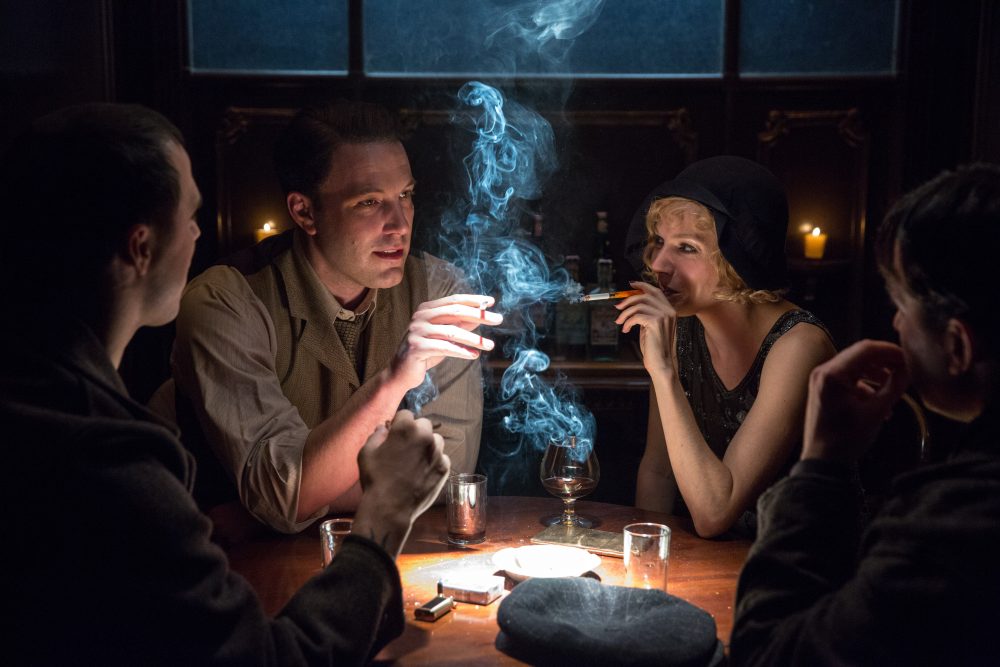
Ben Affleck, as Joe Coughlin, and Sienna Miller, as Emma Gould, in "Live By Night." (Courtesy Warner Bros. Pictures)

Ben Affleck, the good-looking, locally-reared actor, who from time to time has projected a wooden on-screen presence, has turned out to be a reliably decent director. His debut, “Gone Baby Gone” back in 2007, transformed Dennis Lehane’s Boston-seated crime novel into a cinematic pulp noir. That edgy effort had cinephiles anxious for more and Affleck rewarded their patience with another gritty crime drama, “The Town,” in 2010 and then “Argo” in 2012. His latest effort, “Live By Night,” brings another Lehane crime story to the screen.

It begins during the Prohibition Era in Boston, where the Irish and Italians are locked in a blood feud over the bootleg trade, and later transitions to Ybor City, the developing section of Tampa, Florida, where Italian and Latino crime coalitions govern the town and control the flow of molasses — critical for rum.

Brendan Gleeson as Officer Thomas Coughlin in "Live By Night." (Courtesy Warner Bros. Pictures)
Brendan Gleeson as Officer Thomas Coughlin in “Live By Night.” (Courtesy Warner Bros. Pictures) Continue reading

Patriots Day

19 Dec

Wahlberg’s Dramatized ‘Patriots Day’ Won’t Suture Any Wounds

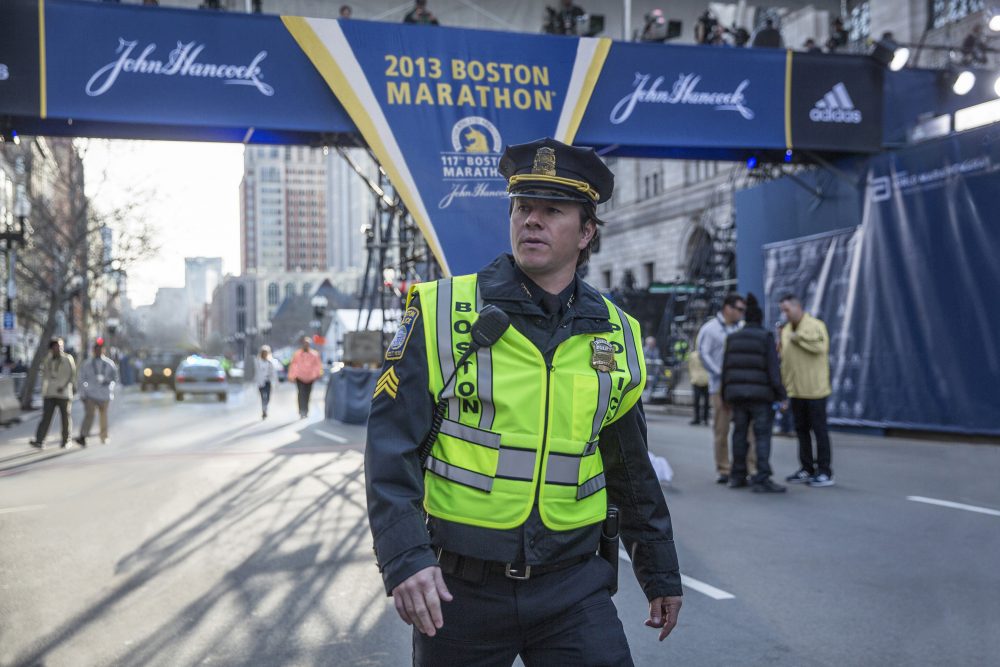
Mark Wahlberg as fictional BPD Sergeant Tommy Saunders in "Patriots Day." (Courtesy CBS Films)

So here comes the big cinematic rendering of the 2013 Boston Marathon bombing that rocked the city for the better part of a week and now seems destined to be etched into our collective history just below city-defining headliners like the Boston Tea Party, busing in the ‘70s and the murderous legacy of Whitey Bulger.

The good news about “Patriots Day,” which opens Wednesday, is that it delivers a modicum of cathartic release as well as an intriguing look behind the scenes as an active crime investigation takes shape. The bad news, however, is that it knowingly injects fiction into the mix in a way that nearly subverts the project’s mission of “getting it right,” as Boston-bred star and producer Mark Wahlberg has said repeatedly. In the process, the dramatization shortchanges those that were there — the heroes and the victims — and the character of our fair city.

Three screenwriters, including the director Peter Berg, are credited with the script. The studio’s publicists informed me that the sources ranged from conversations with the Boston Police Department and other local agencies that responded to news reports and “60 Minutes.” What they’ve cooked up feels like a cobbling together of news feeds condensed and sanitized into a singular heroic narrative that regularly brims with the Boston Strong motto.

Continue reading

A Sidewalk Picasso — Artist Eric Kluin Makes Newbury Street His Studio

3 Oct

Published in the WBUR ARTery

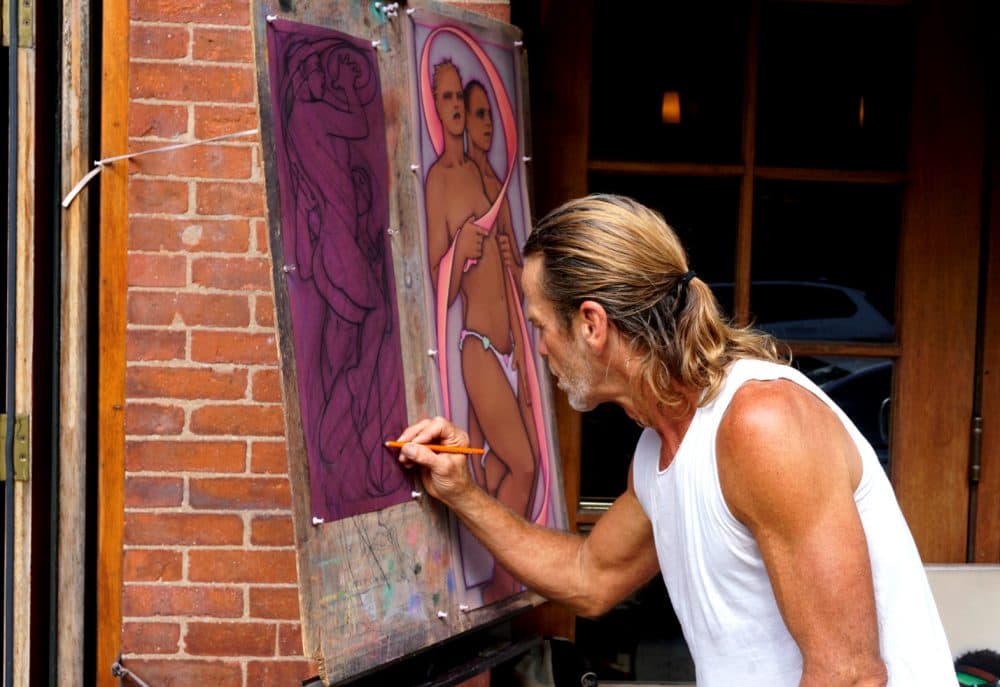
Artist Eric Kluin outside the Newbury Street restaurant Sonsie. (Tom Meek for WBUR)

If you’ve ever been by Sonsie on Newbury Street on a bright sunny day in the past 20-plus years (since the restaurant’s opening back in 1993), you’ve probably seen Eric Kluin — the surfer-esque painter with six-pack abs — busily at work on his easel perched just outside the establishment’s welcoming French windows that open out onto the sidewalk.

A shirtless fixture that’s hard to miss, Kluin’s something of a curio. Does he have a license to secure that spot? Is this some entitled ploy to pick up women? These are questions you might ask yourself as you pass by. Reasonable questions for the intrigued, but the answers might surprise you.

Kluin, a pretty laid back individual, moved to Boston in the late ’80s after working at a halfway house in Arizona where he had formerly been a resident. He’s been a recovering alcoholic for 22 years, and ironically, it was a bar that gave him his shot at a sustained recovery.

He began consuming alcohol abusively at the University of Michigan where he studied art, and didn’t stop until he was scraped off the floor of his flat in Boston by a concerned friend and tossed into rehab — twice. He admittedly describes himself as a “classic alcoholic who would drink himself to death if given the opportunity.”  Continue reading

Wiener-Dog, Todd Solondz Interview

7 Jul

‘Wiener-Dog’ — A Comedy Of Despair About Mortality And A Dachshund

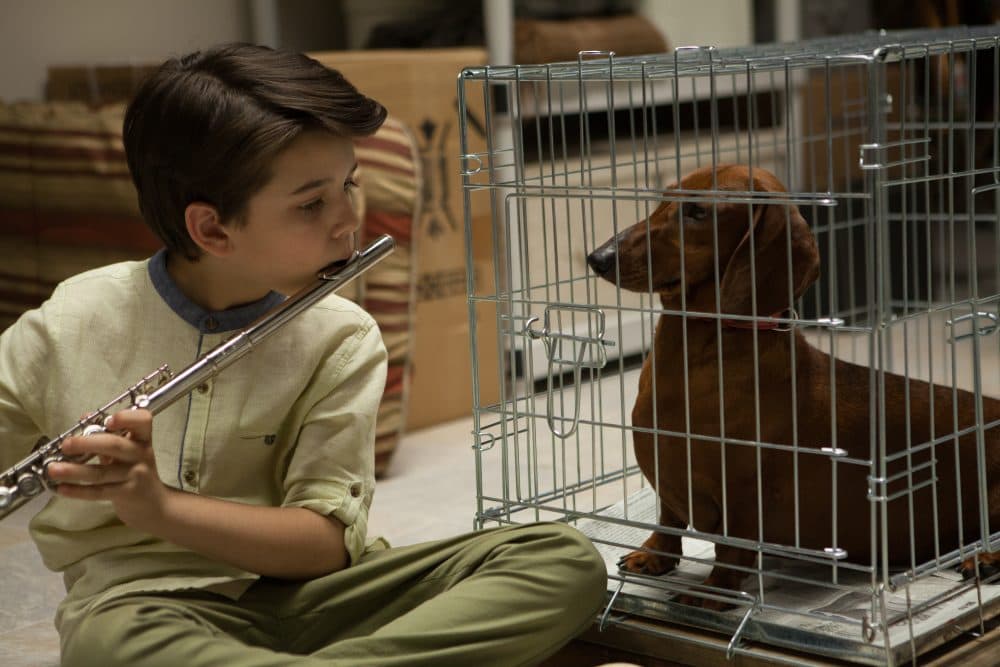
A still from Todd Solondz's latest film "Wiener-Dog." (Courtesy IFC Films)closemore

Indie auteur Todd Solondz, whose latest dark comedy “Wiener-Dog” opens Friday, has always made films his way — on his own terms — plumbing moral and ethical realms that would make most cringe. If he sounds like something of a maverick or self-starter, on paper he is, but in the flesh he casts a very different image.

To begin with, Solondz, who cites Andy Warhol and John Waters as influences, is a mild reflective sort and willing to collaborate for the sake of art. He’s quite humble too. After eight features he points out, “I am very fortunate I am still able to get films made,” referring to the struggle many directors face trying to garner enough funding to make independent film.  Continue reading

Election Flicks

23 May
A still from the film "Weiner." (Courtesy of IFC Film)

The political season is well upon us, more vehemently and contentiously so than past presidential primaries, especially given the surprising number of upstarts, lack of usual faces and an arguably unpopular field. If either of the Democratic candidates win, history will be made with the first female commander in chief or the oldest citizen to assume the Oval Office. If Republican front-runner Donald Trump wins, his victory will cap a campaign of shock and awe, bluster and division, the likes of which seemed only possible in a movie.

That said, hitting the campaign trail has not been a particularly vast topic explored on film, but when it has, it’s been done with biting satire or a telling inward look at ourselves, our society and how we value democracy.

Most often those films stoke our fear of big corporations and power brokers seeking to influence control, as well as our fascination with scandal, the politician’s sudden fall and the tabloid train wreck that ultimately becomes a reflection of our impossible expectations, our own hypocrisies and an illumination of the intoxicating stupor of power that leads to self-destructive hubris.

Below is a list of 10 movies that bear particular relevance to the campaign as it is currently unfolding. (The last film in the list, “Weiner,” opens this weekend in select locations.)

“The Best Man” (1964)

Gore Vidal’s seminal skewering of big egos clashing for the White House pit a fictionalized version of Adlai Stevenson (played by Henry Fonda) against a JFK-like incarnation (Cliff Robertson), both vying for a former president’s approval. The shards of political courtship carry the tang of Obama having to mitigate his allegiances with Sanders and his former secretary of state Clinton. Vidal adapted his stage play, Franklin J. Schaffner (who helmed “Planet of the Apes” and “Patton”) directs and Lee Tracy was nominated for an Academy Award for best supporting actor for his turn as the ailing former president, casting an ostensible nod to Harry Truman.   Continue reading

The Hateful Eight

24 Dec

Samuel L. Jackson in "The Hateful Eight." (Courtesy Andrew Cooper/The Weinstein Company)

What’s ultimately served up is Tarantino channeling Tarantino with men of swagger caught in a mean situation waxing about righteousness and the universe in pulpy poetic verse as tensions rise. It’s what you’d expect and hope for in a Tarantino film, but by the edgy auteur’s barometer (he’s helmed eight movies to date), it’s a lesser cut.

What holds “Eight” in check mostly is its overindulgence, lack of nuance and the fact Q.T. has been to every corner of this room before — and I don’t mean “Four Rooms.” From “Kill Bill, Volume I” onward, Tarantino’s been busy reshaping the revenge flick while paying homage the quirky genres of the ‘70s, namely the cheesy b-roll (“Kill Bill” and “Grindhouse”), the Spaghetti Western (“Django Unchained”) and the chopsocky silliness of kung fu flicks re-cut with lethal seriousness for the “Kill Bill” series.  Continue reading

Steve Jobs

16 Oct

Michael Fassbender stars as Steve Jobs in a scene from the film, "Steve Jobs." (Universal Pictures/AP)

Steve Jobs,” the new bio-pic about the iconic Apple entrepreneur, is a film in love with men (a man) who possess prescient clarity.

To underscore that notion, the film opens with a clip of Arthur C. Clarke back in the ‘70s, extolling the virtues of the computer and how it will change the lives of humans one day. H.G. Wells scored some great future picks too, but both those men were primarily writers, neither of them produced or pushed product, something, that the film, helmed by Danny Boyle and written by Aaron Sorkin, asserts Jobs did with unbridled ardor and rabid commitment.

Clearly Boyle and Sorkin have swallowed the “visionary” pill and are all in. It’s easy to get that too as they’re working with Walter Isaacson’s biography, which Jobs had a hand in before his death. As the film suggests, the digital maestro, currently in everyone’s pocket, was also a master strategist laying the roots of his stratagem and giving them years to germinate before reaping the rewards. As a result, one can’t walk away from “Steve Jobs” without a sense that maybe Jobs saw this coming, his own hagiography, and planted the seeds to brand his legacy and ensure the enduring future of Apple and all things preceded with a lowercase “i”.

Michael Fassbender appears in a scene from, "Steve Jobs." (Francois Duhamel for Universal Pictures/AP)

The film’s told uniquely in three chapters, each taking place in the moments leading up to a product launch (staged demos in velvet adorned opera houses) that Jobs, a fan of simple design and closed systems so hackers and hobbyists can’t muck with his perfection, proclaims will change the computing industry.

We launch back in 1984 with the unveiling of the Mac, but Jobs (played by Michael Fassbender) is in a mad arrogant snit because the machine crashes when it tries to say “Hello” and the fire department won’t allow him to shut off the exit signs to gain total darkness for the overall wowing effect. In the first five minutes, as Jobs runs through a gambit of nail-in-the-coffin problems, much akin to Michael Keaton’s stressed thespian in “Birdman,” but a far different bird, one drinks in an effortless multitasker, a brilliant human able to pull from both the left and right lobes, and an intolerable a—hole with small glimmers of compassion within. In all three product launches, he’s tended to by his loyal head of marketing, Joanna Hoffman (Kate Winslet bringing great nuance to a woman clearly in a thankless role and radiating with a deep care for her beloved tormentor) who’s the only one who able to push back and still have a job. Continue reading

The Martian

1 Oct

Matt Damon, Jessica Chastain, Sebastian Stan, Kate Mara and Aksel Hennie portray the crew members of the fateful mission to Mars in

The much anticipated big screen adaptation of Andy Weir’s hot-read “The Martian” finally lands in theaters this week.

For local boy Matt Damon and director Ridley Scott, it’s a respectable go, but for science and NASA, it’s an unequivocal win. Following the film’s release those chem and bio books on high schoolers’ nightstands will get a little sexier.

For those not familiar with Weir’s self-published e-book that became a New York Times bestseller, it takes place in the short near future, when manned flights to Mars are doable and entails the ordeal of an astronaut left for dead on the Red Planet, who then must survive for four years until the next mission from Earth arrives. The major must haves, air and water (no, it’s not prescient of the findings) are relatively “easy” to ascertain.

The big gotcha is food, as the pup-tent bivouac is only stocked with enough rations to feed a crew of six for 60 days. If you’re doing the math and forecasting, that’s the joyful brain bait Weir imbued throughout his novel. The book has been hailed as one of the best pure science, science fiction books in a long while (Weir, a former programmer who worked on the Warcraft video games was reared on a steady diet of Arthur C. Clarke).

Scott and screenwriter Drew Goddard (“World War Z” and “Cloverfield”) however don’t have reams of paper or time to stop and explain the not-so-basic math, chemistry and biology solutions that propel “The Martian,” but what they do have are digi-logs, so that Damon, playing left-behind spaceman Mark Watney, a biologist by trade, can speak directly into GoPro cams or any of the myriad of the recording devices sprinkled throughout the space tent known as a “hab” and the rover, an all-terrain SUV on steroids.

To explain how Watney gets marooned and rises from the dead would be doing the uninformed a disservice. It’s smart and sharply done in both mediums, as is how Watney is discovered alive on the far off planet by satellite wonks at NASA (there’s no comms that can reach that far to squawk real time). But all these golden plot nuggets come directly from from Weir’s blueprint. What’s missing is the looming sense of dread that so effectively filled other recent deep space conundrums like “Gravity” and “Interstellar,” let alone the imposing power of loneliness like Tom Hanks so convincingly evoked on a similarly remote and desolate body (an island on Earth occupied by a volleyball) in “Cast Away.”

Continue reading

Fury Road

15 May

Ka-chunk, ka-chunk, ka-chunck, back in 1985, the “Mad Max” trilogy unceremoniously sputtered to an anticlimactic halt rather than going out on a furious, nitro-boosted blast. That tepid finale, “Beyond Thunderdome,” would become the post-apocalyptic Outback series’ weak link, an unsatisfactory follow up to its crowning production. That film, “The Road Warrior” (1981), not only elevated Mel Gibson to bankable star status in Hollywood, it seamlessly spun together an odd olio of diverse genres without faltering into camp and boasted some of the greatest real-action car stunts recorded on film. What director George Miller and Gibson revved up was an instant cult classic, a box office smash (it covered its budget in the U.S. in one week) and a can-do mashup from Down Under that would become a model that many would try to copy, but few could emulate. With “Mad Max: Fury Road,”(released May 15) the series is back on track, and boldly so. It took decades to get here, but it’s well worth the wait, something well oiled in lineage and ready to sear into the minds of a new generation of thrill-injected converts.

Continue reading

Casting Doubt

21 Mar

The documentary “Merchants of Doubt,” based on the 2010 book by Naomi Oreskes and Erik M. Conway, targets the naysayers of climate change, shining a light on the corporations that employ scientists denying climate change to misdirect and obfuscate in order to protect the bottom line. The book’s authors argue that this practice started with Big Tobacco. When the health risks of smoking became widely documented by the medical and scientific communities, tobacco responded by conducting their own studies, putting scientists in their pocket, conjuring up counter-evidence and most importantly, casting doubt.

“It’s easy to poke holes,” Oreskes, a professor of history of science at Harvard said in an interview. “Real science is hard.” And it seems especially arcane when it comes to the state of our environment’s health. “Global warming and climate change are very complex,” she explains. “There’s a lot of science behind it, so it’s not so easy to explain, and scientists are not the best at explaining. That’s why it’s easy for a ‘merchant of doubt’ to hold up a snowball in Congress.” (Oreskes will take part in a Q&A at the Kendall Square Cinema after the 7:10 p.m. shows Friday and Saturday.)

Naomi Oreskes, author of the book "Merchants of Doubt." (Courtesy of Sony Pictures Classics)

The reference to Sen. Jim Inhofe’s now-infamous gimmick of tossing a snowball at his fellow lawmakers to “prove” that global warming’s a myth is one of the many face-palming gems in “Merchants of Doubt.” The documentary is directed by Richard Kenner, best known for turning a few people vegan with“Food, Inc,” the raw and edgy examination of the mass livestock and meatpacking industries, which was Oscar-nominated for Best Documentary in 2010. Oreskes and Conway’s book singles out the squad of well-paid scientist and academics, referred to contemptuously as the “gang of four,” who have been doing the bidding of big business since the cigarette lobby of the 1960s. The movie focuses in on one of the four, the aging physicist Fred Singer, as well as on the Koch brothers and Marc Morano, a mouthpiece for conservative interests, who, while lacking discernible academic cred (his CV lists ties to Rush Limbaugh and Inhofe), compels with the kind of winning charisma and unshakable confidence that would make Ronald Reagan smile.

Kenner’s environmental illumination isn’t quite as biting or tightly tied as “Food, Inc,” and while, comparisons to “An Inconvenient Truth,” 2007’s Oscar winner,  and “The 11th Hour” are inevitable, “Merchants of Doubt” walks its own path and confidently so. It’s less about trying to convince us that global warming is happening, more about showing that there are people out there trying to actively deny it for monetary gain. Kenner punctures the decade-spanning narrative with interludes of a wry magician (Jamy Ian Swiss who is also in “An Honest Lair” also opening in Boston at the same time) wowing a small crown with deft sleight-of-hand. The cutaways from the “merchants” to the acts of chicanery draw a barbed parallel to the work Morano and Co. do as they spin and deflect for “deep carbonized” special interests.

Marc Morano, a leading climate change skeptic, featured in "Merchants of Doubt" (Courtesy of Sony Pictures Classics)

And to Inhofe’s point, Oreskes understands the lazy logic employed there and points to the shifting jet stream as the polar ice caps melt. The pummeling that Boston took this winter and our current all-time snowfall record helps underscore the point. “People finally are starting to get it,” Oreskes says, perking up on the Boston subject, “that it’s not just a singular freak occurrence and that these weather pattern disruptions are the result of climate change and global warming.”

Well before the movie, Oreskes’s work researching scientific consensus on climate change and advocacy had been a touchstone for many, especially those who had embraced the notion of “going green” as something more than just a lifestyle choice. “Scientific debates are settled by evidence, not arguments,” says Quinton Zondervan, president of Green Cambridge and a fan of Oreskes’s book. “At the end of the day,” he poses in a vein akin to Oreskes, “people need to ask themselves a simple question: Am I making the world a better place, or am I contributing to its destruction?”   Continue reading