Tag Archives: travel

Harvard Square sees the light again

5 Dec

By Tom Meek

Friday, December 5, 2025

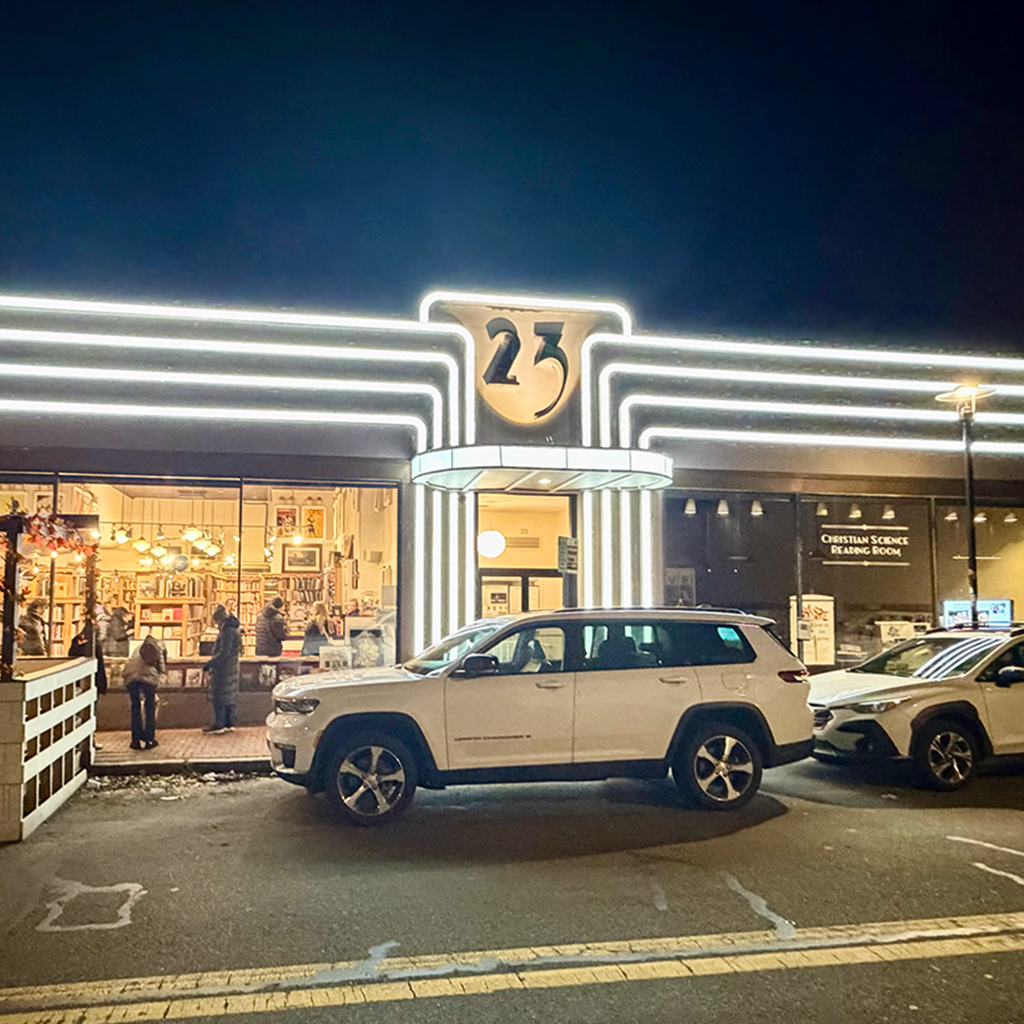
The restored lighting at the Christian Science Reading Room on Church Street in Cambridge’s Harvard Square.
A burst of brightness came to a gloomy stretch of Church Street last month as the Christian Science Reading Room restored soft white art deco lighting absent from the building’s facade for decades.
The lights returned to Church Street, across from the long-dormant AMC Loews Harvard Square, at a Nov. 7 unveiling. Pictures of the alluring illumination have become a slow-trending wave on local social media.

“Now when you see it, it catches your eye,” said Jason Fredette of Poyant Signs, the New Bedford company that restored the lighting over nine months. “The building looks totally different.”
The first structure at the site was a blacksmith shop in the late 1800s, later a veterinary practice. That became mixed retail at the turn of the century as Harvard Square became more thickly settled and the subway arrived in 1912, said Cambridge Historical Commission executive director Charles Sullivan. The 23 Church St. structure was razed in favor of the current one-story 1936 art deco design by architect William Laurence Galvin as a new, upscale home for Cambridge Gas and Electric Light Co.

Continue reading

Danehy Park at 35: a dump that became a glowing urban emerald

15 Sep

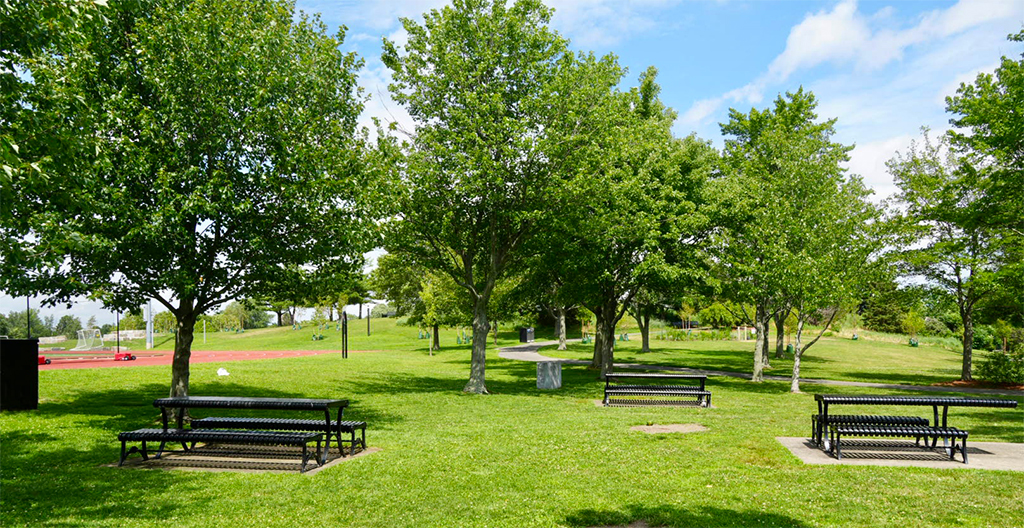
Cambridge’s Danehy Park is a green destination born from a dump.

Hard to believe Danehy Park turns 35 on Monday.

This 50-acre North Cambridge destination for lounging and recreation, picnicking, sports and events big and small hosts the annual Family Day on Saturday; a jazz festival in July; and Shakespeare troupes and the Oldtime Baseball Game, with guests of Red Sox royalty such as Lou Merloni, Oil Can Boyd, Jonathan Papelbon and Pedro Martinez suiting up at St. Peter’s Field.

Continue reading

Talk returns of bridge for bikes and pedestrians behind museum, a $302M proposal from 2023

1 Sep

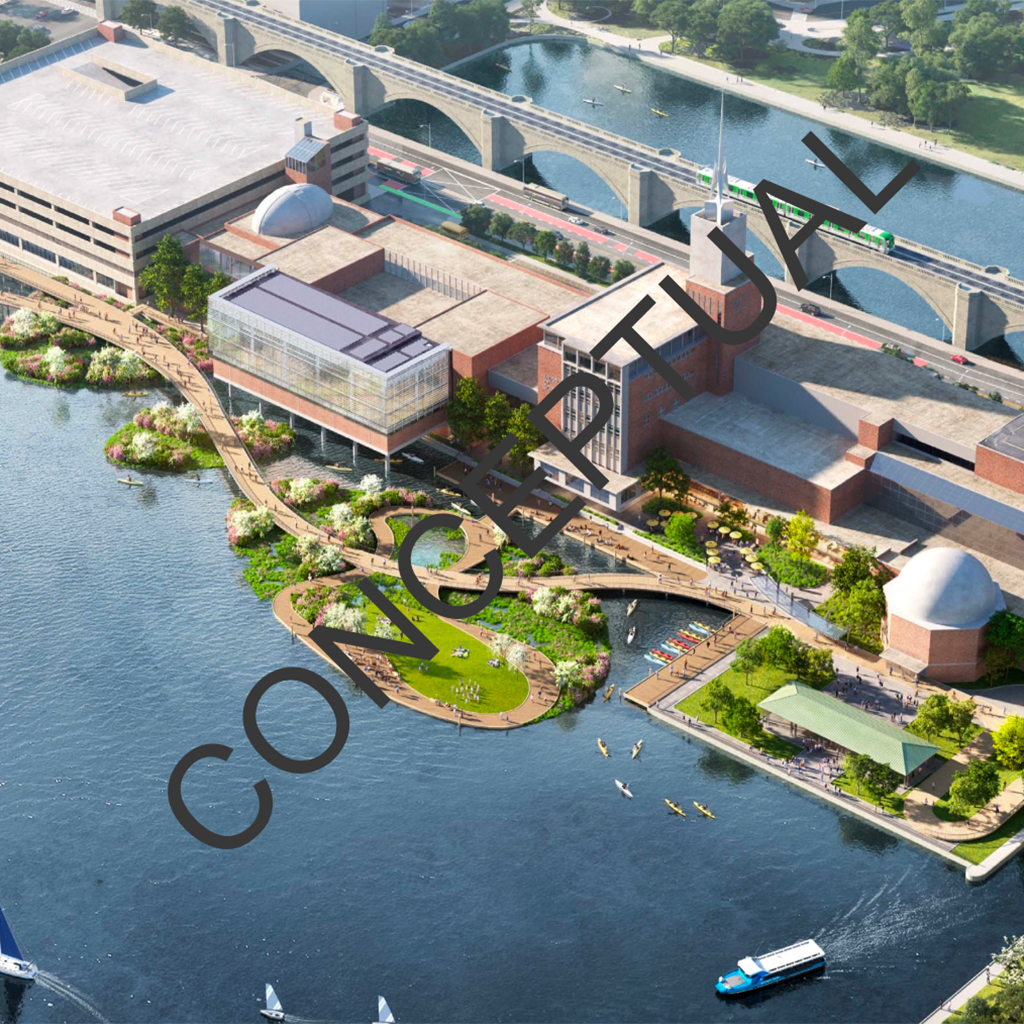
A rendering of a proposed “Riverwalk” for bicyclist and pedestrians across the Charles River. The Museum of Science refused use of the image without the watermark labeling it “conceptual.”

A bike lane and footpath bridge across the Charles River past the Museum of Science is being discussed again by state Department of Transportation officials as being in early stages of planning.

The “Riverwalk” path along the back of the Museum of Science would connect Lechmere Canal Park and the CambridgeSide mall with the Teddy Ebersol Field section of Boston’s Esplanade without having to navigate the bustle of the McGrath-O’Brien Highway in Cambridge and Somerville or Leverett Circle across the river.

Continue reading

Critical Mass comes to Cambridge to remember three riders who died after being hit by vehicles

29 Sep

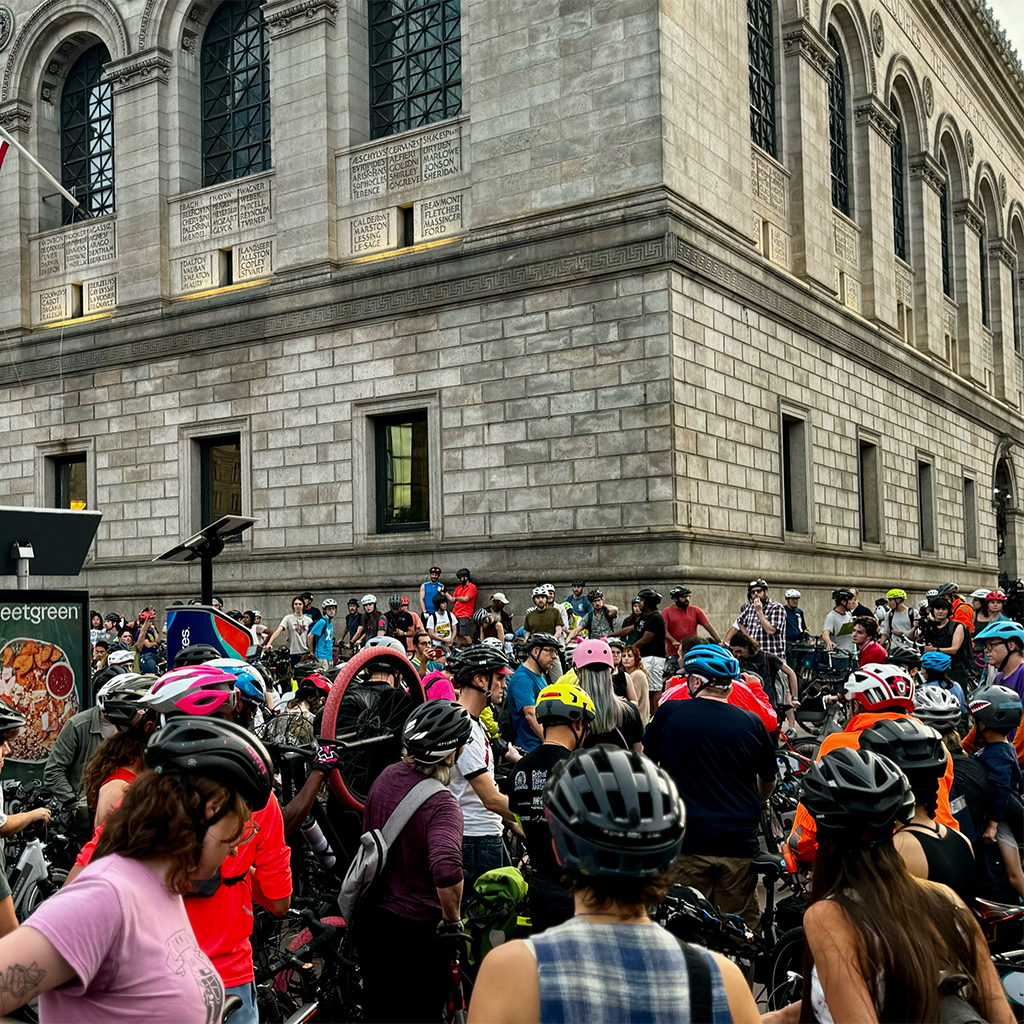
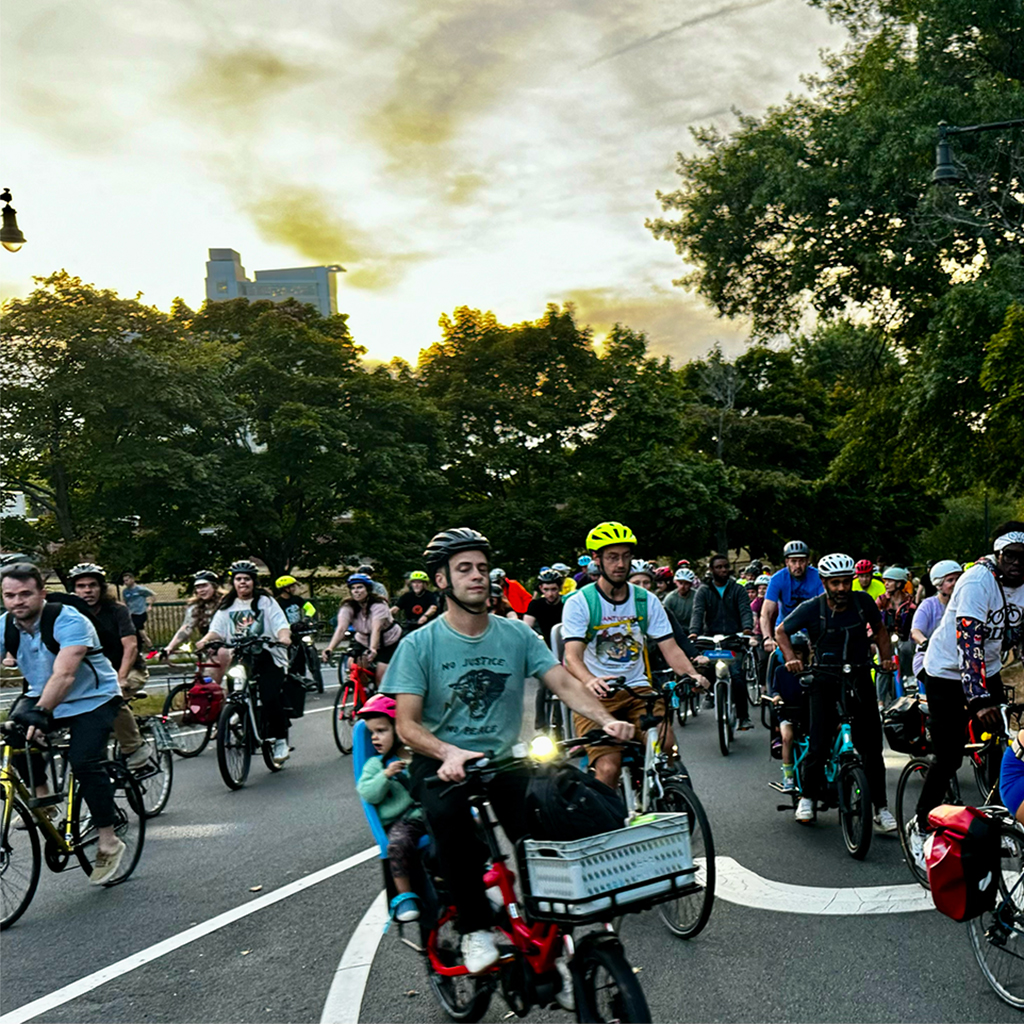
Bicyclists ride a Cambridge rotary Friday to honor three victims of fatal crashes.

More than 700 bicyclists came Friday to ride three times around the Cambridge rotary where Memorial Drive intersects with the Boston University Bridge – once for each of the riders who have died on Cambridge Streets over the past four months: Minh-Thi Nguyen and Kim Staley, who were struck and killed in June, and John Corcoran, who was killed Monday on a sidewalk by the nearby DeWolfe Boathouse.

The rush-hour protest was put on by the Boston chapter of Critical Mass, an organization with branches in several hundred cities worldwide that hold group rides to promote street safety and advocate for better cycling infrastructure.

Riders met at the Boston Public Library for a brief rally before heading to the bridge near the boathouse where Corcoran was struck. The ride continued down Memorial Drive before heading back into Boston across the Harvard Bridge, ending at Boston Common. The ride was well organized, with ride marshals giving commands to stop or mass up to obey the rules of the road or to let cars out caught in the throng of riders.

Critical Mass had gone dormant in the area for nearly eight years because many members felt there was a confrontational aspect growing among the ridership. Citywide group rides morphed into the Boston Bike Party, which had a more festive and less activist evening events; Critical Mass rides targeted rush hours on the fourth Friday of every month.

Bicyclists gather in Boston on Friday before riding into Cambridge for a memorial. (Photo: Tom Meek)

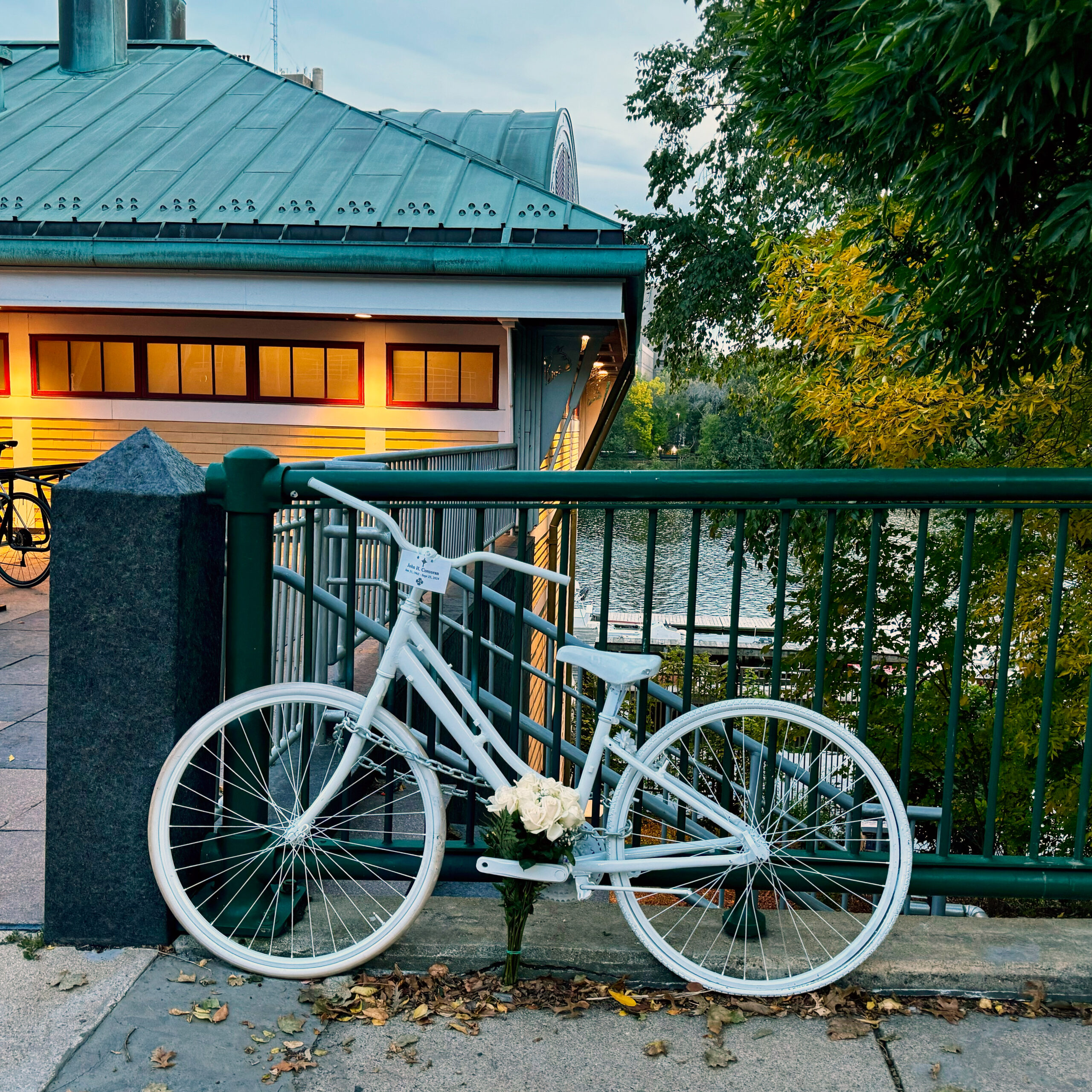
The dedication of Corcoran’s ghost bike was held Saturday at the BU boathouse. In attendance were Corcoran’s family and friends and about 100 cyclists and other community members.

Ghost bikes mark where cyclists have died; a bike painted white is chained at the site permanently. “We have placed too many of these,” MassBike director and volunteer ghost bike committee organizer Galen Mook said at the ceremony.

The service was co-led by the Revs. James Weldon, Corcoran’s minister at the Parish of the Good Shepherd in Newton, and Laura Everett, a bike advocate and part of the ghost bike committee. Weldon biked to the ceremony and was clad for it. The bike was donated by Bikes Not Bombs in Boston’s Jamaica Plain neighborhood and painted by committee member Peter Cheung. The ceremony focused on community and grief for Corcoran, an investment manager who was remembered as a kind and giving spirit with strong ties to Harvard University, where his son and daughter – who were in attendance – are a senior and a junior.

The ghost bike placed Saturday in honor of John Corcoran.

There was a time for advocacy and a push for change, but that was not the purpose Saturday, Mook said in remarks to the crowd. They were hard to discern as cars on Memorial Drive zipped by fast enough to make attendees on the sidewalk uncomfortable.

“We’ve been begging the DCR for seven years to make changes to this road, and we’ve been continually ghosted,” said Jamie Katz-Christy, head of the Green Streets Initiative and a member of the Cambridge Bicycle Safety Group and Memorial Drive Alliance. She referred to the state Department of Conservation and Recreation, which oversees the road.

A department spokesperson told The Boston Globe on Wednesday that work was underway “to introduce additional bike lanes to this area of Memorial Drive to improve safety for both cyclists and pedestrians.” (Mook countered that “They’ve known this is a problem” for years.)

The penultimate part of the ceremony was a “litany of grief and gratitude” before the family came forward to dedicate the ghost bike amid a chant of “from a place of death to a place of life.”

Road improvements are still hastened by deaths but slowed by resentments

16 Jun

A sticker posted at the scene of a June 7 traffic death in Cambridge’s Harvard Square.

Nearly 10 years ago, after cyclists Bernard Lavins and Amanda Phillips died within three months of each other, I wrote about the vulnerability of cyclists as road users and hoped to see lowered speed limits, fewer trucks in areas where cyclists and pedestrians were common and a shift from car-centric urban planning to equitable, safer-for-all streets. Much has changed. Cambridge’s Cycling Safety Ordinance went through, then-governor Charlie Baker enacted a “safe passing” law, Bluebike stations have blossomed around Greater Boston and e-bikes have made two wheels a more accessible alternative form of commuting for more people. Yet in that time, three more cyclists have been killed by trucks on Cambridge streets, including a 55-year-old woman June 7 at Mount Auburn and DeWolfe streets in Harvard Square; and lawsuits for a time sought to halt and reverse the CSO by returning the slim slivers of safe haven to trucks and other carbon-emitting vehicles – all as unchecked temperatures continue to rise globally. We are allegedly making progress, but trending backward and people are dying.

As a cyclist who’s been riding the streets of Cambridge and Boston some 4,000 miles a year for nearly 40 years, the need to bike defensively hasn’t changed much: There’s still a lack of deference to the safety of vulnerable street users by motor vehicles who don’t look for them, zipping past before making a hard right or blasting their horn because they don’t think they belong on the road.

Nearly all cyclists are multimodal – they also walk and drive – but most will tell you that when on a bike, they have to have their senses engaged more keenly. “Head on a swivel,” as many say. To put it another way, as a pedestrian you don’t regularly assume a car is going to come up on the sidewalk; in a car, if you have a green, you don’t yield for fear that another car will blast through a red and hit you, since you have the right of way. And in both scenarios you have a designated safe place in a sidewalk or a 2-ton encasement should any of that happen, unlikely as it is. On a bike, one ding and you’re out in the road and at the mercy of a six-seat SUV going twice your speed, with nothing to protect you.

This is documented easily by crash data from the state Department of Transportation and Cambridge police open portals. Over a 10-year period, six cyclists have died on our streets and 11 pedestrians; as a percent of population (approximately 105,000 and 9,000), bike riders are six times more likely to die via a motor vehicle strike than a pedestrian. More telling is that at least five of the six fatal crashes involved a truck.

Friday’s tragedy occurred shortly after the CSO took a blow in a recent City Council vote, with deadlines potentially extended in places unless the city laws are adjusted to find more car parking. But a bike-lane backlash has been going on for years – “They run red lights”; “They don’t wear helmets”; “Their bikes don’t have lights” – in addition to resentment over the loss of parking, with spaces for people with disabilities being the emotional ante often laid down. Reckless behavior is never acceptable, and cyclists can be their own best ambassadors by showing courtesy and respect to other road users; that said, motor vehicles pose the far bigger public risk and are the sole agent of road deaths. Meanwhile, in the recent makeover of Porter Square, when separated bike lanes were installed, the number of accessible parking spaces available more than doubled as part of the project.

An important aspect about that June 7 crash is that it happened where there were separated bike lanes. Whether the box truck made an illegal right (rights are allowed only on a green arrow) or the cyclist proceeded through a red light or some other factor was at play has yet to be determined. It may be some time before we know the results of an investigation, but one thing that should be considered in the interim is street design. This section of Mount Auburn is an opening-up point, which adds to its complexity. For traffic heading east on Mount Auburn, there are five traffic lights and three signs. That’s a lot to take in; if you sit at the intersection and observe for a few signal cycles, you will see confusion from users. And, of course, there are those who push through illegally. We try out traffic pattern designs to hopefully improve road safety, but must balance the needs of businesses and those who need to get around. It’s a challenge, and one with impacts.

The long and short is, traffic flows need to be simple and intuitive. Are cyclists from other states familiar with Boston bike signals, are the signals and signs at Mount Auburn and DeWolfe in the best location for each type of road user? These are nagging questions that should have been answered by post-installation use and review by those who came up with them, as well as those who enforce traffic. We’re a world-class city with revered universities that draw people from all corners of the globe; there are going to be new-to-Boston people in the streets every day. Our rotaries are infamous for their WTF factor to those newly entering Massachusetts; intersections in Harvard Square don’t need to be.

The victim, who hailed from Florida, was on a Bluebike, eliciting on social media boards sentiments that those who ride the rentals “don’t know what they’re doing.” Bluebikes are designed to be a simple walk-up-and-use transportation; it’s the violence of the streets that’s the real factor here, and we should acknowledge that. If we applied this same logic of “needing to know how to navigate the streets of Boston before getting on a bike” and extend it to cars, would anyone deplaning from Italy, the U.K. or Japan be able to rent a car at Logan?

The intersection will change. The city will act. The sad reality is that it took a life to do it. We’re one of three area cities with Boston and Somerville that have adopted Vision Zero goals – to eliminate traffic fatalities through engineering – but we’ve struggled to meet checkpoints. Potentially extending CSO deadlines only addles those efforts.

There is a sprig of hope, however, as on Monday the council gets a policy order asking the city to undertake a review of intersections where crashes have resulted in a serious injury. It’s a decade late, but something that could have real results. And getting measurable results is the only way to evaluate downstream efforts: ink is cheap, blood is not. Furthermore, as we become a denser city, we need to rethink how we use our streetscapes and who uses them. It’s not just about safety. It’s also about equity.

The bike bus rolls on each Friday in Cambridge, but a recent kids’ ride was more like a parade

23 May

By Tom Meek

Saturday, May 18, 2024

Darren Buck leads a bike bus in Cambridge on Friday.

The Peabody/Rindge Avenue Upper School bike bus is about to notch its second anniversary. It launched at the end of June 2022, just as Cambridge was emerging from pandemic lockdowns and shut-ins, and has operated nearly every Friday of the academic calendar since.

A bike bus is a parent-chaperoned group of children who ride to school together. There’s safety in numbers that provide visibility and street presence, and participants get a low-stress, fresh-air outing. The Peabody/RAUS group led by parents Katherine Beaty and Darren Buck is one of nine bike bus initiatives in Greater Boston and the only one in Cambridge. There are three in Somerville.

Beaty started the bike bus because being a bike advocate in the more traditional, political sense had become taxing, she said, noting its meetings, campaigns, emails and follow-ups yielding little immediate result or much joy. “I wanted to do something that would bring me joy and get my kids to school,” she said, speaking before a bike bus presentation she and Buck gave Wednesday as part of the Streetwise lecture series at the Aeronaut Brewery. Buck, who works in transportation policy, was in the midst of scouting cities to relocate his family to and happened to encounter Beaty leading a group of kids on bike. He knew immediately Cambridge was the place to land, he said.

One of the leading proponents for the bike bus movement is “Coach” Sam Balto, a Portland, Oregon, physical education educator who taught at the David A. Ellis School in Roxbury. He’s also a self-described tactical urbanist – activists such as those in Critical Mass or the Boston Bike Party who take a physical approach and might spray paint bike lanes on a street in the middle of the night. When in Boston, Balto used to place cardboard cutouts of Tom Brady around the Ellis school to get cars to slow down. Beaty referred to him as her “guru.”

A May 8 ride in recognition of National Walk, Bike and Roll to School Day included performers from the School of Honk.

In their Streetwise presentation, Beaty and Buck outlined the three steps necessary for a successful bike bus. First is finding a calm, safe route to the destination, probably less-trafficked side streets; there’s an engagement component of reaching out to the community, other parents and the school administration; the most critical part is to have fun. For a May 8 recognition of the National Walk, Bike and Roll to School Day, the Peabody/RAUC bike bus was accompanied by members of School of Honk, who performed while rolling along. Vice mayor Marc McGovern spoke and rode with the group. Beaty said the caravan had more than 130 riders.

For this past Friday’s regular ride, which I attended, revered Boston institution Keytar Bear was supposed to join but was unable to make it because off traffic issues, promising to accompany a future date instead. This time there was approximately 40 riders, which Beaty said was typical; drop-off in the winter is not significant, she said, though some rides have to be canceled when there’s ice or heavy snow or rain.

The route that Beaty and Buck lead begins at Russell Field near the Alewife T station, with organizers first gathering riders from the Fresh Pond Apartments on Rindge Avenue. Beside parents who serve as ride marshals, there are volunteers from the Cambridge Bike Safety Group who help make sure intersections are safe to proceed through and block traffic as necessary. The right, safer route in this case includes Dudley and Reed streets, some of it parallel to the busier avenue where the school is. Students of all ages participate, with some riding with parents in e-assisted cargo bikes, some kicking along on balance bikes and others doing their own two-wheel propulsion. The communal joy of the activity is palpable, and an apt flourish to the end the week. Most people the bike bus passes cheer and wave, Beaty and another Bike Safety volunteer said. You can often see on the faces of onlookers the effect of a parade of second-graders gliding by.

The Peabody bike bus works only for the commute to school, not from, because of varying after-school schedules and one-way streets that prevent a calm and safe path back to Russell Field. Many parents bike their kids home on the sidewalk, or load their bicycles into their car or the hold of a cargo bike. Organizers are asking the city to designate certain streets as a Neighborway, as they are doing in Somerville.

Beaty said she would love to see more bike buses, but cannot be in two places at once – and she and Buck live close to Russell Field. Their children won’t be at Peabody forever, either, and Beaty, a Harvard library employee, will be on a research sabbatical in Rome next year. The hope is that others will step up. Given the group’s energy and levels of participation, that might not be a problem.