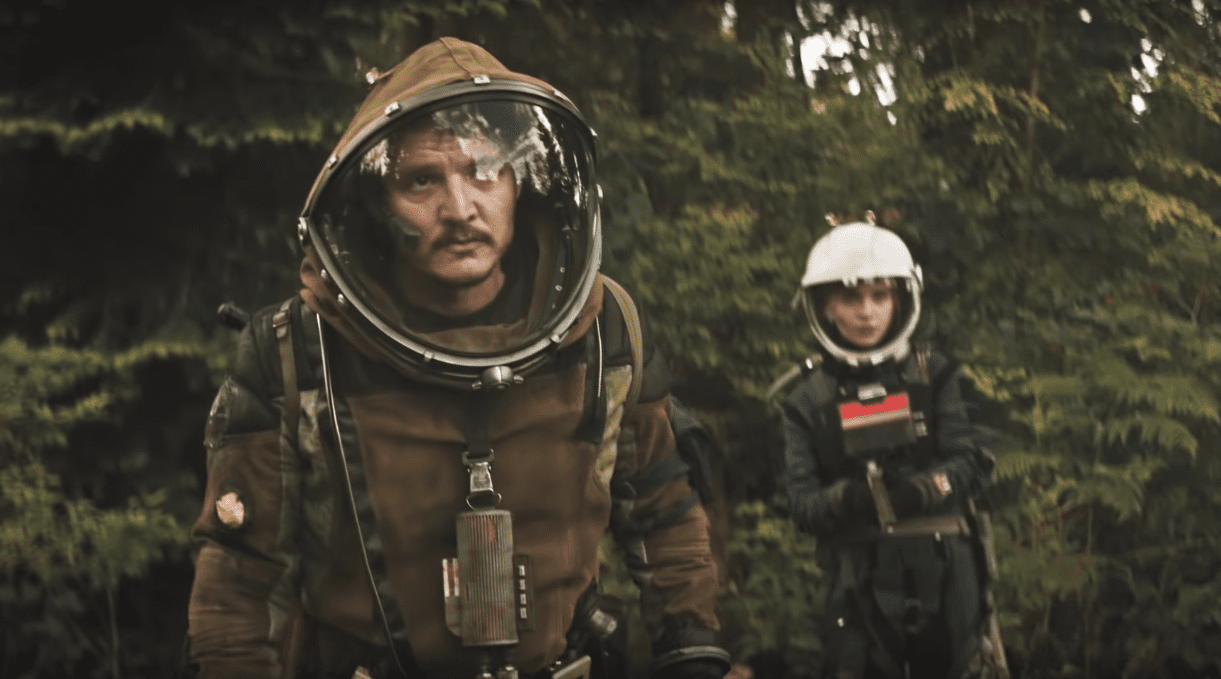
A deep space mission to harvest something called Aurelacs – a highly valued gem that grows in slimy organic sacs that would make David Cronenberg proud – goes horribly wrong in “Prospect,” stranding a father-daughter team in a future where space travel across galaxies is relatively common. Made arty and moody by rising filmmaking duo Christopher Caldwell and Zeek Earl, expanding on their 2014 short of the same name, the themes and atmosphere echo that of “The Martian” (2016), “Interstellar” (2014) and even “2001: A Space Odyssey” (1968) – if not for the retro space suits, then at least all the heavy breathing.
 Pulling from familiar tropes, the landing party (descending in a neat little capsule that looks something like a lunar module or whatever it was Matt Damon cruised in on in “The Martian”) hope to make one big “prospecting” score and move on to a better, less perilous lifestyle. Dad (Jay Duplass, co-director of the 2006 indie surprise, “The Puffy Chair”) and his teenage daughter, Cee (Sophie Thatcher, the film’s revelation) descend on a bucolic planet that’s as verdant, dank and lush as the Pacific Northwest forests were in Debra Granik’s “Leave No Trace” this year – still, as gorgeous and inviting as it is, you need to be suited and with a full tank of oxygen.
Funny, as far out as they are and in the middle of nowhere, they barely get started on their quest when they bump into two malcontents who prove none too welcoming. Shortly enough, Cee and the one named Ezra (“Game of Thrones” actor Pedro Pascal) set out to find the the Aurelacs mother lode (aka the “Queen’s Lair”), despite the nagging matter that Cee’s lander has malfunctioned and Ezra and his cohort have no means off the planet either. For all the riches to be had, folk seem too intently focused on it despite the looming dilemma that there’s no way to realize the spoils.
You could think of “Prospect” as something akin to this year’s unheralded “The Sisters Brothers,” in which the gold at the center of the quest is little more than a MacGuffin and the characters sail through a lawless terrain with nothing but themselves to rely on for salvation or justice. There’s other beings, mostly human we assume, that Cee and Ezra encounter along the way, including a dominatrix who gets her charges on their knees by blasting distorted disco rhythms into their helmets. It’s a weird world to wind up not-so alone in, and given greater impact by tight, intimate camera work.
Beyond Thatcher, who pulls the film along the way Anya Taylor-Joy did “The Witch” in 2015, the best part of Caldwell and Earl’s collaboration becomes the hellbent “Godot”-esque mission to nowhere. If you caught “Annihilation” earlier this year, you’d have a pretty good idea of the psychological fabric as the normal plunges headlong into chaos. “Prospect” also moves in bends and inflections that are largely – and pleasantly – unpredictable. Sure, it’s odd that folks amid an evergreen paradise can’t breath the air except in unseemly yurts, but “Prospect” rises on character, mood and a derivative tang that glances just off the penumbra of homage and avoids shameless lifting.
 As with all the “Jurassic” flicks, the action begins down in Costa Rica, at the theme park from the last chapter that’s been abandoned and overrun by rampaging dinos. The crisis du jour becomes increasing volcanic activity that threatens to “re-extinct” the “de-extinct” lizards (okay, birds). Congressional debate rages about saving them or not and, blessedly, Jeff Goldblum looms at the epicenter with rapturous logician metababble; then, just like that, the crew from the last “World” – the park overseer (Bryce Dallas Howard) and raptor wrangler (Chris Pratt) – are back as part of a conservation effort to get as many of the dinos as possible off the island and to a “sanctuary.”
 Set in the near future where driverless cars are the norm and criminals and vagrants roam the littered cityscape, Grey and his wife are beset upon in a vehicle that goes way off course. It doesn’t end well – she’s dead; he might as well be. A few days later Grey’s up, learning to walk again, a super computer chip implanted in his head to help make all connections to the nerves that make him go. He also hears voices in his head: his own personal Siri, that, if Grey grants permission to take control, can use his body in lightning-fast ways. In short, he becomes his own personal “Terminator” on the trail of getting revenge on the posse of vermin who offed his wife.
 At one point in the movie, someone says, “It’s not about you.” It’s an astute observation, as the film is at its thriving best when the screen is filled by the potpourri of personality that orbits the pivotal pilot of the title. The problem with Han (played by Alden Ehrenreich) as a character here is that he’s just not all that interesting of a dude, or in the least close to what was hinted at by Ford’s wisecracking incarnation. Also too, and I hate to say it, Ehrenreich is no Ford – not even a shadow. He tries, but you spend more time searching for vestiges and mannerisms of the Han you know than you are transported to the then and there.
  “A Quiet Place” drops you into a post-calamity spot that feels all too close, given the current state of division and fear in the country and creeping need to think about how to survive a civilization-crumbling war or sweeping, sudden natural disaster. We catch up with a family out on a scavenging mission to get medicine and supplies. Inside a ransacked pharmacy, they’re all barefoot and don’t speak to each other as they go about their task. Mom (Blunt) picks up and puts down pill vial after vial with all the deliberate care of one of the silent thieves in Jules Dassin’s great heist film, “Rififi” (1955). The lack of spoken communication and the worry etched on the faces of the nuclear-plus family ratchets to a nerve-racking tic. Wandering about on his own, the youngest boy reaches for a toy space shuttle that lights up and beeps, but dad (Krasinski) is fast on the take and in sign language sternly tells him “No.” Outside, they remain silent and walk single file, never veering from the painted white center line of the road. Along their amble through a rural country-scape we see no other humans and soon learn why – after a noise emitted unwittingly by one of the party draws something formidable and fast out from the woods, and the family is suddenly one less.
  In the year 2045, gaming has become the opium of the masses. Everyone suits up, dons virtual-reality goggles and enters a place in the cloud known as the Oasis, a platform breathed to life by a master game creator named James Halliday (Academy Award winner Mark Rylance), who’s recently passed but has left an Easter egg (apt that it’s being released on the eve of the Paas egg-dyeing holiday) tucked away somewhere in his worldwide video game. The lucky one who finds it takes over Halliday’s Amazon-like empire.
  In “Ex Machina,” the ladies get the last laugh on the guys; here too the tale’s more about female resolve than male bravado. The five women who venture into Garland’s void exhibit plenty of steel under fire, until they start losing their minds – literally. After a brief glimmer of a meteor striking a coastal lighthouse, the film dotes on the emotional throes of a widow (Natalie Portman) struggling with accepting that her husband (Oscar Isaac), a special forces officer missing in action for a year, is likely dead, as well as the guilt of the affair he unearthed on the eve of his departure. Things feel like a dramatic downer, but one night he shows up, something of a zombie, a bit washed-out, disoriented and unable to give answers other than “I don’t know.” We’re hooked.
  If that sounds like a win-win, it is – except that to do so you must get shrunk down to five inches and live in domed enclaves full of mini mansions, rolling green golf courses and swank nightclubs and eateries. Once done, your $50-a-week food budget can cover you for half a year. It’s a choice, and the world is roughly split down the middle between bigs and littles. Occupational therapist Paul Safrenek (local boy Matt Damon, more in the news these days for his backfiring #MeToo opines) and his wife, Audrey (Kristen Wiig, in the film far too little) decide the only way to achieve the house of their dreams is to go small. The medical process isn’t so easy either, and god forbid you leave dental implants in during the process. The matter for Paul becomes a quest for self-discovery in a new land after his wife (genders separate as they do the process en masse and in the bare) balks in the eleventh hour before shrinkage and hops a jet elsewhere.
  Given all that, it’s still an unenviable task to have to take over the reins from J.J. Abrams, the creative wunderkind who helmed “The Force Awakens” and has a reputation for making what’s old trendy and hip again – i.e., the “Star Trek” reboot – but Rian Johnson, who also scripted, proves more than game to go where Abrams has taken the next franchise trilogy, and beyond. To be sure, there’s a lot going on in “Last Jedi”; the gaping absence of Han Solo (Harrison Ford), the elevation of Skywalker back to the fore (Hamill well up to the task), the deeper darkening of Darth Vader successor Kylo Ren (a palpably conflicted Adam Driver) and the Trump-like megalomania of the craggy supreme leader with the silly moniker of Snoke (Andy Serkis doing what he does best: seamless live-action capture) and even Yoda – yes, Yoda. But Johnson, who had so effectively juggled time travel threads folding back in on themselves in the satisfying sci-fi thriller “Looper” (2012), orchestrates it all masterfully, jumping from one far-flung point in the galaxy to the next without disconnect, and with plenty of humor and wit to fill any dead space.
 For What it's Worth