| FINDING NEMO BY TOM MEEK |
|
With this fish tale about family ties, director Andrew Stanton and the animation brain trust at Pixar (Toy Story and Monsters, Inc.) do it again. Sure, the plot about a father’s odyssey to save his imperiled son is old hat, but it’s the clever details, enchanting emotional nuances, and cheeky humor that make Finding Nemoswim. One of those sublime details is the “lucky” (undersized) fin that the neophyte of the title (voiced by Alexander Gould) is blessed with. As a result, the little white-and-orange-striped clown fish (the species is supposed to be funny, but Nemo’s dad can’t tell a joke to save his tail) isn’t a very good swimmer and isn’t supposed to leave the safety of the reef, but when he does, he’s nabbed by a diver and relegated to an aquarium in a dentist’s office. Marlin (Albert Brooks), Nemo’s widowed father, sets off to retrieve his son, forming an unlikely alliance with a batty blue tang fish who’s impaired by short-term memory loss (deftly done by Ellen DeGeneres). Along the way they encounter a trio of sharks who are trying to give up their piscean diet (“Fish are friends, not food”) and a 150-year-old turtle who articulates in affected surfer speak (“Yah dude!”). You know exactly how this one ends; yet getting there is such an enjoyable delight. |
Finding Nemo
20 Mar
Ghosts of Mars
20 MarGHOSTS OF MARS
 GHOSTS OF MARS: Natasha Henstridge and Ice Cube exchange views on the latest from Jay-Z. |
Director John Carpenter returns to his slash-and-squirt roots with this Martian horror thriller. On the surface it’s derivative of many a deep-space chiller (think Alien 3, Event Horizon, and Supernova), but it’s really a retooling of his 1976 cult classic,Assault on Precinct 13.
The year is 2176, and Mars has been turned into an atmospherically correct mining colony. Lieutenant Melanie Ballard (Natasha Henstridge, who does the Sigourney Weaver bit in her undies and tiny tank T) leads a crew of rogue and rookie cops on an extradition mission to extract notorious murderer James ” Desolation ” Williams (Ice Cube) from a remote outpost. When they arrive, they find all the inhabitants either missing or butchered in the most unspeakable fashion; yet hanging tight in lock-up are Desolation and a few other wayward souls. In a flash, cops and cons are thrown together as a ghoulish horde of miners turned punk-rock marauders launch a gory and never-ending onslaught. How and why the sadistic berserkers came to be is pure cockamamie, but that doesn’t detract from the campy fun of seeing Henstridge’s babe commando hold Ice Cube’s bristling thug under her thumb while doing battle with the minions of a bloodthirsty incarnation.
BY TOM MEEK
Issue Date: August 30 – September 6, 2001
Event Horizon
20 MarEvent Horizon
This dark, eerie, genuinely creepy outer-space thriller is hardly original, yet director Paul Anderson manages to blend the archetypal elements of horror and science fiction into a stomach-fluttering experience that maintains its suspenseful edge from the opening thump to the final ka-bang.
It’s set credibly in the near future, with Sam Neill starring as the creator of the Event Horizon, a spaceship equipped with a gravity drive designed for interdimensional travel. The ship has been absent for seven years, so when it resurfaces, Neill requisitions Laurence Fishburne’s deep-space search-and-rescue unit to aid him in his Ahab-esque quest. At the far recess of the solar system, they encounter the Event Horizon, crewless and dormant. But something unfathomable has returned with it. First apparitions appear and rattle the team’s sanity — imagine The Exorcist or The Shining remade on the set of Alien. Then, after more inexplicable goings on, the carnage begins. The why and what of the destructive force is never quite explained, which is annoying, but this film is really about mood, set design, and crisp editing, all of which Anderson achieves with a master hand. Nothing too inspirational here, just plenty of well-orchestrated frights.
Offside
19 Mar IT’S ANYBODY’S GAME: But Jafar Panahi’s pro-feminist drama actually scores. |
As it did the director’s pro-feminist 2000 neo-realist drama The Circle, the Iranian government has banned Jafar Panahi’s latest contemplation of the oppression of women in Iran. Offside takes a lighter tack as it challenges the law barring women from public sporting events. Six disparate females — ranging from shy and mousy to acerbic and tomboyish — dress up as boys (one audaciously as a soldier) and get caught as they try to sneak into Iran’s World Cup 2006 qualifier against Bahrain. They’re relegated to a makeshift holding pen atop Tehran’s Azadi Stadium, able to hear the roar of the crowd with cutting clarity but just a few tantalizing feet from seeing the game (which Iran won, 1-0). Instead they engage in a debate with the young soldiers guarding them; the men aren’t happy about enforcing the law, but they fear reprisal if they show any leniency. Amid the back and forth of the game, Panahi taps into universal humanity and delivers a liberating twist in the contest’s aftermath.
Gigli
19 Mar| GIGLI BY TOM MEEK |
|
Disregard the negative buzz: Gigli is woeful but not disastrous. Ben Affleck’s Larry Gigli (“pronounced like really with a G”) is a hit man assigned to kidnap and house-sit the DA’s simpleton brother (Justin Bartha) so the DA won’t proceed against Larry’s mob boss. Larry’s handler (a bug-eyed Lenny Venito) doesn’t trust him, so he sends in gorgeous back-up Ricki (Jennifer Lopez). She’s a lesbian, he’s a wanna-be player, and because the apartment is so small, they have to share a bed. Written and directed by Martin Brest (Scent of aWoman and Midnight Run), Gigli is a banal exercise in vanity. Yes, Ben looks fetching, and yes, J. Lo gets to showcase her posterior, but the fashion shoot gets tired fast. Their big love scene is tepid and gets upstaged by the inane foreplay banter about turkey (“Time to eat. Gobble, gobble.”) and “heterolingus.” Christopher Walken and Al Pacino lend their mugs to this embarrassment. The one high point is Bartha, whose idiot savant is Rain Man infused with Eminem. |

Deep Blue Sea
19 Mar| Deep Blue Sea |  |
 |
| DIRECTED BY: Renny Harlin | REVIEWED: 08-02-99 | |
|
Jaws in triplicate and with brains — that’s the hook behind this horror-adventure vehicle that packs a few good thrills and sleek FX behind its nonsensical premise. Director Renny Harlin, back from the dead after the abysmal Cutthroat Island, places his cast of chum on a techno-cool atoll called Aquatica. The rig is an isolated research facility where the beautiful and brainy Saffron Burrows (The Loss of Sexual Innocence) enlarges the cerebellums of three sharks in search of an Alzheimer’s cure. After one of the lab sharks gets loose, the man with the money, Samuel Jackson, drops in on the clam shack to see how his dollars are working. A storm cripples the structure and everyone sits around waiting to become shark hors d’oeuvres. The battery of piquant characters includes Stellan Skarsgård as the head scientist with a perilous desire to smoke and Michael Rapaport as the nervous technician. As the shark handler, up-and-comer Thomas Jane is an intriguing Mel Gibson-esque variation on Kevin Costner’s mariner from Water World; Burrows is in fine form doing Sigourney Weaver’s Alien bit in her undies; and rapper turned actor L.L. Cool J plays the preachy chef with enough mess-hall ingenuity to take on the watery wolves. Harlin does keep the suspense strung tight, but the über-sharks’ omnipotence borders on cheesy, unintentional camp — though not to the degree of Jaws author Peter Benchley’s made-for-TV flop, Creature. If you want shark-with-smarts guffaws, try to catch the mid-’70s Saturday Night Live skit “Land Shark.”
–Tom Meek
|
||
Any Given Sunday
19 MarR: ARCHIVE, S: MOVIES, D: 12/23/1999,
Any Given Sunday
Oliver Stone’s football fantasy is in some ways a locker-room rendition of All About Eve. Dennis Quaid plays the loyal, aging quarterback, Jamie Foxx is his cocky understudy, and holding the team (the fictitious Miami Sharks, ostensibly fashioned after the NFL’s notorious bad boys, the Oakland Raiders) together is Al Pacino as the old-school coach. Shades of Pete Carroll: the team struggles to make the playoffs and the coach’s leadership is challenged, both on the sidelines by the flashy upstart QB and from above by the franchise’s brassy new owner (a wonderfully bitchy Cameron Diaz).
Stone, for all his frenetic edginess, does a decent job of forging credible relationships among the leads — though Quaid’s QB uncharacteristically steps outside his persona to fuel the plot trappings. Foxx demonstrates a surprising range, and Pacino brilliantly toggles between tenacious warrior and beleaguered once-was. The ensemble supporting cast boasts a who’s who of Hall of Famers including Jim Brown, Lawrence Taylor, and Johnny Unitas. Stone indulges too much of his nauseatingly grandiloquent editing style, which takes some of the zip off the gridiron action. But if Any Given Sunday isn’t quite in the same league asNorth Dallas Forty or The Longest Yard, it’s good pigskin entertainment. Be sure to stick around for the credits; that’s when the film goes into OT and delivers the kicker.
— Tom Meek
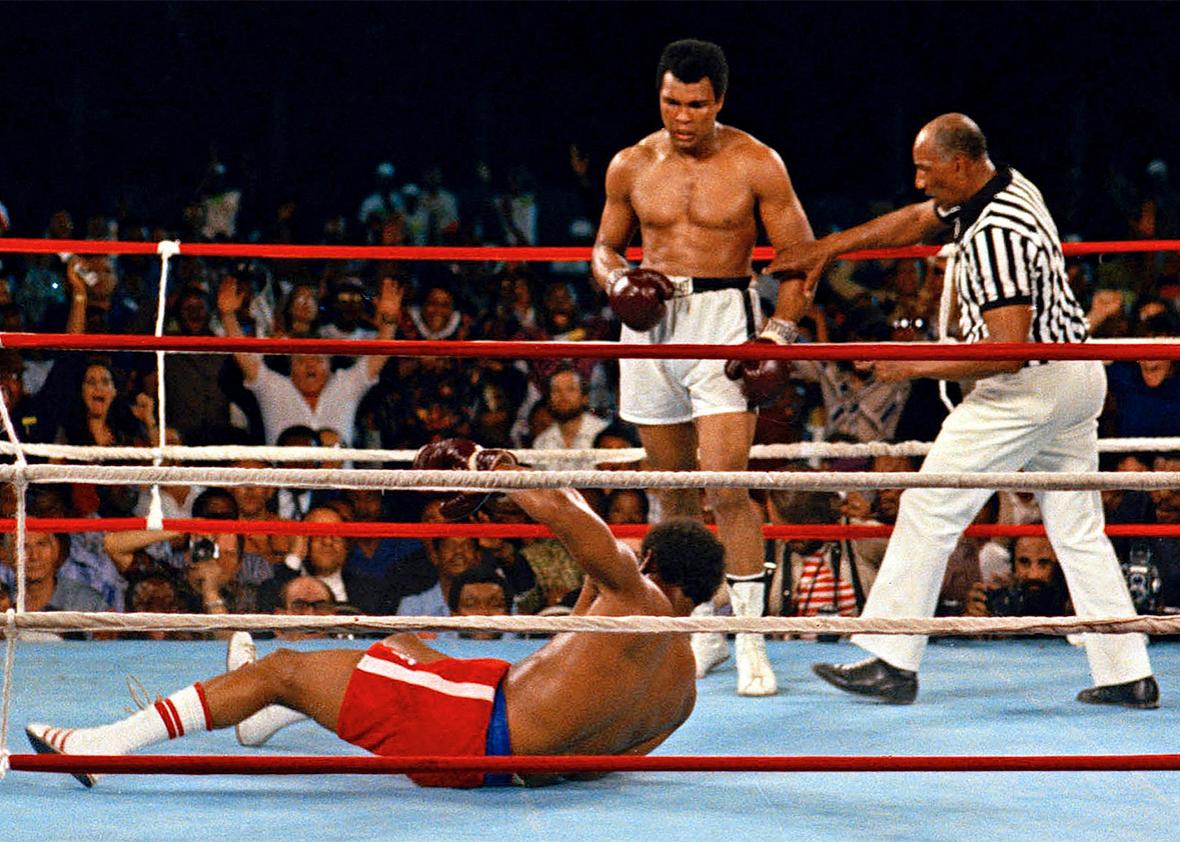
When We Were Kings
18 Mar
When We Were Kings |
|
The Descent
18 Mar
THE DESCENT: Every arterial spray and bone crack makes a point. Few gore fests (including Hostel and Saw) make me cringe, but this one had my stomach on edge even before the team of spelunking sports babes winds up face to face with albino cannibals two miles underground. It’s everything The Cave (2005) might have been and more. Neil Marshall (who mined similar terrain in Dog Soldiers) works masterfully on a small budget to invoke claustrophobia and paranoia as the squad squeezes through narrow pipes and ultimately gets sealed in. Soon after, a fall results in a shinbone grotesquely protruding through the skin, and the women stumble into a dank ossuary of sorts. The ensuing carnage is ample but not gratuitous; every arterial spray and bone crack makes a point. In such circumstances, it might be too much to ask for character development, though Aussie dancer/singer Natalie Mendoza holds her own as the can-do leader, and Shauna Macdonald prevails as the weak link who finds her inner Ripley.
|
The Express
18 MarThe Express
By TOM MEEK | October 9, 2008
 |
Ernie Davis may be the greatest running back never to play in the NFL. He was the first African-American to win the Heisman Trophy, in 1961, and though the color of his skin didn’t break new ground (Jackie Robinson had already suited up for the Dodgers, and Jim Brown preceded him at Syracuse), this bio-pic offers a stark reflection on our not-so-proud past. Gary Fleder, who’s known mostly for pre-fab work (Kiss the Girls and Runaway Jury), and his screenwriter, Charles Leavitt (working from Robert Gallagher’s book The Elmira Express), choose to recount the bittersweet rise to stardom not so much in the big moments (winning the 1959 national championship) as by focusing on Davis’s personal trials and triumphs before he became a household name and those he experienced later, after he was diagnosed with leukemia. It’s a smart call, showing Davis vulnerable as a stuttering youth in the face of bullies and then as a young man challenged by a childhood friend turned radical to use his blossoming star power for the greater African-American political cause.
The Pride of the Yankees and Brian’s Song were poignant depictions of promise, courage, and greatness cut short, and the actors threw their souls into their characterizations. The same holds true here. Rob Brown (Finding Forrester) portrays Davis as torn by optimism and anger. (A scene in which Davis and his black teammates are not allowed to attend the national-championship banquet in Dallas does more in that brief moment to bring to light past racial inequities than the whole of Spike Lee’s Miracle at St. Anna.) And Dennis Quaid’s portrayal of ’Cuse coach Ben Schwartzwalder, a decent man sometimes forced to choose between virtue and victory, personifies the conflicted American conscience of the era.
 For What it's Worth