“Joker: Folie à Deux,” “The Apprentice” and “Red Rooms”
‘The Apprentice’ (2024)
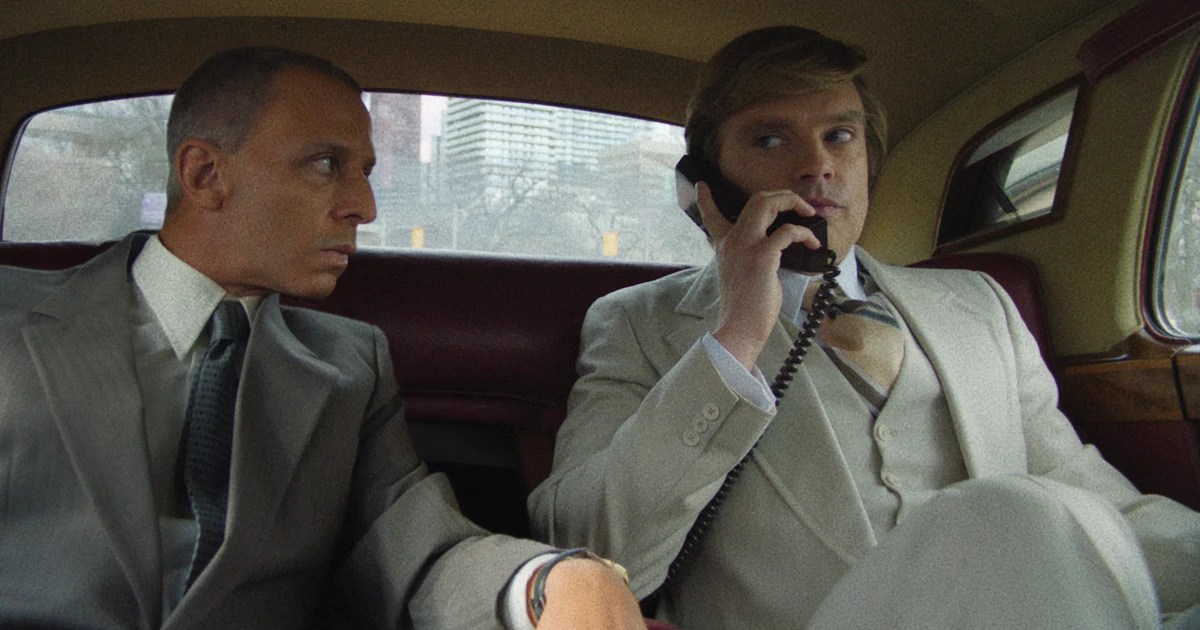

Not so much a takedown of Donald Trump as a look at the early years of the man who would be president as he morphs from socially awkward entrepreneur to megalomaniac, viewing capitalism and New York City as his oyster to shuck – all under the tutelage of Roy Cohn (thus the film’s title). The film opens with Nixon giving his famous “I am not a crook” speech, the erection of the World Trade Towers and Trump (Sebastian Stan, “Captain America: The Winter Soldier,” “Fresh,” and on screen now in “A Different Man”) going door-to-door in a tenement building shaking down low-income residents for back rent. Turns out the Trumps are under suit and facing stiff penalties from the Department of Justice for discriminating against people of color. Trump is enamored with the well-connected Cohn (Jeremy Strong of “Succession”), who served as chief counsel to U.S. Sen. Joseph McCarthy during his 1950s Red Scare and prosecuted the Rosenbergs, who were executed for espionage. One night he catches the eye of his idol at a swank club and enlists him to represent the family in the suit. To say Cohn employed questionable tactics would be an understatement, but he has advice for the young Trump: Always be attacking; when accused, always deny; and if you lose, claim victory. It seems to have stuck. The films chronicles Trump’s very public fight with Mayor Ed Koch over getting Trump Tower built, his tumultuous first marriage to Ivana (Maria Bakalova, so good at taking down one of Koch’s mayoral successors in “Borat Subsequent Moviefilm”) and his disavowal of Cohn – a closeted gay man who used homosexual slurs constantly – when he comes down with AIDS. It’s directed by Ali Abbasi, who has done equally dark tales in other lands: “Border” (2018) in Denmark and “Holy Spider” (2022) in Iran. The punchy “Apprentice overall” casts a cynical sheen over the young DJT but feels balanced; as the ego swells and grows into a horrific hubris, that’s when we get the goring of a demagogue akin to Oliver Stone’s “W.” (2008) and Adam McKay’s “Vice” (2018). Stan, often under prosthetic makeup, looks the part (the hair!) but doesn’t quite sound it, yet still holds the film together, while Strong is a captivating, conflicted pit bull as Cohn and steals scenes with every razor-barbed line he fires off. Historical icons such as Andy Warhol and Roger Smith pop up, and Cohn has wild orgies that Trump stumbles into, but it’s the timing of the film so close to an election that may raise eyebrows, considering a pretty graphic sexual assault scene featuring the man who would be our president. That said, it doesn’t really tarnish the man or give him an out. It paints a picture that somehow makes the aspirational DJT somewhat sympathetic and allows us to connect the dots.
‘Red Rooms’ (2023)


The Nicolas Cage flick “Longlegs” was supposed to revive the serial killer genre, but Cage’s bold acting style wasn’t enough of a jolt. Here, in Pascal Plante’s “Red Rooms,” common genre elements get respun more powerfully. We start by witnessing the binding, torture and killing of a victim over the Internet, except that we don’t: It’s experienced only through the aglow facial expressions of an observer who has paid a fortune on the dark web to revel in the act – a bespoke snuff experience, filled with dismemberment and sexual assault. There’s never blood or gore, which makes the result far more visceral than any gushing arterial spray. Set in Canada’s Quebec province (and mostly in French), Ludovic Chevalier (Maxwell McCabe-Lokos) is on trial for the murder of three lithe, blonde and blue-eyed teens, because that “look” brings the best price. In court, Chevalier sits in a thick glass cage, as if in a zoo. The trial is open to the public, but there are limited seats that trial junkies such as Clémentine (Laurie Babin) and Kelly-Anne (Juliette Gariépy) line up for daily so they can drink in every gory detail. Clémentine is a conspiracy theorist who thinks the gaunt, extraterrestrial-like Chevalier is innocent. Kelly-Anne is a psycho killer fan – a hybristophiliac, if you will – and at one point during the trial, dyes her hair blonde, puts in blue eye contacts and dons a schoolgirl outfit, looking just like the dead daughter of the parents she’s sitting behind. As she’s evicted, Chevalier looks up for the first time, smiles sheepishly and waves to her with a mild, knowing expression. The film’s less about the court case and the details of Chevalier’s deeds and more about Kelly-Anne and her obsession. The film works so effectively for the most part because of Gariépy. Her Kelly-Anne is in fact a part-time model and works out arduously, emanating the cold, detached demeanor that comes with the part. She lives alone, messing around on the Internet where we learn she’s blessed with the hacker skills of a Lisbeth Salander (“The Girl With the Dragon Tattoo” 2011), and even better at online poker, scoring buckets of bitcoin that pay for her posh high-rise apartment and schedule-free lifestyle. The concept of red rooms is a bit of Internet urban folklore, though the notion of such snuff chambers goes back to David Cronenberg’s 1983 “Videodrome” decades before the Internet bubble. The fact that they exist in Plante’s universe is all the more effective as a backdrop to Kelly-Anne’s enigmatic drive and obsession. Plante knows how to orchestrate a mood and dial up the stakes in small, unsettling shifts, in part by using an immersive score and sound editing. Along with Gariépy’s impeccable performance, “Red Rooms” spins up unspeakable horrors we see only in our mind’s eye.
‘Joker: Folie à Deux’ (2024)


Joaquin Phoenix picked up a little golden statue for his 2019 spin on Gotham City nemesis The Joker (much as Heath Ledger did in 2009 for “The Dark Knight,” so it’s a pretty good Oscar gig), an origin story directed by “Hangover” helmer Todd Phillips. “Joker” shone a light on the fragile, fragmented mind of Arthur Fleck, abused as a child, steered wrong, isolated, lonely and seething inside. His alter ego became a manifestation of false leads and media hype for entertainment at Fleck’s expense, but also his defense mechanism. As we know from the death of popular late-night-TV show host Murray Franklin (Robert De Niro) at the end of “Joker,” Fleck gets the last bloody laugh, though “Folie à Deux” deals with Fleck’s imprisonment and trial for Franklin’s death. As we catch up, there’s been a made-for-TV movie about The Joker that has the denizens of Gotham riveted, so much so that Lee Quinzel (aka Harley Quinn, played here by Lady Gaga) commits herself to the same facility that Fleck is in, hoping for a meet-and-greet. The two meet during movie night; sparks fly, she gets him, he gets her, they need to escape and get away to a personal paradise, just them two – nothing an act of arson can’t broker. But the bigger deal is Fleck’s very public trial. After being smitten with Lee, he fires his attorney (a dutiful Cathrine Keener in a flat role) and decides to represent himself. There’s not a lot of true action in the film, and anything that has The Joker in makeup and dancing with malice-tinged merriment is an alter-reality where Quinn and Fleck, more often than not, break into song. There’s even one bit ripped from Sonny and Cher. Some of this works, but Phillips and co-writer Scott Silver can’t decide if Fleck is a Forrest Gump who transcends, a maniacal martyr or someone who got screwed by the system. Perhaps all three, and Phoenix toils arduously to shift gears as the filmmakers see fit. The awkward handling of mental illness and Gaga’s take on Quinn are other issues: She’s nowhere near the kitschy Harley Quinn of Margot Robbie in “Birds of Prey” (2020) or “The Suicide Squad” (2021); there is darkness, no question, but it’s not the infectious, high-energy of a Jersey girl but a dourness that doesn’t add up in the end. The film’s biggest hobbling is that its tonal and contextual (and textual) shifts don’t click. It goes out on a limb with bold bravery, and one of the most impressive things is Gaga and Phoenix doing all the songs on set, not in a sound studio; we know Gaga can crush it, and she does, but Phoenix holds his own for the most part and does a pretty neat tap dance to boot. But the bough breaks.





 For What it's Worth