A couple with troubles: ‘Foe’ and ‘Fair Play’ flicks challenge love by offering escape and imbalance
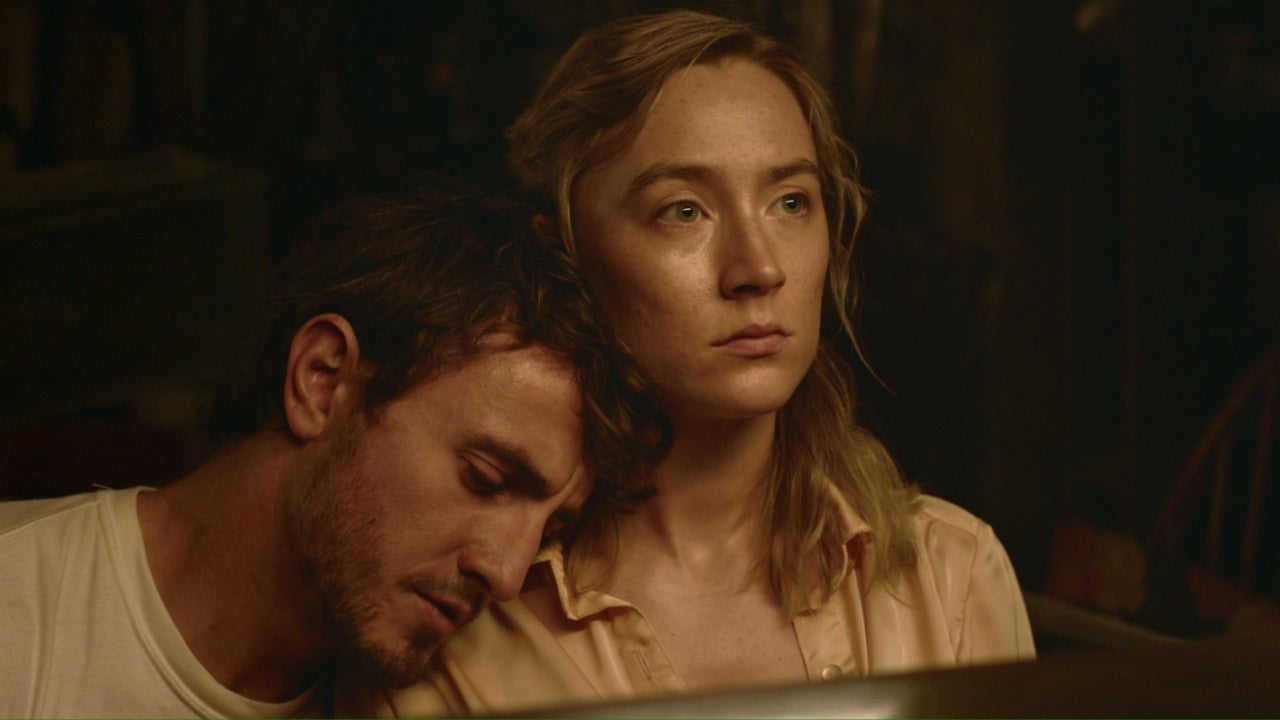

Tense couples make for riveting drama. Within such, it’s amazing how a small event can trigger a rapid downward slide: A lascivious sext from a lover discovered by a previously unaware spouse or the covert depletion of the family nest egg are surefire detonations of trust and passion, but how about the promotion of one partner over the other or, even more out there, one who gets selected for a multiyear post on an idyllic space station while the other has to remain in the barren dust bowl of the Midwest? That’s what happens in “Fair Play” and “Foe,” films that despite their vast scope come off as boxed stage plays centered around the fracturing of two souls.
“Foe” boasts Oscar timber with Saoirse Ronan (“Lady Bird”) and Paul Mescal (“Aftersun”) as Hen and Junior, a couple trying to live off the grid in 2065. Much of the Americas are the dying, dust-choked, wasteland-in-waiting that we witnessed in Christopher Nolan’s “Interstellar” (2014). Because of climate change and human avarice, folks are in dire need of a place to breathe clean air, which in this case means humanmade colonies floating in the dark beyond. Hen and Junior are definitely not simpatico when we meet them: She regularly sends him to the guest room to sleep. One night, a dapper stranger (Aaron Pierre), well-composed and all business, comes knocking. Turns out he’s from the agency that runs the colonies and informs the two that Junior has been selected for an outer world stint to help boot up a station. To make things whole and fair in the interim, they will deliver a replicant-like (yes, “Blade Runner”) facsimile of Junior to keep Hen company. The process of cloning Junior’s persona is arguably more intense – blood, sweat and tears are literally shed – than simply mapping the memories of Tyrell’s niece.
The edgy emotional play between Hen and Junior rivets, and Pierre’s interloper (he’s staying with them for the cloning process) adds fuel to the fire with pronounced notes of sexual and racial tension. The rendering of a dying earth and industrial chicken harvesting plant that Junior works at – a sterile, cavernous maze of conveyers issuing an endless supply of plucked fowl – are wonderments of grim revelation well done by director Garth Davis (the acclaimed “Lion,” which paired Nicole Kidman with Dev Patel), cinematog Mátyás Erdély (“The Nest”) and the set design team. That said, one has to wonder: If Junior remains so apprehensive about the mission, why not send the clone? It’s one of many such questions that nearly submerge the film, but the visuals, moody, immersive score and Ronan and Mescal’s clear talents hold the fragile, end-of-the-world bait-and-switch together, just barely.


More in the now, nestled in the male-dominated hedge fund biz, Chloe Domont‘s “Fair Play” tackles issues of gender and class in devious, piquant ways. Emily (Phoebe Dynevor) and Luke (Alden Ehrenreich) are a secretly engaged couple who work at One Crest Capital, a big Manhattan investment firm that forbids employees to date. Each morning they take separate routes to the office to keep suspicious minds at bay. Luke got his gig through connections, while Emily comes from the other side of the tracks and is just happy to be there. Luke’s expects to be promoted to the newly open VP slot, but guess what: Em gets the nod, and Luke has to report to his betrothed. That bump up in rank shuffles a lot of dynamics in their cozy Midtown flat, and not for the best. Em now stays out until 2 a.m. with head honcho Campbell (Eddie Marsan, so good in “Happy Go Lucky” and intimidating here, with a calm, tacit aloofness) in which conversations about Luke’s value to the company oft come up – never pleasant, as Luke recently got Campbell to bite on a $50 million hunch that imploded wildly.
Despite that, and in the name of love, Em goes above and beyond to put in a good word for Luke, but it doesn’t ease the tension at home. You could call “Fair Play” an erotic psycho-thriller of sorts, but don’t think Michael Douglas and Glenn Close in “Fatal Attraction” (1987); it’s much racier than that, without the bloodletting but with an early scene in which the act of oral sex results in a broad, bloody smile. What Domont puts under the scope here is the fragile white male ego. The performances by Ehrenreich (“Solo: A Star Wars Story”) and Dynevor, a slap-in-the-face discovery, are paramount to pushing the shill into reasonable credibility as it ebbs into its less-than-credible final act. Domont clearly has her finger on something, but just can’t quite close, and you can’t ignore that these two (and all in their sphere) are doing quite well by comparison to most, and in an industry known for its greed. Still, there’s Dynevor, and she rings the bell in every scene she’s in with resounding tintinnabulation.


 The intimate nature of the film (Gerwig also writes, but does not appear) builds in subtle yet palpable strokes with a devilishly barbed edge as it tackles the mandatory rites of senior year: prom, sex and college acceptance. One of the many angles that makes Christine such an intriguing character study isn’t so much her sass with a dash of surly, or red-shocked (dyed) locks that give her a tint of goth-punk, but the fact she’s a perpetual outsider, not religious and not well off, going to a parochial school and running in circles of affluence while dad (an endearing Tracy Letts), an outdated computer programmer, can’t land a job and mom (Laurie Metcalf, giving the best mom performance of the year behind Allison Janney in “I,Tonya”) hold the house together with stoic tough love.
 For What it's Worth