Tag Archives: Joker

Short Takes

13 Oct

“Joker: Folie à Deux,” “The Apprentice” and “Red Rooms”


‘The Apprentice’ (2024)
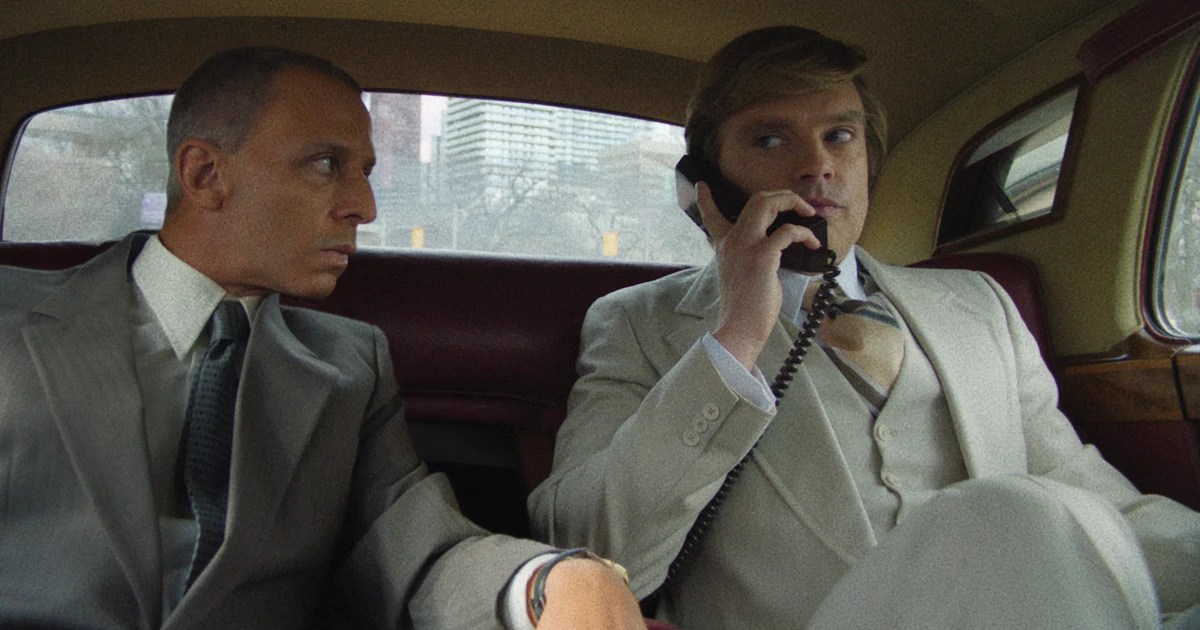
Not so much a takedown of Donald Trump as a look at the early years of the man who would be president as he morphs from socially awkward entrepreneur to megalomaniac, viewing capitalism and New York City as his oyster to shuck – all under the tutelage of Roy Cohn (thus the film’s title). The film opens with Nixon giving his famous “I am not a crook” speech, the erection of the World Trade Towers and Trump (Sebastian Stan, “Captain America: The Winter Soldier,” “Fresh,” and on screen now in “A Different Man”) going door-to-door in a tenement building shaking down low-income residents for back rent. Turns out the Trumps are under suit and facing stiff penalties from the Department of Justice for discriminating against people of color. Trump is enamored with the well-connected Cohn (Jeremy Strong of “Succession”), who served as chief counsel to U.S. Sen. Joseph McCarthy during his 1950s Red Scare and prosecuted the Rosenbergs, who were executed for espionage. One night he catches the eye of his idol at a swank club and enlists him to represent the family in the suit. To say Cohn employed questionable tactics would be an understatement, but he has advice for the young Trump: Always be attacking; when accused, always deny; and if you lose, claim victory. It seems to have stuck. The films chronicles Trump’s very public fight with Mayor Ed Koch over getting Trump Tower built, his tumultuous first marriage to Ivana (Maria Bakalova, so good at taking down one of Koch’s mayoral successors in “Borat Subsequent Moviefilm”) and his disavowal of Cohn – a closeted gay man who used homosexual slurs constantly – when he comes down with AIDS. It’s directed by Ali Abbasi, who has done equally dark tales in other lands: “Border” (2018) in Denmark and “Holy Spider” (2022) in Iran. The punchy “Apprentice overall” casts a cynical sheen over the young DJT but feels balanced; as the ego swells and grows into a horrific hubris, that’s when we get the goring of a demagogue akin to Oliver Stone’s “W.” (2008) and Adam McKay’s “Vice” (2018). Stan, often under prosthetic makeup, looks the part (the hair!) but doesn’t quite sound it, yet still holds the film together, while Strong is a captivating, conflicted pit bull as Cohn and steals scenes with every razor-barbed line he fires off. Historical icons such as Andy Warhol and Roger Smith pop up, and Cohn has wild orgies that Trump stumbles into, but it’s the timing of the film so close to an election that may raise eyebrows, considering a pretty graphic sexual assault scene featuring the man who would be our president. That said, it doesn’t really tarnish the man or give him an out. It paints a picture that somehow makes the aspirational DJT somewhat sympathetic and allows us to connect the dots. 


‘Red Rooms’ (2023)

The Nicolas Cage flick “Longlegs” was supposed to revive the serial killer genre, but Cage’s bold acting style wasn’t enough of a jolt. Here, in Pascal Plante’s “Red Rooms,” common genre elements get respun more powerfully. We start by witnessing the binding, torture and killing of a victim over the Internet, except that we don’t: It’s experienced only through the aglow facial expressions of an observer who has paid a fortune on the dark web to revel in the act – a bespoke snuff experience, filled with dismemberment and sexual assault. There’s never blood or gore, which makes the result far more visceral than any gushing arterial spray. Set in Canada’s Quebec province (and mostly in French), Ludovic Chevalier (Maxwell McCabe-Lokos) is on trial for the murder of three lithe, blonde and blue-eyed teens, because that “look” brings the best price. In court, Chevalier sits in a thick glass cage, as if in a zoo. The trial is open to the public, but there are limited seats that trial junkies such as Clémentine (Laurie Babin) and Kelly-Anne (Juliette Gariépy) line up for daily so they can drink in every gory detail. Clémentine is a conspiracy theorist who thinks the gaunt, extraterrestrial-like Chevalier is innocent. Kelly-Anne is a psycho killer fan – a hybristophiliac, if you will – and at one point during the trial, dyes her hair blonde, puts in blue eye contacts and dons a schoolgirl outfit, looking just like the dead daughter of the parents she’s sitting behind. As she’s evicted, Chevalier looks up for the first time, smiles sheepishly and waves to her with a mild, knowing expression. The film’s less about the court case and the details of Chevalier’s deeds and more about Kelly-Anne and her obsession. The film works so effectively for the most part because of Gariépy. Her Kelly-Anne is in fact a part-time model and works out arduously, emanating the cold, detached demeanor that comes with the part. She lives alone, messing around on the Internet where we learn she’s blessed with the hacker skills of a Lisbeth Salander (“The Girl With the Dragon Tattoo” 2011), and even better at online poker, scoring buckets of bitcoin that pay for her posh high-rise apartment and schedule-free lifestyle. The concept of red rooms is a bit of Internet urban folklore, though the notion of such snuff chambers goes back to David Cronenberg’s 1983 “Videodrome” decades before the Internet bubble. The fact that they exist in Plante’s universe is all the more effective as a backdrop to Kelly-Anne’s enigmatic drive and obsession. Plante knows how to orchestrate a mood and dial up the stakes in small, unsettling shifts, in part by using an immersive score and sound editing. Along with Gariépy’s impeccable performance, “Red Rooms” spins up unspeakable horrors we see only in our mind’s eye. 


‘Joker: Folie à Deux’ (2024)

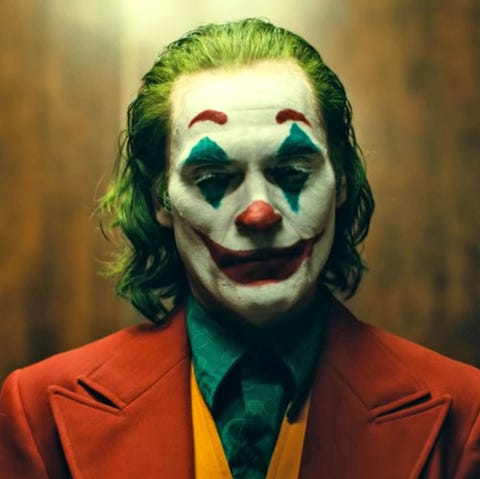
Joaquin Phoenix picked up a little golden statue for his 2019 spin on Gotham City nemesis The Joker (much as Heath Ledger did in 2009 for “The Dark Knight,” so it’s a pretty good Oscar gig), an origin story directed by “Hangover” helmer Todd Phillips. “Joker” shone a light on the fragile, fragmented mind of Arthur Fleck, abused as a child, steered wrong, isolated, lonely and seething inside. His alter ego became a manifestation of false leads and media hype for entertainment at Fleck’s expense, but also his defense mechanism. As we know from the death of popular late-night-TV show host Murray Franklin (Robert De Niro) at the end of “Joker,” Fleck gets the last bloody laugh, though “Folie à Deux” deals with Fleck’s imprisonment and trial for Franklin’s death. As we catch up, there’s been a made-for-TV movie about The Joker that has the denizens of Gotham riveted, so much so that Lee Quinzel (aka Harley Quinn, played here by Lady Gaga) commits herself to the same facility that Fleck is in, hoping for a meet-and-greet. The two meet during movie night; sparks fly, she gets him, he gets her, they need to escape and get away to a personal paradise, just them two – nothing an act of arson can’t broker. But the bigger deal is Fleck’s very public trial. After being smitten with Lee, he fires his attorney (a dutiful Cathrine Keener in a flat role) and decides to represent himself. There’s not a lot of true action in the film, and anything that has The Joker in makeup and dancing with malice-tinged merriment is an alter-reality where Quinn and Fleck, more often than not, break into song. There’s even one bit ripped from Sonny and Cher. Some of this works, but Phillips and co-writer Scott Silver can’t decide if Fleck is a Forrest Gump who transcends, a maniacal martyr or someone who got screwed by the system. Perhaps all three, and Phoenix toils arduously to shift gears as the filmmakers see fit. The awkward handling of mental illness and Gaga’s take on Quinn are other issues: She’s nowhere near the kitschy Harley Quinn of Margot Robbie in “Birds of Prey” (2020) or “The Suicide Squad” (2021); there is darkness, no question, but it’s not the infectious, high-energy of a Jersey girl but a dourness that doesn’t add up in the end. The film’s biggest hobbling is that its tonal and contextual (and textual) shifts don’t click. It goes out on a limb with bold bravery, and one of the most impressive things is Gaga and Phoenix doing all the songs on set, not in a sound studio; we know Gaga can crush it, and she does, but Phoenix holds his own for the most part and does a pretty neat tap dance to boot. But the bough breaks. 

Napoleon

23 Nov

Like its topic, this biopic is not short, has epic battles and a Josephine worth the exile

When you think of the films of Ridley Scott, it’s most likely his early sci-fi classics “Alien” (1979) and “Blade Runner” (1982), but the prolific filmmaker’s first effort, “The Duelists” (1977), was a period piece set in France during the Napoleonic wars. In that film (not to be confused with “The Last Duel” from 2021, which Scott made with local guys Ben and Matt), the French emperor’s presence was felt constantly, but Napoleon himself never steps into the frame; it’s with a daub of poetic justice that Scott, nearly 50 years later and with a budget almost 200 times bigger, gets to deliver a biopic epic centered on the historically notorious icon known as much for his hubris and the self-esteem complex named after his alleged diminutive stature and inflammable ego as for his military gamesmanship.

As Napoleon, the usually reliable Joaquin Phoenix (“Beau is Afraid,” “You Were Never Really Here”) feels somewhat subdued. That said, it is intriguing to see him reunite with Scott some 22 years after “Gladiator,” in which Phoenix also played a self-absorbed ruler – a deliciously sniveling fop of a Roman emperor. What’s missing is some of the entitled, mercurial and Oscar-winning zing baked into his mirthless Gotham ghoul in “Joker” (2019).

The film opens with Napoleon witnessing the beheading of Marie Antoinette. The French Revolution is in full swing, and the British are looking to gain a bigger foothold across the channel. To prove his worth to the new republic, Napoleon leads the fierce and tactically astute Siege of Toulon, where underpowered French forces take out a well-ensconced British fort under the cloak of night. It doesn’t help that the Brits are in the midst of sweeping, drunken merriment and caught with their pants down, literally.

Thus begins Napoleon’s ascent from military marksman to iron-fisted ruler as one part of the French Consulate triumvirate and later emperor, and efforts to expand the French empire into Africa and Eastern Europe take hold as well as the long-simmering desire to crush the hated English and their hold on the seas (see “Master and Commander”). The main threads of Scott’s film, penned by David Scarpa (“Man in the High Castle” and Scott’s “All the Money in the World”) focus on Bonaparte’s obsession with besting Russian Tsar Alexander I (Édouard Philipponnat), a handsome man-boy that Napoleon seems to hold in deference, and his capricious relationship with Josephine (Vanessa Kirby). Scott’s orchestration of the Battle of Austerlitz, where Napoleon takes it to Russian and Austrian forces (also called the Battle of Three Emperors), as well as the infamous, post-Elba exile grudge match, Waterloo, are stunning in scope, choreography and gritty grandeur. Kirby, who plays the White Widow in the “Mission: Impossible” films, is no stranger to strong women and fills those shoes well here, yet the relationship and the tempo of its tears and folds is wildly uneven – which is not on Kirby, to say the least. Kirby portrays a woman whose confidence and sensuality are more than worthy of holding the gaze of a man with limitless power and, as a result, after their marriage implodes because of heir matters, remains a regularly sought confidant, counsel and simmering longing. The sex scenes have a cheeky silliness, not too far off from some of Scott’s work with Cameron Diaz and a racy sports coupe in “The Counselor” (2013) and most recently Lady Gaga and Adam Driver in “The House of Gucci” (2021).

Beyond the major battles – epic with a capital “E” – and sticking to the historic record, Scott and Scarpa don’t let Bonaparte off the hook for his actions. His Ahab-esque quests cost needless lives, something the film registers as clearly and coldly as the hoar of the harsh Russian winter. As far as the size thing goes, the record shows Napoleon at just north of 5-foot-6; it’s rumored that the Corsican (a lesser, looked-down-upon ilk to most French noblemen at the time) was surrounded intentionally by taller, statuesque guardsmen. Scott and Scarpa wisely choose not to delve into the matter, but Scott often shoots down on Bonaparte, or up from his POV, lending to the effect. 

The picture, which holds one’s eye throughout the 157-minute running time, is opulent but bears the jerky unevenness of Scott’s “Gucci.” Perhaps a Thanksgiving Day viewing will leave visual feasters of all things Napoleonic hungry and searching the streaming universe for the timeless 1927 treasure of the same name crafted by Abel Gance. Seek it out and enjoy the treat. It’s not an either-or, mind you, as Gance’s tale tells of a young Napoleon in school and his early days in the military, dovetailing nicely in time to where Scott’s vision starts. 

The Batman

4 Mar

‘The Batman’: The Dark Knight gets darker

By Tom Meek Wednesday, March 2, 2022

“The Batman” is a dark, deeply emotional affair that’s got a lot going for it and a lot going on – perhaps too much. (It’s almost three hours long.) We could also call it version 3.5 of the cinematic dark knight, with the Tim Burton and Joel Schumacher films in the 1990s and Christopher Nolan trilogy being 1.0 and 2.0 and Ben Affleck’s donning of the cowl in the “Justice League” films the 0.5 splitter. It may be 4.5 if we take into account the spoofy, goofy BAM! POW! fun of the Adam West television series.

What drives this reboot is a succession of grim murders of municipal higher-ups, beginning with the mayor and working its way over to the heads of the police and district attorney’s offices. Personally, if I was orchestrating such sinister deeds I would have saved the top cat (the mayor) for last – it just feels more operatic. The thing that links the macabre deaths are the signatures left at each crime scene: a riddle punctuated with a giant question mark, an encrypted cipher, a card addressed to “The Batman” and some spray painted (or blood painted) messaging about a web of lies or some such thing.

Given that Paul Dano plays The Riddler, you can probably guess who’s behind the acts that play out in sadistic fashion like a sin-atoned-for in David Fincher’s “Se7en” (1995) or a Jigsaw trap from one of the “Saw” films. The Riddler here just may be darker and more demonic than the spins on Joker performed by Heath Ledger and Joaquin Phoenix: One clue leads to a thumb drive with a severed thumb attached to it, so those recovering it can unlock it via thumbprint, and it clearly takes a lot of work to be that twisted. But wait, this film’s about the bat, right? Well yes, and you get plenty of Robert Pattinson in the beefy Kevlar suit, which turns out to be a bit of a double-edged sword. We get to embed with him more, but the tease of enigma that has been the traditional draw dissipates. Director-writer Matt Reeves (“Let Me In,” “Cloverfield”), co-writer Peter Craig and Pattinson paint their Batman/Bruce Wayne as a deeply tortured soul, a monomaniacal tool of vengeance with no trace of mirth or joy and no bifurcation of personalities; what we drink in is all dour, sullen anger, underscored by the incarnation’s theme song, Nirvana’s broodingly depressive “Something in the Way.”

What carries the film are the sly intricacies of The Riddler’s misdeeds, the mysterious intent behind them and the stunning set designs that range from the crowded, rain-slicked streets of Gotham to the gaping Batcave and an Edward Hopper-styled diner lit in green neon. The cumulative effect is a strange, wonderful fusion of Walter Hill’s “Streets of Fire” (1984) and Ridley Scott’s future noir, “Blade Runner” (1982). The other aspect of “The Batman” that largely works is that our bat here is something of a master sleuth, a tech-age Sherlock Holmes, if you will. It’s a little off-putting to see him sniffing around a live crime scene CSI style, but part of the joy comes in looking beyond the obvious, going one level deeper and admiring the acumen of our hero. Caught up in the mix too is the updated version of Catwoman (Zoë Kravitz), though she simply goes by her birth name of Selina and works in a nightclub owned by Oswald Cobblepot, aka The Penguin, played beguilingly by Colin Farrell under gobs of makeup. He’s something of a brotherly incarnation of Robert De Niro’s portly Jake LaMotta in “Raging Bull” (1980).

The rest of the impressive supporting cast includes a perfectly coiffed Andy Serkis as a dutiful Alfred who’s killer at decoding ciphers, John Turturro as the local crime boss all trails seem to lead to, Peter Sarsgaard as the sleazy DA and Jeffrey Wright, channeling his cagey investigative reporter from “The French Dispatch” (2021) as Lt. Gordon, the guy who fires up the bat signal and may be the only clean cop on the force. The new take on the Batmobile is something of a throwback to the muscle cars of the 1970s; it’s like someone bat-tatted a classic Dodge Charger and strapped on a jet engine turbo boost like one of those nitro-infused junkers in “The Road Warrior” (1981).

Pattinson and Kravitz look fetching together, and given their raw charisma you’d think the two would click together like Legos (there is that “Lego Batman Movie”), but the romantic undercurrent between them feels postured and unearned. Then again, this is a brooding, relentless lad who takes his mission as a higher cause – “I am vengeance” gets tossed around a lot. Batman’s most genuine connections are those with Gordon, who for reasons not on screen trusts him emphatically, and his lifelong loyal butler and caregiver Alfred, though that ultimately gets challenged as “the veil is pulled back and the lie’s exposed.” I grew up near Connecticut cities where corruption scandals were an annual “wait for it” event that didn’t disappoint, and of course we had infamous mayor Buddy Cianci just down the way in Providence. Gotham’s not much different: dirty cops with drug money washing political hands. What it does have is that dashing millionaire orphan who likes to dress up, break out the bat toys and take out the trash.

Joker

3 Oct

‘Joker’: Phoenix tries to hold it all together, but eventually film lets loose, breaks down

Image result for joker images

Throughout Batman’s long history, the Joker’s been played by some pretty mighty performers. Standouts include Jack Nicholson, who pretty much hijacked Tim Burton’s “Batman” (1989), and Heath Ledger, who won a bittersweet, posthumous Oscar for his deeply felt portrait of derangement in Christopher Nolan’s “The Dark Knight” (2008) – and let’s not forget the comic genius of Cesar Romero during the 1960s TV series. Nolan and Burton felt like the right hands to shepherd a dark superhero/villain origins tale, but Todd Phillips, with such swinging steak comedies as “Old School” (2003) and the “Hangover” films to his credit? Odd as it may seem, it’s a somewhat logical evolution from drunken vomit awakenings to blood-splattered foyers with a panicked dwarf who can’t reach a chain bolt to escape.

The real reason Phillips’ “Joker” succeeds is simple: Joaquin Phoenix makes the anti-antihero psycho-saga all his own. There’s also the script by Phillips and Scott Silver that plays with the Batman mythology artfully without getting bogged down in the bigger picture – though we do briefly see Bruce Wayne at a young age, when dad and mom are with us – but without Phoenix, I don’t think “Joker” takes flight. It’s a bravura go, and Phoenix should be right up there at year’s end (like Ledger was) with Brad Pitt and Leo DiCaprio when Oscar nods are called out. With maybe the exception of Ridley Scott’s “Gladiator” (2000) it’s hard to find a movie in which Phoenix doesn’t shine with brilliant quirk and dour doses of menace. He delivers all that here and more; it’s a total immersion. For the part of clown turned Gotham icon and sociopathic perp, Phoenix lost a ton of weight, something done with equal austerity by Christian Bale (who took up the bat cowl for Nolan) in Brad Anderson’s “The Machinist” (2004) or, inversely, when Robert De Niro added 50 pounds as Jack LaMotta in “Raging Bull” – and if as on cue (send in the clowns), the Martin Scorsese-forged actor shows up in “Joker” as beloved late night TV show host Murray Franklin, whom Arthur Fleck (the Joker’s birth name) and his not-quite-all-there mother (Frances Conroy, excellent in the small complicated part) watch religiously. Continue reading