
Todd Solondz’s films have always been about the quiet struggles in dark corners. His 1989 debut, Fear, Anxiety, and Depression,pretty much tells you that in the title, but it was his sophomore effort, 1995’s Welcome to the Dollhouse, a coming-of-age tale down all the wrong paths, that cemented that notion and branded Solondz an indie auteur to watch for.
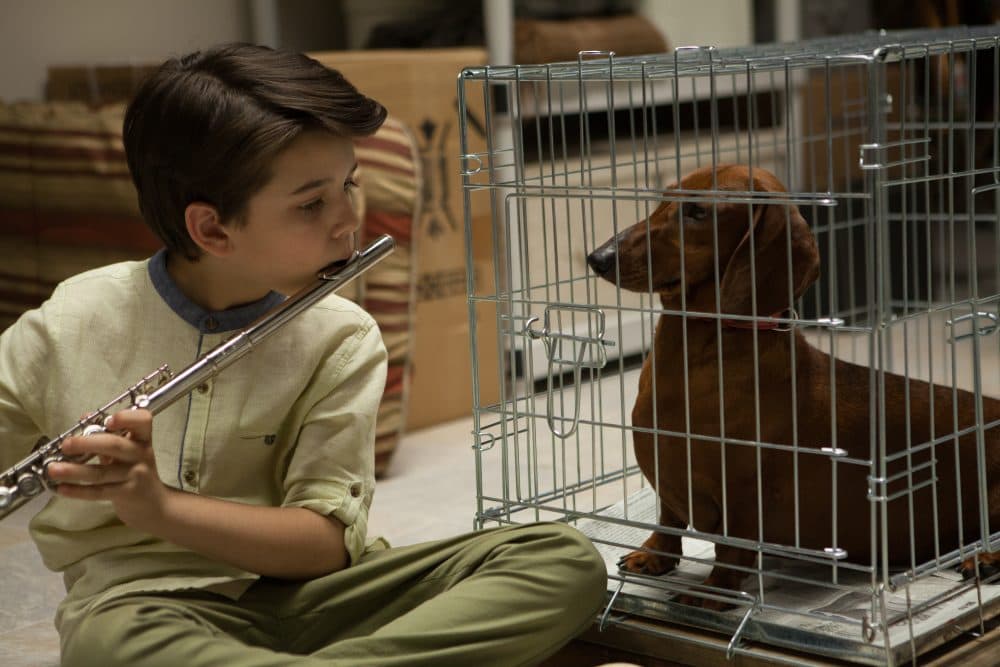
Solondz’s latest, Wiener-Dog, is a sequel of sorts to Dollhouse as that film’s protagonist, Dawn Wiener, is one of several owners of the film’s titular dachshund. This is not the first mention of Dawn in Solondz’ cinematic universe; her name also popped up in the director’s 2004 flick Palindromes, which featured the travails of her cousin Aviva played by seven actors of varying race, age and gender. Sadly, it was revealed early on in Palindromes that Dawn had committed suicide. With Wiener-Dog, it’s unknown if Solondz has had a change of heart or if this film take places before Dawn’s death. Either way, Dawn “Wiener Dog” Wiener is back, with Greta Gerwig taking over for Dollhouse‘s Heather Matarazzo.
In Solondz’s latest, the titular pup evokes, much in the same way the onerous ass does in Robert Bresson’s timeless classicAu Hasard, Balthazar (1966), the true nature of its handlers. Just how humane are they behind closed doors with no one but the dog as a mute witness. But unlike Au Hasard, Balthazar‘s donkey, Christ-like and in ways, more human than the people around it, Wiener-Dog is just a furry prop, however sad and vulnerable, that is passed from one set of hands to the next to elicit the truthful testimony of Solondz’s troubled souls. Continue reading
 The basis of the film is an unpublished novel by Karen Rinaldi, who must be a friend of Miller’s. Or perhaps the project began as a fragile conversation at a cocktail party and took root once the financial backing got the green light. After sitting through the visual adaptation, I can only imagine that the final pieces of Rinaldi’s complicated love triangle among intellects never quite got cemented – thus its in-limbo status. Miller, who adapted the story as well as directs, is clearly all in and seems more comfortable behind the camera than with earlier efforts “Personal Velocity” (2002) and “The Ballad of Jack and Rose” (2005).
  For What it's Worth