Tag Archives: Ed Harris

Love Lies Bleeding

13 Mar

Noir goes to the gym, coming out taut and sweaty (with big hair)

“Love Lies Bleeding,” the delightfully audacious lesbian crime noir from Rose Glass, may not be a road movie per se, but it sure feels like one. It’s everything “Drive-Away Dolls” wanted to be and more: edgy, free of tropes and seared tight by the kind of angry authenticity that imbued “Titane” (2019), “Bound” (1994) or anything Greg Araki ever lambasted us with in the 1990s.

The setting’s a podunk New Mexico town in the mid-1980s – boxy cars, big hair and no cellphones – where Lou (Kristen Stewart) bides her time toiling at a no-frills pump-and-grunt gym, where unclogging the toilet is job No. 1. (And this loo is not like the sleek pieces of pristine public art tended to in Wim Wenders’ well received “Perfect Days.”) No, this is like a Fenway’s men’s room at its odorous worst, and the clientele are all juiced-up meatheads, though Lou feels at home among them, like one of those small fish that swims calmly among sharks and cleans their gills. It probably helps that she has a side hustle shilling steroids.

Lou lives a modest existence. Her flat is classic Allston: worn sofa, tatty rug and clothes strewn everywhere. Her life feels flat too. There is no light in it. Even her one passing love interest, Daisy, (Anna Baryshnikov, daughter of Mikhail), a vapid young woman with a beaming smile and nothing to say even though she’s always talking, feels done and over with. Clearly something has to give, and we get the first whiff of what’s going on under the covers when two FBI agents posing as old family friends come by to inquire about Lou’s father and mother. It’s here we learn Lou is somewhat estranged from her father, Lou Sr. (Ed Harris, rocking a Brian Eno ’70s do), who owns the gym, a gun range and most everything (and everyone) else in the town, but remains close to her sister Beth (an unrecognizable Jena Malone in a blonde bob) who has a tumultuous home life with her husband J.J. (Dave Franco), a rat-tailed scum who works at the firing range.

Tangled webs and criminal pasts get more tangled when Jackie (a super-jacked Katy O’Brien) drifts into town and Lou’s gym, but not before an encounter with J.J. Jackie’s a transient soul pumping her way across America en route to a bodybuilding contest in Las Vegas. She’s got big dreams and even bigger pecs. It’s love at first pump, or something like that. After getting cornered by two sneering lunkheads, Jackie and Lou fall into bed. Souls get bared, love springs and Jackie moves in (she had been sleeping under a bridge). For much-needed cash, she takes up a job waitressing at Lou Sr.’s shooting range, which doesn’t sit too well with Lou.

Glass, who made audiences take notice with “Saint Maude” (2019), an immersive, eerily tense ambient piece, strikes a dutiful balance between pulp punchiness and grrl power anthem with a peppering of gonzo genre-stretching flourishes. One of those goes-to-11 touches is Jackie juicing to the point of Hulk-like ’roid rages and some outré, almost Lynchian veers into alter reality. The chemistry between Lou and Jackie carries the film atop its broad, sculpted shoulders, driven by the kind of passion and injustice that made “Thelma & Louise” (1991) and “Bound” (1996) such indelible fist-in-the-air fuck-the-patriarchy staples. The cinematography by Ben Fordesman recasts the neon-basked Southwest in a gritty neo-noir light that deepens the film’s sense of time, place and genre, but the key here is Stewart, whose underreactive restraint is the film’s hook. Jackie’s the hammer. The two together are an intoxicating tandem, vulnerable yet steeled as they try to make it to tomorrow and their way out.
Top Gun: Maverick

27 May

‘Top Gun: Maverick’: Cruise, back in pilot’s seat, hits the same targets with wisdom of experience

By Tom Meek Wednesday, May 25, 2022

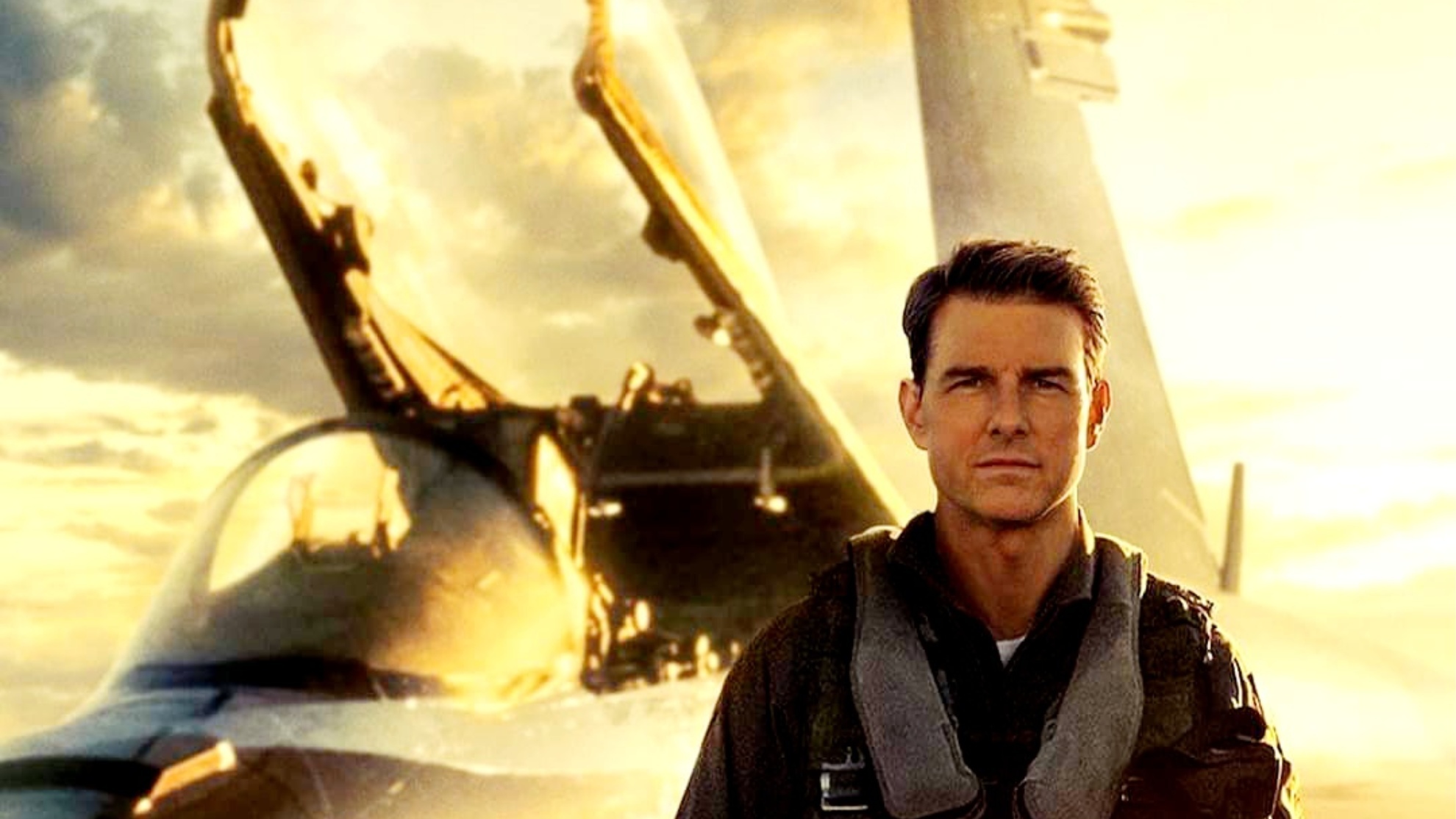
Hard to believe it’s been 35 years since Tom Cruise and Val Kilmer tangled in the Danger Zone. The original “Top Gun” (1986) was branded by ’80s flair (the hair), music (Kenny Loggins and Berlin’s hauntingly excellent “Take My Breath Away”) and the era’s go-for-broke excess (cocaine and unregulated Wall Street), something that got amped up for effect by producers Don Simpson and Jerry Bruckheimer and director Tony Scott; amazingly, what’s on screen in the long-cooking sequel, “Top Gun: Maverick” eerily channels the spirit and vibe of that earlier film while sliding seamlessly into the now. It’s a neat parlor trick pulled off by director Joseph Kosinski, who worked with Cruise on the sci-fi thriller “Oblivion” (2013), and Bruckheimer (he’s back; Scott and Simpson died during the in-between years). The ace in the hole, as it was then, is Cruise. Do the math: Cruise was 25ish when he made the first one and near 60 here. If you look at him in both you’d be hard pressed to think that 10, let alone 20 or, god forbid, 35 years have passed. Sure, there are some crows feet, but the man is a movie star who maintains his asset like Tom Brady does – the main difference being that Cruise has to look good doing it, and you could argue that doing his own stunts at his age is as dangerous as avoiding oncoming linemen when you’re 15 years younger.

If you put the two “Top Gun” movies on the tarmac together, the newer one would leave the other in its vapor trail with relative ease. The 1986 chapter was steeped in macho cliches, the tang of pre-#MeToo sexism and thin characters pumped up to be more than they were. “Maverick” is more about soul finding than chest beating; while there’s some of the latter, it’s reserved mostly for the new young guns.

Continue reading

The Lost Daughter

18 Dec

‘The Lost Daughter’: One gets away at a getaway in Maggie Gyllenhaal’s powerful directorial debut

Maggie Gyllenhaal, the actress best known for her turns in “Secretary” (2002) and “Adaptation,” (2002) gets behind the camera for her directorial debut with “The Lost Daughter,” an adaptation of Elena Ferrante’s novel about a woman struggling with loss and trying to find solace in the present. It’s a tight, intimate portrait of a person trying to move on who gets caught up in the dramas of others. Gyllenhaal gathers a fantastic cast and educes some award-worthy performances. Her lead could not be any better: Olivia Coleman, so good in “The Father” (2020) and an Oscar winner for her royal turn in “The Favourite” (2018), plays Leda Caruso, a comparative literary professor from Cambridge, Mass. (it’s not explicit but we can assume Harvard) on vacation at a Greek resort. Ensconced in a book, a quiet day of beach reading is interrupted by a raucous crowd of partiers from Queens. She won’t cede her spot on the beach to the group, which has choice Jersey Shore reaction to her stiff-upper-lip rigidity. Then the young child of one of the festive lot (Dakota Johnson, “Fifty Shades of Grey”) goes missing. There’s mass panic along the beach, which Leda – experiencing some anxiety – has left. Natch, she finds the young girl in the woods on the way to her cabana and returns her to her mother, Nina (Johnson). The group from Queens rethinks their opinion of their obstinate beach neighbor, and an uneasy bond between the women takes root. Nina looks to Leda for maternal advice, while the writer in Leda probes into Nina, her familial and romantic relationships, as well as her furtive ditherings. Leda has her own dubious doings, absconding with the child’s favorite doll and reacting with zero affect when the child breaks down crying for their security blanket.

“The Lost Daughter” is less about that present story between Nina and Leda than about Leda’s internal emotional journey. In flashbacks we see the young Leda (played by Jessie Buckley, so good in “I’m Thinking of Ending Things”) living an ideal life with a husband and two daughters, but is drawn by the allure of power and intellectual commonality by an established literary professor (Peter Sarsgaard, Gyllenhaal’s husband). The performances by Coleman and Buckley (who won the Boston Society of Film Critics for best supporting actress last week) are sublime and deeply felt. What’s more is that the transition between the two feels genuine and universal. The rest of the ensemble includes Ed Harris as a caretaker trying to break Leda’s icy facade, Paul Mescal as a resort attendant and Oliver Jackson-Cohen as one of the boisterous crew from Queens. It’s also one hell of a debut by Gyllenhaal, who’s going to have the cinema world hanging on her next directorial project. 

Resistance

31 Mar

‘Resistance’: You know mime Marcel Marceau, but this is when clowning stopped to kill Nazis


Resistance

Many know Marcel Marceau as one of the greatest mimes who lived, but he also was also part of the French Resistance during the Nazi occupation of France, helping hundreds of orphaned, mostly Jewish children escape to Switzerland. His father was Jewish and as the film “Resistance” has it, none too keen of his son wanting to be like Charlie Chaplin, calling him “a useless bum who wants to be a clown but has the muscles of a ghost.” His father, a butcher, would end up being put to death in a concentration camp, and Marcel would change his last name as he and his brother joined the fight.

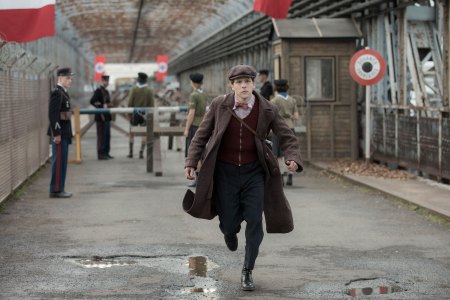
Jonathan Jakubowicz’s self-important film is framed with Gen. George S. Patton (Ed Harris) citing Marcel (Jesse Eisenberg) for his heroics to a crowd of U.S. soldiers after the liberation of France. It’s an awkward, out-of-place device – as is much of the film awkward. Harris, normally dead-on in his male bravado, is a mouse stepping into George C. Scott’s shoes, and Eisenberg, while game, struggles with the subtlety of mime and the nuance of an actor feigning composure under the masochistic boot of Klaus Barbie (a scene-chewing Matthias Schweighöfer, a pleasing, malevolent distraction) trying to shake down an escape plot. The film’s told with a Holocaust thriller edge, yet it never quite thrills nor enlightens, especially given the rich historical material at hand.

Just what drives Marcel – or Jakubowicz’s plot – is hard to say. He’s so enamored with Chaplin and breaking out as a performer, it’s hard to know if protecting children or a way of life is more important. Then there’s the sullen but determined Emma (French actress Clémence Poésy), who’s in on the cause and a romantic interest; many of these seeds never fully sprout, leaving the realization of Marceau and his legacy as something of a muddled miss.

Jakubowicz’s choice of title is austere but irrelevant. Yes, Marceau served in the Resistance, but the movement and his time in it are not the film’s major thrust, making it another aspect of the film that raises more questions than it ever answers. One of the very best films (if I may suggest) about the French Resistance is Jean-Pierre Melville’s dark and daunting “Army of Shadows” (1968). Due to the famous May 1968 civil rebellion against the presidency of Charles de Gaulle, the film, with its favorable portrayal of de Gaulle, was not widely embraced; it didn’t get a theatrical release in the United States until 2007. It’s well worth seeking out.

mother!

15 Sep

‘Mother!’ Is A Provocative, Swirling Contemplation On Our Relationship With The Earth

Javier Bardem and Jennifer Lawrence in a scene from "mother!" (Courtesy Paramount Pictures via AP)closemore

Biblical allegories and weighty world matters abound in Darren Aronofsky’s latest tempest of anger and wonderment that takes mankind to task. Part horror story, part existential ponderance and ever doing cinematic backflips, “mother!” is a movie that certainly won’t be everyone’s cup of tea. But those who see it are certain to be held rapt from the very first frame to the film’s fiery crescendo.

Things begin serenely enough as we catch up with a young woman immersed in restoring a grand country manse, where there no cell service and nothing but trees and grass as far as the eye can see. The woman is never identified onscreen, but called “Mother” in the credits — and Jennifer Lawrence carries her heavy emotional burden well.

Her selection of earth tones to plaster the walls is of no coincidence. She tends quietly to these finishing aesthetics as her husband (Javier Bardem), identified in the credits simply as “Him,” broods about struggling to reboot his creative juices. He’s a beloved poet who’s been blocked since the death of his previous wife and is wildly possessive of the crystalline shrine he has erected in his study to memorialize her.

His aloof peculiarity strikes a chord early, but then again he’s a creator and, as with anyone whose artistic process breeds success, idiosyncratic methods often get overlooked. Then “Man” (Ed Harris) shows up, believing the stately octagon shaped estate is a B&B. The two men get bombed as if they’re old friends and later, Man wretches up an organ. Then there’s that troubling picture of Him that Mother finds in Man’s bag. Continue reading