By Tom Meek
In states such as Massachusetts, where recreational marijuana is legal, the processing for awarding sellers’ licenses has been done with a preference and prioritization for those from communities adversely impacted by drug criminalization laws. That translates mostly to people of color from inner-city enclaves, though just what “adversely impacted” means may be elusive to most looking in at the process. For anyone who’s wondering or finds that phraseology somewhat vague, Nicole Jones’ documentary “The Third Strike” arrives to set you straight.
“The Third Strike” revolves around laws enacted in the early 1980s that made a three-peat drug offender a candidate for life in prison – actually, automatically, with no deliberation or real process. That may sound good if we were talking about a violent criminal, but this is about people who deal an occasional dime of weed, something barely above a jaywalking offense today. In the threes-strikes era, a person who commits murder three times would be entitled to parole hearings and the possibility of release; deal even a small amount of weed three times and it’s essentially “a death sentence,” as one taking head in the film puts it.
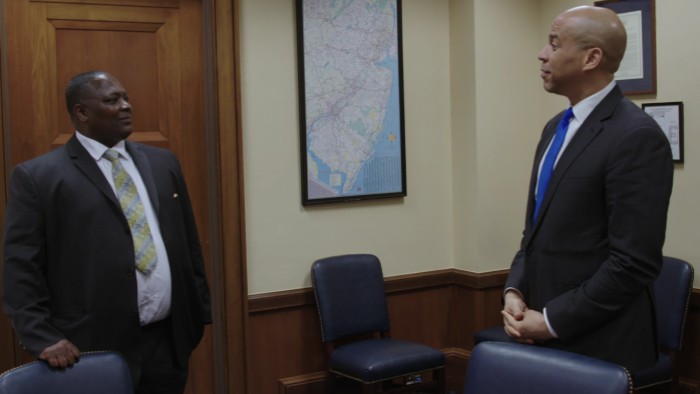
To underscore the point, Jones examines the case of Edward Douglas, the first man released as a result of The First Step Act in January 2019. Key players in his freeing are attorney MiAngel Cody, who leads a liberation project, and U.S. Sen. Cory Booker, who talks in convincing volumes about the injustice of the “three strikes” law. Jones’ juxtaposition of Douglas’ transgression with those of hardened violent criminals is an easy sell, but the soul-shaking win of the film is the man himself, a sweet, jovial, innocent sort, looking to catch up on lost time with family and grateful rather than angry. He brims with innate warmth and obvious humanity.
The conclusions of “The Third Strike” are nothing new, but it does shed a powerful light on social inequities of color and crime and reminds us of people who did little more than spit on the sidewalk still rotting in jail, tagged with a sentence more ironclad than that of the repeat killer one cell over.

 Larry’s not a bad guy, he’s got an inert French Bulldog with the greatest facial expressions and he looks after his ailing nana (Olympia Dukakis ) who’s in a nursing home, but he does get fired from his waiting job for stealing booze – and keys a coworker’s car on the way out. Around the corner at the same shopping mall complex, Larry quickly lands a job at a Quick Lube oil change shop, where her enjoys the discipline of assembly line work (he vacuums out the cars and has to pay a loose-money finders fee to the lube monkeys higher up the food chain) and falls for his new boss Lupe (Eleanore Pienta).
 Heineman gained a perilous unlimited access to his subjects; it might be more accurate to say he’s embedded. The film begins with the steamy nighttime capture of an outdoor meth lab where the brewers wear bandannas to conceal their faces from the camera – and the noxious vapors. They do what they do out of opportunity. “As long as god allows it, we make drugs,” one offers meekly. They learned how to make their cocktail from an American chemist and his son. (Maybe Walter White is still kicking around?)

 For What it's Worth