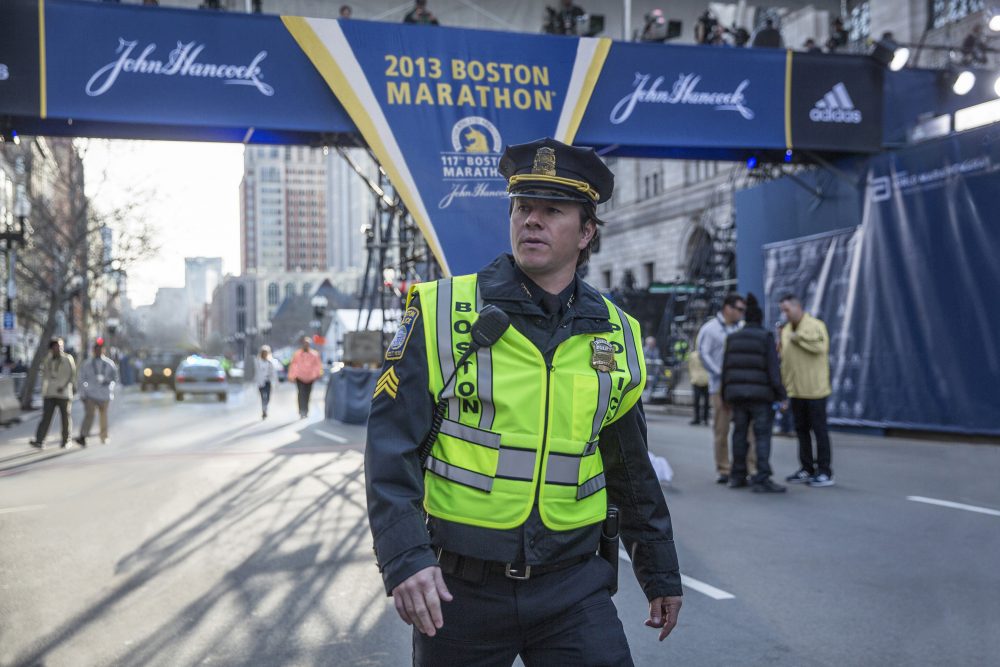
So here comes the big cinematic rendering of the 2013 Boston Marathon bombing that rocked the city for the better part of a week and now seems destined to be etched into our collective history just below city-defining headliners like the Boston Tea Party, busing in the ‘70s and the murderous legacy of Whitey Bulger.
The good news about “Patriots Day,” which opens Wednesday, is that it delivers a modicum of cathartic release as well as an intriguing look behind the scenes as an active crime investigation takes shape. The bad news, however, is that it knowingly injects fiction into the mix in a way that nearly subverts the project’s mission of “getting it right,” as Boston-bred star and producer Mark Wahlberg has said repeatedly. In the process, the dramatization shortchanges those that were there — the heroes and the victims — and the character of our fair city.
Three screenwriters, including the director Peter Berg, are credited with the script. The studio’s publicists informed me that the sources ranged from conversations with the Boston Police Department and other local agencies that responded to news reports and “60 Minutes.” What they’ve cooked up feels like a cobbling together of news feeds condensed and sanitized into a singular heroic narrative that regularly brims with the Boston Strong motto.

 Few probably knew that balancing the books could be such a lethal endeavor, or that such a cockamamie idea, especially with the normally tacit and wooden Affleck, could translate into such a satiating pleasure – a guilty one. With ledger-entry care we get into it one plodding record at a time, beginning with blurry images of a hitman taking out linguini-eating mobsters in a scene that’s reminiscent of the young Michael Corleone removing the family nuisance in “The Godfather.” Then, before we get the assassin’s mug, we flash to a quaint country manse in the hills of New Hampshire where the young Christian (Seth Lee), having a bit of an OCD fit, is being interviewed by a doctor who specializes in children with Asperger’s and autism. It’s here, in the unhappy family moment, that we also learn that the lad can solve a complicated puzzle in 20 licks.
 It’s been only a few years since the disclosures by former intelligence worker Edward Snowden and subsequent firestorm ripped opened a debate on privacy and security. During it all, documentarian Laura Poitras captured the real-life Snowden holed up in a Hong Kong hotel as he readied exposure of the CIA and NSA for spying on U.S. citizens without cause, hacking and mining private Facebook posts – even accessing computer cameras to look in on citizens of interest, should they care. Her film, “Citizenfour,” went on to win an Academy Award. Poitras makes her way into Stone’s “Snowden” as a character, played by the ever-graceful Melissa Leo, sitting in a room shooting Snowden (Joseph Gordon-Levitt) and “Guardian” journalist Glenn Greenwald (Spock player Zachary Quinto). Stone wisely doesn’t retrace much of Poitras’ steps, but makes the story about Snowden the man, his roots in the military, his nerdy proclivities, his cut-above skill set and capabilities and his on-again, off-again relationship with girlfriend Lindsay Mills (a vivacious Shailene Woodley) – for the two, it’s love at first IP trace.
  “Million Dollar Baby” and “Invictus” were two such inwardly wound gems, and Eastwood’s latest, “Sully,” marks another fully palpable portrait of human determination that’s more interested in the human condition and compassion than heroics. Don’t get me wrong – there’s plenty of heroics in “Sully.” After all, the film is branded after the man who executed the “Miracle on the Hudson”; if you were asleep in 2009 in the wake of the economic meltdown, when good news was hard to come by, that was when Sully (aka Chesley Sullenberger) gave the nation something to cheer about, putting down a badly damaged jet on the Hudson River, saving the 155 lives aboard and avoiding incalculable collateral damage should a return to LaGuardia fail.
  Basically in the new “Jason Bourne” we’re a long way from the Robert Ludlum material that was so organically and intricately concerned with spy games and double dealings at the highest levels, with Jason Bourne caught up as the harried fly in the ointment. In the five installments – four starring Matt Damon and now three of those helmed by chaos choreography maestro Paul Greengrass (“Captain Phillips” and “United 93”) – the impetus has moved from an internal struggle driven by outside forces to dubious machinations in those external structures (the CIA and its splintered sub-organizations) looking for any excuse to put Bourne in someone’s crosshairs. In this case it’s those of CIA director Robert Dewey (a craggy Tommy Lee Jones, inheriting the role of heavy from Albert Finney) who doesn’t want Bourne (and his long-running inside collaborative, Nicky Parsons, played again by Julia Stiles) to pull a WikiLeaks dump of the Treadstone file (listing all the behaviorally engineered Bourne-like assassins). Plus he’s got his hooks into social media mogul Aaron Kalloor (Riz Ahmed), an amalgam of Zuckerberg and the Google guys, and wants to leverage the company’s Deep Dream network platform (think Facebook) as a tool to acquire info on anyone, anywhere, anytime.
  The basis of the film is an unpublished novel by Karen Rinaldi, who must be a friend of Miller’s. Or perhaps the project began as a fragile conversation at a cocktail party and took root once the financial backing got the green light. After sitting through the visual adaptation, I can only imagine that the final pieces of Rinaldi’s complicated love triangle among intellects never quite got cemented – thus its in-limbo status. Miller, who adapted the story as well as directs, is clearly all in and seems more comfortable behind the camera than with earlier efforts “Personal Velocity” (2002) and “The Ballad of Jack and Rose” (2005).
 In “The Nice Guys” we’re hanging out in Los Angeles circa 1977 where the neon buzz of “Boogie Nights” is everywhere and the veins of corruption, akin to “L.A. Confidential” and “Chinatown,” run deep. It’s in this tawdry underbelly that Jackson Healy (a paunchy Russell Crowe) makes a living by punching people in the face. Got a stalker? Want them off your back? Give Healy a few bucks and the problem’s solved. Healy would like to be something more than a hatchet but isn’t certain he’s got the goods to cut it as a private detective, though he might make a better one than Holland March (Ryan Gosling), a lush who talks so much he reveals all his cards before the hand’s dealt. To be fair, he’s coping with the loss of his wife and trying to raise a preteen daughter (Angourie Rice, channeling the sass of Jodie Foster and Tatum O’Neal in the 1970s).
 For What it's Worth