Tag Archives: Danny Boyle

“28 Years Later: The Bone Temple”

27 Jan


Faster, angrier and meaner—that’s how folks have come to like their zombies since director Danny Boyle and writer Alex Garland flipped the genre on its head in 2002’s “28 Days Later.” They introduced a “rage virus” that transformed infected humans into berserk, flesh-rending decathletes on crack. George Romero’s shamblers could barely hold the beer of these boss-level zombies and a series was hatched. The latest entry, “28 Years Later: The Bone Temple,” is chomping its way through theaters.

Boyle and Garland have dropped in and out of the series. Neither were onboard for the 2007 follow up, “28 Weeks Later” (perhaps its best chapter), but reunited last year for “28 Years Later”—the ostensible cornerstone of a trilogy, now a tetralogy probably still not complete. Garland wrote the script for “Bone Temple” but Boyle hands directorial duties to Nia DaCosta, who caught our eye with their 2021 “Candyman” remake, lost us with their insipid “Marvels” meander in 2023, but regained our interest with last year’s opulent and bawdy “Hedda.” DaCosta may not be a top orchestrator of character and the human element, but they do have a formidable visual sense, and “Bone Temple” is strikingly framed — be it scenes of bloody butchery or serene countryside meadows. Its rampant gore is hard to look away from.

At the end of last year’s first act, our pre-teen protagonist Spike (Alfie Williams) had left his family’s island enclave to seek answers on the mainland. There he teamed up with Sir Jimmy Crystal (Jack O’Connell) and his band of lost boys, known as the Jimmys. A cartoonish ending (golf clubs and parkour to take out the “infected”) offered a wisp of hope. But “Bone Temple” finds them in a place that is dark, sinister and grim.

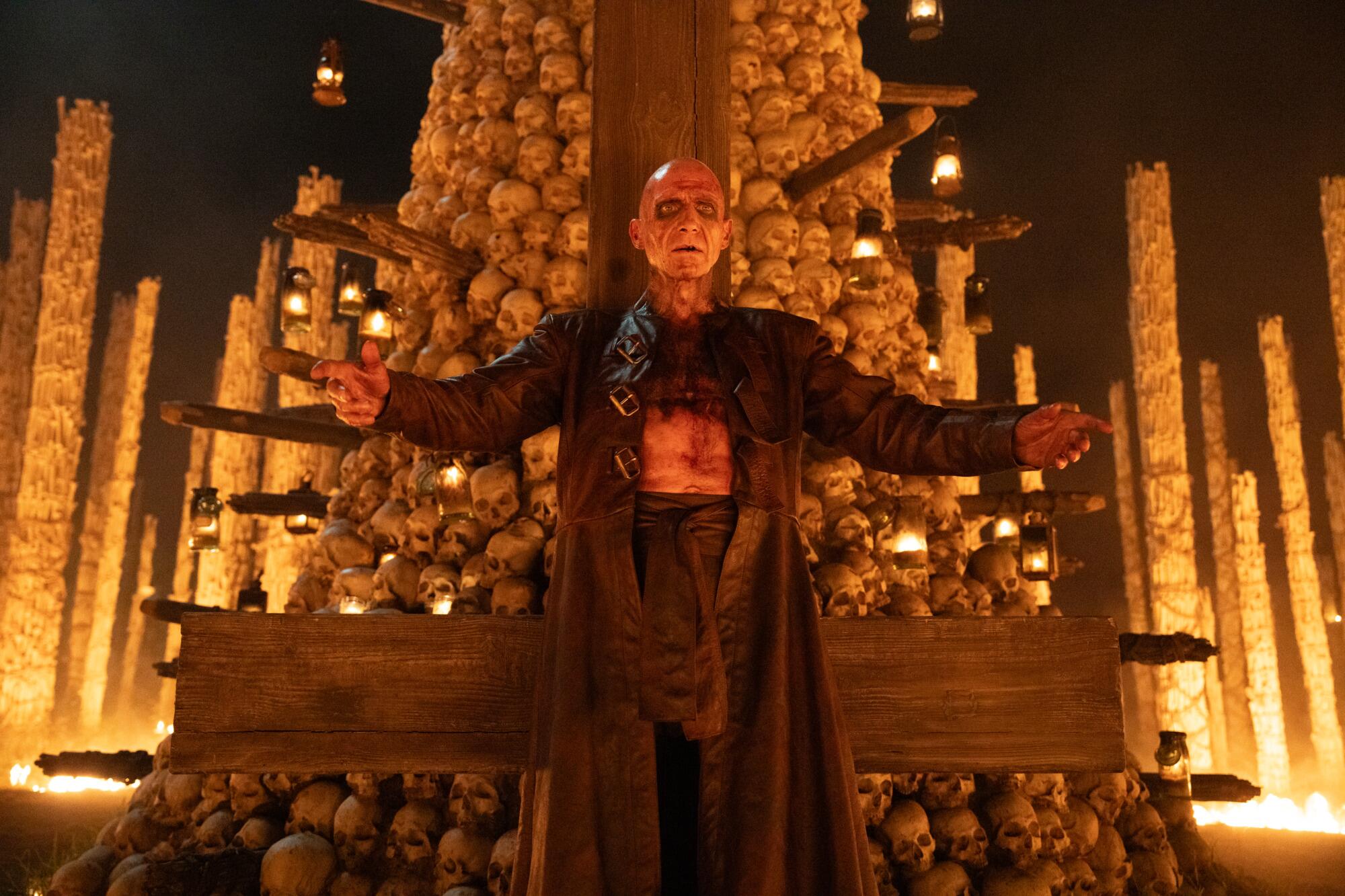
The sequel opens with Spike in a death match to earn his into Jimmy’s gang. O’Connell’s Jimmy presides over the fray, a cartoonish Nero savoring the slow demise of another. The film’s other thread reunites us with Dr. Ian Kelson (Ralph Fiennes), curator of the Bone Temple ossuary — pillars of bleached ulnas and tibias surrounding a tower of skulls — and observer of the infected. Kelson, slathered in iodine (which staves off the virus), has developed the neat trick of using morphine darts to tranquilize zombie Alphas, infected that can rip the spine from a human like blowing their nose. This allows him to bond with one regular visitor that he names Samson (six-foot-eight former MMA fighter Chi Lewis-Parry, who looks like Jason Momoa’s maxi-me). It’s an intriguing relationship, with Kelson something of a fatherly Frankenstein seeking to strike connection and balance.

Jimmy has a different relationship with the “infected.” He was the young boy watching the “Teletubbies” in act one’s preamble when his da, a priest, embraced the horde descending on his house and church as a divine intervention (Jimmy is the only one who escapes). Jimmy’s character is inspired by flamboyant, blonde-wig wearing 1960s–’80s British TV host Jimmy Savile, who was revealed after his death in 2011 to have been a prolific pedophile and sexual predator. But Jimmy and his wig-wearing minions put another evil layer on things — they roam the countryside pillaging and torturing other quarantined survivors in the name of Old Nick (another name for Satan). It’s a bit of a leap, but one that DaCosta, O’Connell, and Garland mostly make stick.

O’Connell was also a villain in “Sinners,” playing the opportunistic vampire Remmick in Ryan Coogler’s imaginative, genre-blending period piece and current awards contender. At least Remmick had a code. Jimmy is an amoral sadist with a deity complex and an intense amount of charm, which makes him twice as lethal.

The Kelson and Jimmy threads eventually converge, not because of Spike’s prior connection to Kelson, but through Jimmy’s manipulation when he deems Kelson Old Nick himself due to his Satan-red application of iodine — a claim Jimmy weaponizes to cement his authority over his restless charges.

“Bone Temple” moves in strange and unexpected ways that mostly work. When it falters, Sean Bobbitt’s rich visuals and a knockout performance by Fiennes easily carry it past the rough patches. Williams, too, is strong as the torn and vulnerable youth roped into an unenviable and horrific existence, Lewis-Parry gives  anuanced turn as the massive, naked Alpha. O’Connell is just as (for better or worse) pop-off-the-screen audacious here as he was in the waning moments of last year’s film.

Those expecting waves of zombie carnage may be surprised by “Bone Temple.” Its ugliest horrors come from human cruelty dressed up as moral purpose, acts Jimmy chillingly tags as “charity.” These are often peek-through-your-fingers grim. As with previous entries in the series, “Bone Temple” closes on a note of wary hope, punctuated by a big reveal that promises that the “28 Years” saga will shamble on.

28 Years Later

20 Jun

You can try to live with rage virus but it’ll just keep evolving into something weirder

As laid out, this latest in the Danny Boyle-Alex Garland zombie apocalypse series is more reboot than a trilogy closeout for “28 Days Later” (2002) and “28 Weeks Later” (2007). In fact, it’s alleged to be the start of a new trilogy, with “28 Years Later: The Bone Temple” already slated for 2026. But two films, a cinematic hat-trick does not make.

We also need to clear the chronology slate, 28 years later is not 2053, but more around now – 2030, if we extrapolate from the release date of “28 Days Later.” As with the other films, the setting is Britain, which still is the only infected area in the world as far as we know – in “Weeks,” as well as here, there are implications that the “rage virus” may be elsewhere, but it’s teaser. As to why survivors still reside on the isle of Britain: The island nation is quarantined and its coast patrolled rigorously by other countries – France and Sweden, at least.

Continue reading

T2 Trainspotting

29 Mar
Johnny Lee Miller and Ewan McGregor reprise their roles as Sick Boy and Renton, both a little older but not much wiser

It’s been 21 years since Danny Boyle and Ewan McGregor shocked audiences with that creepy dive into a fecal-fleeced toilet in Trainspotting, somehow making being a heroin addict a hilariously biting — albeit tragic — trip along the way. Part gonzo romp, part sad social satire, the stylish weave followed the vein-piercing antics of four Edinburgh junkies, slaves to skag and capable of doing anything to score their next fix — including ripping off their best mates. Not a great lot to throw in with, but a highly entertaining one as the fix-needing squabbles reached the near hyperbolic absurdity of the Three Stooges.

At the end of that 1996 adaptation of Irvine Welsh’s cult novel, one of the four is dead and another runs off with the group’s hard-earned drug money, which leave affairs in a difficult place to pick up, but Boyle and his screenwriter John Hodge, who adapted T1 and has collaborated with Boyle on several other projects, have a real feel for the lads and leverage Welsh’s 2002 follow up, Porno to give the middle-aged blokes a shot at redemption before heading off for the nursing home.

We first catch up with McGregor’s Renton (the guy who stole all the money and — as the film has it — ruined everyone else’s life) now living in the Netherlands and who appears to have made good on his promise at the end of Trainspotting to change, but a small cardiovascular event trips him up (literally) and sends him back to Scotland where he learns his mom has passed. A quick check in with old pal Spud (Ewen Bremner) finds unhappy times for the sweetly pathetic user who’s been unable to shake his monkey. The reunion is cemented by an uproarious eruption of vomit that becomes one of the film’s most lingering images the same way excrement took center stage the last time. Next up on the reunion tour is Sick Boy (Elementary‘s Johnny Lee Miller) who half wants revenge but also needs Renton to help launch a massage parlor that’ll offer happy endings to those in the know. Renton agrees partly out of remorse and old time’s sake but also because he’s drawn to Sick Boy’s girlfriend and house-madam-to-be, Veronika (Anjela Nedyalkova, who’s sultry, yet knowing presence lights up the screen). Continue reading

Steve Jobs

16 Oct

Michael Fassbender stars as Steve Jobs in a scene from the film, "Steve Jobs." (Universal Pictures/AP)

Steve Jobs,” the new bio-pic about the iconic Apple entrepreneur, is a film in love with men (a man) who possess prescient clarity.

To underscore that notion, the film opens with a clip of Arthur C. Clarke back in the ‘70s, extolling the virtues of the computer and how it will change the lives of humans one day. H.G. Wells scored some great future picks too, but both those men were primarily writers, neither of them produced or pushed product, something, that the film, helmed by Danny Boyle and written by Aaron Sorkin, asserts Jobs did with unbridled ardor and rabid commitment.

Clearly Boyle and Sorkin have swallowed the “visionary” pill and are all in. It’s easy to get that too as they’re working with Walter Isaacson’s biography, which Jobs had a hand in before his death. As the film suggests, the digital maestro, currently in everyone’s pocket, was also a master strategist laying the roots of his stratagem and giving them years to germinate before reaping the rewards. As a result, one can’t walk away from “Steve Jobs” without a sense that maybe Jobs saw this coming, his own hagiography, and planted the seeds to brand his legacy and ensure the enduring future of Apple and all things preceded with a lowercase “i”.

Michael Fassbender appears in a scene from, "Steve Jobs." (Francois Duhamel for Universal Pictures/AP)

The film’s told uniquely in three chapters, each taking place in the moments leading up to a product launch (staged demos in velvet adorned opera houses) that Jobs, a fan of simple design and closed systems so hackers and hobbyists can’t muck with his perfection, proclaims will change the computing industry.

We launch back in 1984 with the unveiling of the Mac, but Jobs (played by Michael Fassbender) is in a mad arrogant snit because the machine crashes when it tries to say “Hello” and the fire department won’t allow him to shut off the exit signs to gain total darkness for the overall wowing effect. In the first five minutes, as Jobs runs through a gambit of nail-in-the-coffin problems, much akin to Michael Keaton’s stressed thespian in “Birdman,” but a far different bird, one drinks in an effortless multitasker, a brilliant human able to pull from both the left and right lobes, and an intolerable a—hole with small glimmers of compassion within. In all three product launches, he’s tended to by his loyal head of marketing, Joanna Hoffman (Kate Winslet bringing great nuance to a woman clearly in a thankless role and radiating with a deep care for her beloved tormentor) who’s the only one who able to push back and still have a job. Continue reading