Tag Archives: Ari Aster

Eddington

18 Jul

Ari Aster’s America with Covid, mask off and reeling
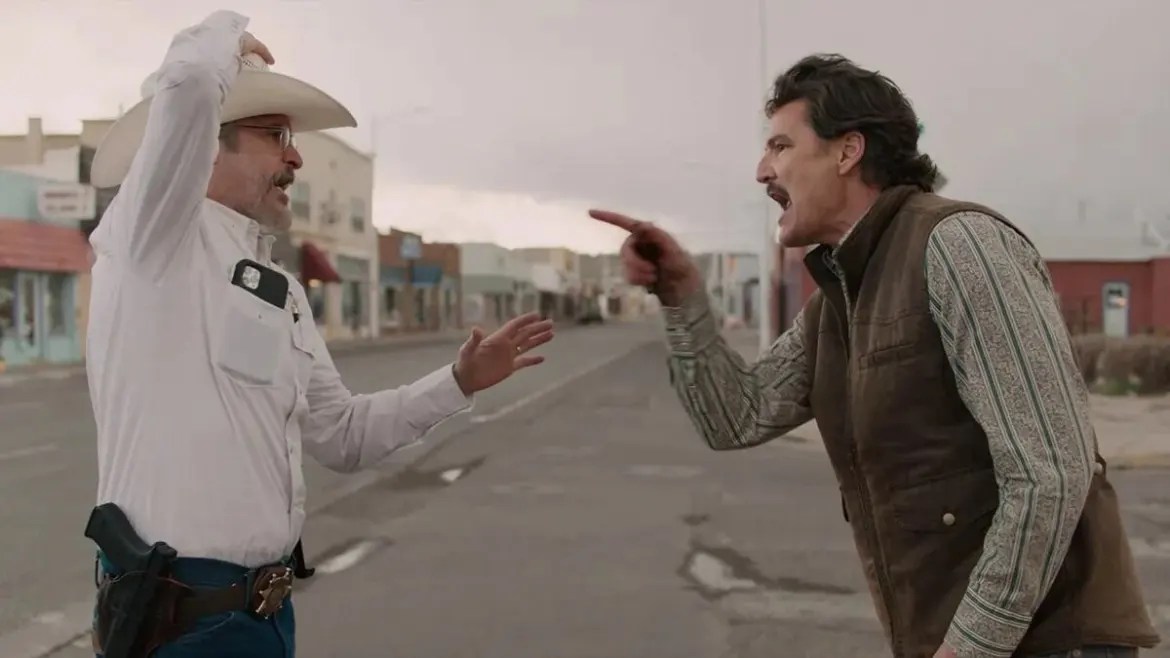
The latest from art house horror darling Ari Aster, like his last outing, “Beau is Afraid” (2023), isn’t quite the occult blood-and-guts fest one has come to expect from an auteur of the macabre (“Hereditary,” “Midsommar”). But it is an American horror story to be certain. Set in the fictional Southwestern town of the title, “Eddington” takes place during the height of the Covid pandemic, with ripple effects of George Floyd’s murder and the Black Lives Matter movement factoring large into the equation. Eddington is a small, financially struggling New Mexican town of 2,000 that abuts a Pueblo Indian reservation. Beau, I mean Joaquin Phoenix, plays Joe Cross, the county sheriff who, despite orders from the governor and mayor (Pedro Pascal, who seems to be popping up everywhere), refuses to wear a mask. He’s not an antivaxxer or Covid denier per se, but close enough – and as a result, decides to challenge Pascal’s smooth and composed Ted Garcia for his mayoral seat.

The pratfalls and ills of social media and social politics drive the film for nearly two-thirds of its two and a half hours. It’s imbued with the shaggy-dog docudrama vibe of a Richard Linklater or Paul Thomas Anderson film, sans the slack, droll wit. Some of the satire on white privilege, however, lands quite cuttingly, especially as one pasty young man (Cameron Mann) shouting from a podium tells reluctant listeners that he’s become an antiracist and is ready to sit down and listen to others, but only after he’s had his time at the mic to “racesplain.” Also in focus is Cross’ Black deputy (Michael Ward) as BLM protesters jam the streets, and the sovereignty of the Pueblo Peoples and their lines of jurisdiction overlap with Cross’ and become a point of contention during a murder investigation. On all pointed matters (social media, race and pandemic policy), both sides get their due without a lean – that’s left to the audience. 

Continue reading

Beau is Afraid

22 Apr

‘Beau is Afraid’: Mission to mommy

The latest from Ari Aster doesn’t quite swerve off into a macabre occult or seasonal cult rite the way “Heredity” (2018) and “Midsommar” (2019) did to the delight of art house horror fans, though “Beau is Afraid” has its own special flourishes of outré that disturb as much as they provoke. The film moves in a very A-then-B fashion with flashbacks to inform us on the trauma unfolding in the present. We begin in the dark with a series of dull thuds and agonized groans. There’s occasional bolts of white light and peers through murky pink filament. What’s going on, you might ask, trench warfare at night? Soon the answer is delivered as Beau is birthed and slapped awake into his new world. We leap ahead to find the mature, balding 40-something Beau (Joaquin Phoenix) in therapy, where we learn he has a lot of mommy issues. Given his father died at the very moment of his conception, this makes sense. His mother calls several times during the session; he doesn’t answer, but tells his therapist (Stephen McKinley Henderson) he’s supposed to go visit her the next day – a task Beau doesn’t fully want to do.

We wander through chaotic streets, or is this unsettled world a projection of Beau’s inner turmoil? A berserk tattoo-faced man chases him with maniacal intent on his way home to a high-rise roost, where he hears news of a naked man stabbing people randomly. That evening, as Beau sleeps, a neighbor keeps sliding notes under his door asking him to turn down the music, yet his apartment is mute, and when Beau takes a bath, another neighbor literally drops in, in nearly the same demonic fashion a possessed soul does in the “Evil Dead” reboot out this week. Getting to mom proves elusive too. Lost keys, lost luggage – he never makes it to the airport, and when he calls his mother a UPS driver (Bill Hader, though you’d never know because you never really see him) answers and blathers on about police on the way and something about a chandelier and a missing head.

Beau remains absurdly calm and tries a plan B. The end result is that he gets stabbed, hit by a car and wakes up two days later in the bucolic home of Roger (Nathan Lane) and Grace (Amy Ryan, so good in “Gone Baby Gone”), kind medical professionals who nurse him back to health. Lurking around is a menacing looking “former war hero” (Denis Ménochet) who I’m not sure ever speaks, and the couple’s surly, sassy daughter (Kylie Rogers), who offers to drive Beau to his mother’s house. It turns out to be something of a blunt-smoking, kangaroo-court shenanigan. 

With effusive control, Aster keeps working us – and Beau – in a downward spiral where the sense of what’s real and what’s not is as murky as that birth canal opener. Lost in the woods, Beau stumbles upon a theater group enacting the play of his life, and there’s a neat segue into animation, further gonzo, dark turns and Parker Posey, superb in a brief yet pivotal part. Mom’s in nearly every frame even when she’s not there, but about midway through we get her in the flesh, in flashbacks (played by Zoe Lister-Jones) and breathing fire in the now (Patti LuPone, bringing it). The line-blurring journey is reminiscent of the award-winning Daniels’ film “Swiss Army Man” (2016), with Aster’s frenetic edginess and dread imbued in nearly every frame. It’s a near three-hour odyssey that rivets right up to the Orwellian finale. Not all of it works, and Beau never seems genuinely afraid at times others might hit the panic button, but Aster’s film, like his others, has that lingering provocative tease that’s both a sign and a gift.

Midsommar

5 Jul

‘Midsommar’: Hands-on anthropology studies reveal how dark it can get under midnight sun

Image result for midsommar


As a kid I went to this Danish town north of Los Angeles called Solvang where it was Christmas year-round and the waffles were extra large and strangely exotic, and everyone dressed like they were from “The Sound of Music.” I tell you this because Solvang reminds me so much of the Swedish commune where four Americans wind up for a nine-day fertility festival “Midsommar,” the thrilling new chiller from Ari Aster. Everything’s so old school Lapland you half expect to see the Ricola folk or Max Von Sydow among the elders welcoming the group.

Two of the four Americans dropping in – Josh (William Jackson Harper, TV’s “The Good Place”) and Christian (Jack Reynor, the poor person’s Chris Platt) – are anthropology grad students, and the midnight sun rites are fodder for their theses. It helps that stateside buddy Pelle (Vilhelm Blongren) is from the remote village that feels like pieces borrowed from the sets of M. Night Shyamalan’s “The Village” and Robert Egger’s “The Witch” with a bit of Ikea retrofitting tossed in. Rounding out the U.S. crew is loudmouth Mark (Will Poulter, the dirty cop in Kathryn Bigelow’s “Detroit”) and Dani (Florence Pugh, “Lady Macbeth”), Christian’s girlfriend and a tag-along whom the other lads in the posse aren’t so keen about.

The film begins and ends with Dani. There’s a prolonged opening about her clinginess to Christian, her bipolar sister and a family tragedy that would send anyone to therapy in double time– a hauntingly fraught meander worthy of Paul Thomas Anderson. Once up in the Swedish enclave, Dani freaks out on organic hallucinogens, Pelle clearly has eyes for her and the age-old cult ordains her as the dark horse in the May Queen dance-off.

Early on in the anthropological exploration—which doesn’t feel so scientific or methodical—we get a glimmer into just how dark this eternal summer day can get. Once you’re 72 in the commune, you’re ready for renewal, which has something to do with a swan dive onto a stone pallet or a wedding reception line of celebrants wielding a medieval mallet. It’s not easy to drink in, but it’s when Aster – who played on audiences’ sense of comfort and composure with the equally grim “Hereditary” – lets us know shit just got real. The American scholars, as smart as the allegedly are, don’t take note of such omens, even as their ranks thin. But when things begin to feel a bit “Wicker Man” predictable, Aster focuses on the fractured dynamic between Christian and Dani, and the choices the characters make are telling.

The final scene, just as with the reveal of the fate of Dani’s family, is gorgeously framed and flawlessly choreographed. It’s not everyone’s cup of tea, to be sure, but Aster has again put a new, gory bow on a genre we know too well. If you can make it to the end, you’ll walk out on edge and agape.