The Wait

20 Mar
Published in the Open Window Review in December of 2012.

The Wait

Ten years ago my sister bled out on foreign soil. Her soul is now part of the land she tried to protect. The cause of her demise? The military of a nation our country holds as a close ally. To add to that insult, a judge in that country has just excused the army from any wrong doing.

For one long decade, my family has suffered and prayed for closure. My parents spent their life savings on attorneys and trips to the Middle East trying to exact justice for Anna, to prove that she did not die in vain or in the stupid accidental manner that the Israeli government professes. It was all they did every day for ten years and now it has ended in the most vapid and insensitive way that only widens the hole and makes it bleed more.

Anna was ever the idealist, quick to take up a cause and fight wherever she saw injustice. She was born with a short leg and a lazy eye. The weak and the poor were her kin and her mission. As a Girl Scout she worked in a soup kitchen and visited the elderly after school. During college she set up a literacy fund to help educate inner city kids and get them scholarships to college. She did this all with a smile and a humble heart. She never wanted any recognition or thanks. My father said she had no limits, and no matter what she did, the world would be better for it.  Continue reading
The Season that Almost Wasn’t

20 Mar
Published in Slippery Rock's Literary Journal, SLAB in 2007.

The Season that Almost Wasn’t

For thirteen years I’ve been a Red Sox season ticket holder, though last season, which began with a tantrum, almost was the season that wasn’t.

It was the third Sunday in March, and like every third Sunday in March, we were to gather at Jim’s apartment in the South End to divvy up the tickets. A decade ago, when the South End was still gritty and Jim lived in a cluttered split-level, this process had been easy. There were six of us, and four seats (Section 41, Row 17, Seats 20-23; perched atop the upper lip of the concourse entrance, they were the best cheap buckets in all of Fenway, a short hop to the beer stand and nothing before you but a railing and more legroom than anywhere else in the park, except perhaps the luxury skyboxes), but over the years, things became complicated. Jim upgraded to a penthouse loft. His girlfriend’s father moved to New Hampshire, bequeathing us (Jim, the pool) two pricey box seats, and, as Jim’s entrepreneurial ventures started to take off, it was not unlikely to find one or two new guys at Jim’s on that third Sunday in March. They essentially amounted to generic, J. Crew goons with over-starched collars, who got in because they fed Jim’s bottom line. I was never consulted about such additions, and hated paying double for two cramped slots under the batter’s net (and the rules of our draft deemed you had to pick them) when I could be out in the spacious wilds of the bleachers. By 2004 we had six seats, seventeen shares, a complicated draft process, and rules, on top of rules, on top of rules. In short, the one-hour booze fest had blown up into a three hour, consult my wife on the cell phone, pissing contest.  Continue reading

Scrambling

20 Mar
Included in anthologies from Grub Street and Thieves Jargon.

Scrambling

Always wear a condom, even with your girlfriend. Go easy when hazing the freshmen, you never know who’ll be covering your blindside for the home opener. Never talk back to the coach. Take the cocky shit from the black guys that make you look good when they streak down the field. Never be boastful to reporters. Floss. Always be polite to recruiters; treat each like they’re the first. Never smash the mailbox of any of the businessmen who pay for the Friday night lights—and never, ever, fuck one of their daughters, like Charles Ray did; he ended up with a busted knee cap and lost his scholarship to College Station. Try to stay in state. Don’t go double A. Feed Ma’ each morning. Wash her sheets if necessary. Make sure Mrs. Vasquez gets her dinner while you’re at practice. Call Tilson at the end of the month and remind him to send the money he likes to forget about. Stretch. Hit the weight room before lunch, but don’t lose any flexibility in your throwing arm. Slide for first downs. Only dive if the game’s on the line. Don’t get into fights—drunken has-beens, jealous wannabes and jilted  Continue reading

Crash

20 Mar

Road kill

Paul Haggis gives America the Crash test
BY TOM MEEK

Crash

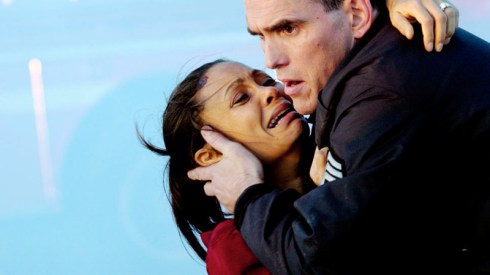
Written and directed by Paul Haggis. With Matt Dillon, Sandra Bullock, Don Cheadle, Terrence Howard, Thandie Newton, Brendan Fraser, Ludacris, Larenz Tate, and Michael Pena. A Lions Gate Films release (107 minutes). At the Boston Common, the Fenway, the Fresh Pond, and the Circle/Chestnut Hill and in the suburbs.

tmp-crash
YOU THINK YOU KNOW WHO YOU ARE, but it turns out you have no idea.

In Sidney Lumet’s unheralded 1990 police drama Q&A, Nick Nolte delivers a blistering portrait of hate as a racist cop who struts through a New York City precinct with Machiavellian bravado, roasting minorities with racial epithets. No one dares touch him, not the higher-ups or his peers. The film may be about dirty cops and corruption, but underneath it all, Lumet lets us know that tribalism is alive and well in the urban jungles of contemporary society.

In Crash, Matt Dillon plays a similar character roaming an equally stark landscape, yet writer/director Paul Haggis, who sailed to the top of Hollywood’s It list after penning Million Dollar Baby, isn’t concerned with departmental politics. Instead, he slices into the racism and the elitism that are rife in America today.

Continue reading

We Are Marshall

20 Mar

We are Marshall

More than a football film

By TOM MEEK  |  December 20, 2006

In 1970, a plane carrying the Marshall University football team crashed, killing all on board. Director McG (Charlie’s Angels) tenderly re-creates the rise from tragedy as the university head (David Strathairn), an injured player who missed the flight (Anthony Mackie), and an idealistic coach (Matthew McConaughey) rebuild the West Virginia team in short order. Their biggest obstacle is the school board, which thinks it’s too soon; the upshot is that the film deals more with the nature of grief than with moving the ball downfield. McConaughey combines flakiness with optimism, and Matthew Fox (Jack on Lost) delivers the details as Red Dawson, the remorseful team recruiter, who can’t get over his decision to surrender his seat on the plane to someone in a hurry.

Bike Porn

20 Mar

Bike Porn cranks your gears in Cambridge

Blown tires?

By TOM MEEK  |  April 14, 2010

1040_bikes-main

The Combat Zone’s been cleaned up and paved over. The days of the porn-movie house went out with the Internet. But if you still want to view steamy cinema in a public setting, we have a festival for you. Provided, that is, that you’re okay with hot bike-on-bike action.

Bike Porn 3: Cycle Bound, The Backlash Tour is rolling into Boston (well, Cambridge, at the Brattle Theater) on April 21, with its fusion of fetish-fueled erotica, art-house amateurism, and bikes. Not to be confused with the Boston Bike Film Fest or the Bicycle Film Festival, this freaky tour’s curator, Reverend Phil Sano, and his posse literally roll into each of the 50 cities it is visiting, as they come in on two wheels. Often that bicycle parade collects a mass of fans and other riders transmuting the tour’s arrival into an impromptu carnival on wheels.  Continue reading

Get Carter

20 Mar

R: ARCHIVE, S: MOVIES, D: 10/12/2000,

Get Carter

Sylvester Stallone trying to fill the thespian shoes of two-time Oscar winner Michael Caine? That’s what this remake of the mod 1971 British noir is all about. Caine even gives it credibility by lending his mug to a supporting role. At least Sly doesn’t try out a cockney accent — the setting has been transposed to cyber-hip Seattle, where his Jack Carter, a heavy for the Vegas mob, has returned home for the funeral of his brother. The alleged car accident doesn’t play well with Carter’s instincts; he suspects foul play and starts poking around. Caught up in the gnashing revenge mix: Miranda Richardson as the widow in mourning, Rachael Leigh Cook as her punked-out daughter, Mickey Rourke as the porn king, Alan Cumming as the flamboyant start-up geek, and Caine as the avuncular overseer with a hidden agenda. The aged Stallone, robotic and thuggish, is almost admirable, and Stephen Kay’s direction is visually slick, but the insipid dialogue and inane plot development do him in. Why would anyone attempt a straight-up remake of one of the truly great British gangster films? I just don’t get it.

— Tom Meek

Blood and Wine

20 Mar

R: ARCHIVE, S: REVIEWS, D: 02/20/1997, B: Tom Meek,

photo


Sterile ‘sequel’

Rafelson’s Blood & Wine runs thin

by Tom Meek

BLOOD & WINE. Directed by Bob Rafelson. Written by Nick Villiers and Alison Cross, based on a story by Rafelson and Villiers. With Jack Nicholson, Judy Davis, Michael Caine, Stephen Dorff, and Jennifer Lopez. At the Nickelodeon, the Harvard Square, and the Circle and in the suburbs.

Bob Rafelson and Jack Nicholson mesmerized audiences with Five Easy Pieces in 1970; two years later they struck again with the bitter, dark The King of Marvin GardensPieces featured Nicholson as the kind of self-concerned, sardonic antihero that was so prevalent at the time (The GraduateEasy Rider). In Gardens, Rafelson took a chance and cast him as the introverted, intellectual brother opposite Bruce Dern’s pie-in-the-sky shyster — a gonzo role that seemed tailor-made for Nicholson’s on-screen persona. Now, some 25 years later, Rafelson and Nicholson have reunited to conclude an unofficial trilogy that journeys through the veins of dysfunctional bonds.

For all that Blood & Wine is a complex and engaging drama, it feels contrived.Pieces and Gardens flowed naturally; here Rafelson seems to struggle with the standards of ’90 sensationalism. Nicholson’s Alex Gates, a Miami-based wine merchant, is a one-dimensional character: he’s on the brink of financial ruin, his marriage is in shambles, but he continues to indulge in a life beyond his means with a sporty BMW and a sultry mistress.  Continue reading

Boxing Gym

20 Mar

Review: Boxing Gym

Frederick Wiseman serves up blood, sweat, and hypnotic cadences

By TOM MEEK  |  November 11, 2010

Whatever his subject matter, documentarian Frederick Wiseman has always been concerned with blood and sweat. La Danse, his 2009 look at the grueling rehearsal routine at the Paris Opera Ballet, is emblematic. Boxing Gym moves in a similar direction as he sets up his camera in a dingy Austin establishment. Owner Richard Lord, a former boxer with a Texas drawl and a rattail, treats all his patrons (pros and amateurs who span sex, age, race, and socio-economic strata) with equal care and respect. And despite the violent nature of the sport, Lord’s dogma of rhythm, footwork, and conditioning is delivered in a calm, avuncular tenor. Wiseman records the rituals of repetition (speed bag and footwork) in poetic long shots that often have two pugilists side by side, each unaware of the other. The cadence is both primal and hypnotic.

Bullworth

20 Mar

R: ARCHIVE, S: MOVIES, D: 05/21/1998,

Bulworth

Warren Beatty’s brave, if ramshackle, political farce tackles the dirty business of racial inequality and corporate greed with the tenacity of a pit bull. As Senator Jay Bulworth (named loosely after Teddy Roosevelt’s Bull Moose Party), Beatty, who also writes and directs, plays an extension of himself: a Kennedy liberal in the ’60s, now disillusioned by the political environment of the ’90s, where big money and favoritism suffocate activism and social advocacy.

Sick of all the hypocrisy and in the midst of a re-election campaign (it’s 1996, as Dole and Clinton duke it out), a sleep-and-food-deprived Bulworth makes a back-room deal for a $10 million life-insurance policy to benefit his daughter, then takes out a contract on himself. His imminent demise gives him the freedom to speak his mind: he tells the parishioners of a black South Central church to “put down their chicken wings and malt liquor”; he calls a group of Beverly Hills entertainment executives “big Jews” and brands their product “crap.” From there Bulworth angles his moral rebirth as a “White Negro,” pursuing a sultry flygirl (the always alluring Halle Berry), hanging out at hip-hop clubs (where they mistake him for George Hamilton), and even taking on a pair of racist cops, but the funniest incarnation comes when the middle-aged white guy starts rapping his anti-big-business sentiments at a chi-chi fundraiser.

As a piece of social commentary, Bulworth has an edgy, in-your-face texture somewhere between Network and Do the Right Thing. And though the plot contrivances — like the self-initiated hit — are old-hat, the dead-on performances, Vittorio Storaro’s kinetic cinematography, and Beatty’s nervy social agenda make this film a provocative tour de force in political incorrectness. 

— Tom Meek