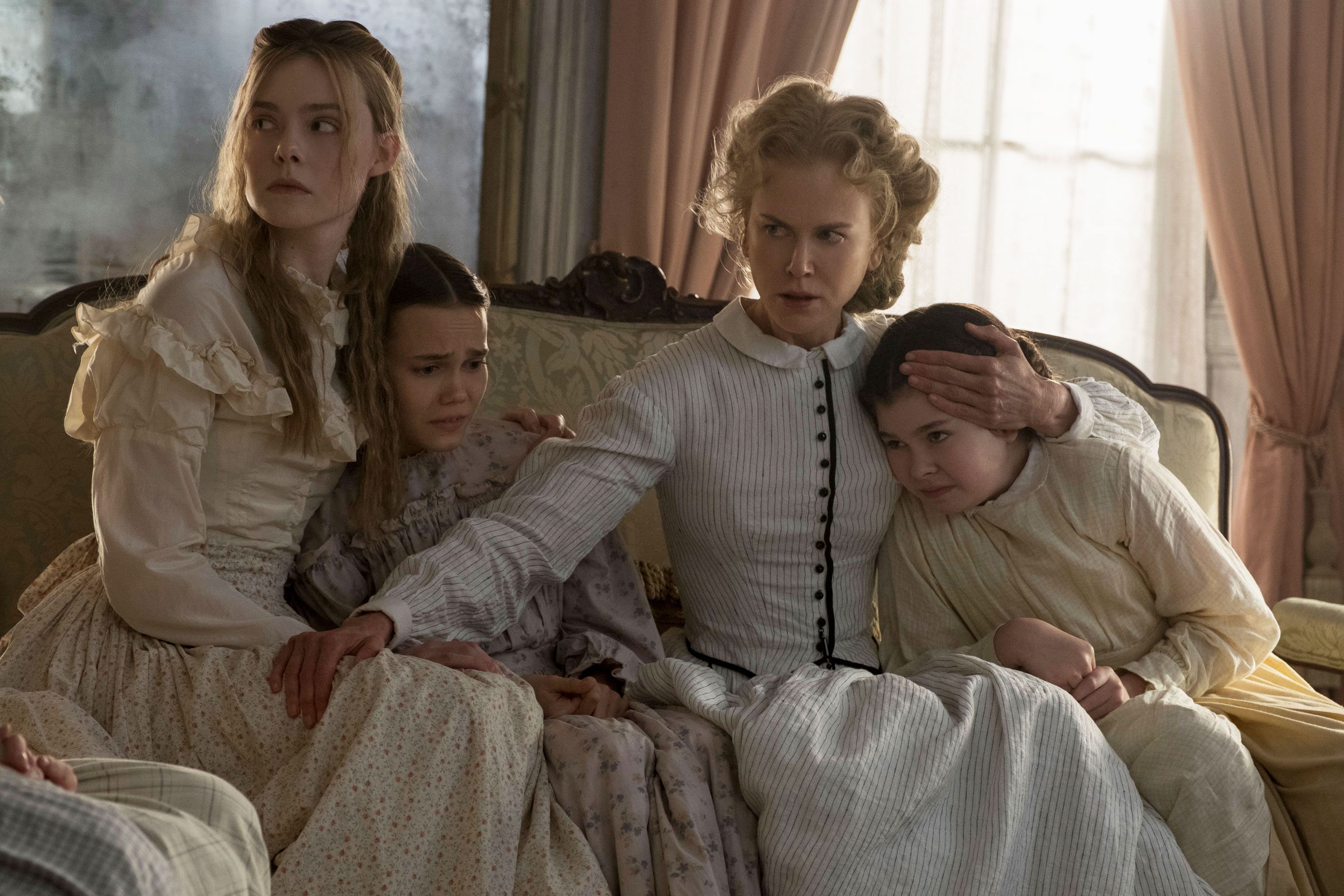
Given Sofia Coppola’s penchant for strong female characters and repressed sexuality, be it the pairing of Bill Murray and Scarlett Johansson in Lost in Translation (2003) or the alluringly perverse texture of The Virgin Suicides (1999), it somewhat makes sense that she set her sights on remaking Civil War Gothic The Beguiled, which starred Clint Eastwood and Geraldine Page. That 1971 film, based on Thomas P. Cullinan’s novel The Painted Devil was directed by Don Siegel — who would later that year pair with Eastwood for the maverick cop avenger fantasy Dirty Harry — who mined Eastwood for all his macho virility as a Yank soldier, wounded behind enemy lines and brought to an all-woman seminary to recuperate. Given the prim nature of the house, the sheer presence of male pheromones wreaks havoc on the females’ sensibilities as Eastwood’s Corporal John McBurney proves to be a feral manipulator, having his way with several of the women and even pitting them against one another. Coppola’s version throws a dash of saltpeter on the role here undertaken by Colin Farrell who turns the good corporal into a more humane, less lurid incarnation.
You’d think a softer touch might educe a deeper plumbing of the complex emotions that get brought to the surface by war, strictly imposed Christian values, and a member of the enemy — and the opposite sex — lying in the very next room, but that doesn’t necessarily prove to be the case. Coppola chases authenticity in small, subtle strokes. Siegel took a far different approach, creating something of a psychological thriller, inserting gauzy fantasy sequences and quick intercuts of the lean Eastwood in bed with one of the lasses as horror etches across the faces of the estate’s matrons attuned to the meaning of the giggles and bumps echoing from the far reaches of the house. The film, a box office disappointment that was to prove Eastwood’s range beyond revenge westerns, bordered on near spectacle, but it possessed an edgy energy that never flagged. Continue reading

 A peek into the Magic 8 Ball says yes.


 As Gray’s account (based on David Grann’s


 Things begin promisingly enough when Scar-Jo’s Major rises elegantly out of a synthetic pool, the first cybernetic organism manufactured by the Hanka Robotics corporation. Major’s a leap forward in human and technology fusion (the flesh and steel body being the “shell,” with her computer-infused brain the “ghost”), yanked from her scientific incubators (a matronly Juliette Binoche among them) and appropriated as a weapon to fight cyberterrorists. The target du jour is an elusive entity known as Kuze (Michael Pitt), who’s out to hack Hanka and the government to pieces. Major’s barely out of the lab when we get a glimmer of her prowess, leaping from a tall building and taking out a room full of assassins with barely a hair out of place. It’s a fiery, kinetic jolt that perhaps comes too early for its own good. The shell in which the film operates becomes quickly inconsistent in tenor and tone, bouncing from somber, semi-serious oppressive future vision (back to “Blade Runner”) to hyperbolic free-for-all and, in the process, uproots the prospect of suspension of disbelief.
 For What it's Worth