Liam’s Lunches of Love

7 Jun

Mission of feeding homeless Lunches of Love leads Liam Hannon, 12, to GoFundMe fame


Liam Hannon, 12, begins a weekly food distribution in April to the needy in Carl Barron Plaza in Central Square. (Photo: Scott Hannon)

This week, 12-year-old Liam Hannon speaks before a worldwide gathering of top brass from GoFundMe, the for-profit crowdsourcing platform that hosts charitable causes and promotes do-gooders. Liam, a Central Square resident who’s become something of a celebrity for providing free lunches to the hungry and homeless each weekend, will be one of the “young heroes” attending the internal conference in San Diego to share his mission, success and vision – and beyond his years, boy, does the kid has vision.

A sixth-grader at the Putnam Avenue Upper School who is quiet and introspective beyond his years, Liam has served more than 4,000 free lunches to the hungry in the three years since launching Liam’s Lunches of Love. Inspired by his father Scott’s journey to Standing Rock, North Dakota, to protest a pipeline being sent though Native American lands, he started the venture with just 20 lunches packed into a small wagon. “I was nervous,” Liam said.“I didn’t have to be nervous, because they were thankful.” 

Scott and Liam Hannon prepare sandwiches for distribution in August 2017. (Photo courtesy of Scott Hannon)

Liam’s Lunches launched with PB&Js in hand-decorated bags; as word of the mission spread and the volume of lunches delivered grew, kids from across the country joined in by sending in hand-decorated bags to help the cause.

Almost every Sunday, Liam and Scott Hannon spend two hours preparing and packaging the meals before setting out to Central Square’s Carl Barron Plaza and, subject to time and logistics, making their way up to the Cambridge Common. “Never,” said Scott Hannon of those they serve, “has any of them ever asked us for money. Never.” The Hannons describe the project as being “judgment free.”

Liam’s Lunches of Love used a smaller cart upon starting in 2017. (Photo: Scott Hannon)

The lunches evolved into more easily mass-produced hot meals such as mac and cheese, soups and pasta. Because the cost of the lunches runs over $200 per weekly offering, Liam and his dad eventually launched a GoFundMe campaign. One of the early requests was for “a bigger wagon,” which pulled in a few hundred dollars. But awareness of Liam’s mission grew – Liam, who shuns the spotlight, has become the subject of media attention, including an award presented to him by actor John C. Reilly and Anderson Cooper nationally on CNN as well as local TV blurbs, a featured spot on a GoFundMe podcast and an appearance at a Celtics game – and the purse for Liam’s Lunches of Love skyrocketed to several tens of thousands of dollars.

A bit of help comes from GoFundMe itself, a company representative said. “We do this on a regular basis as part of our internal GivesBack program where every week, employees nominate a GoFundMe campaign that touches their heart, and if selected, a donation is made to that campaign,” the spokesperson said.

“Any time we get the opportunity to meet these extraordinary people in person, we not only welcome it, but look forward to it. These are the people who make all of us excited to come to work each and every day,” the spokesperson said. “We’re excited that one of our GoFundMe Kid Heroes will be spending time with our employees as we bring our GivesBack program to life.”

Asked about his classmates and the exposure he has received, Liam said, “Some of them help out, but most don’t really know about it. I don’t really talk about it.”

Liam sees his project growing even more. To that end, one goal he’s shooting for is the ultimate bigger wagon: a food truck. The father and son imagine free meals for the needy, quality food for pay for those who have means and jobs for those who need them.  “I want to stick with the model of going to them,” Liam said.

Godzilla: King of the Monsters

29 May

‘Godzilla: King of the Monsters’: Reunion time for earth-shaking titans, humans underfoot

By Tom Meek

Who knew that “Godzilla: King of the Monsters” was a Boston movie? I won’t say how much it is, but I will say that the oldest ballpark in the country (RIP Bill Buckner) and that iconic high-rise so eloquently framed in a semi-famous short story by John Updike make it in there – and then some. The Japanese-launched franchise has matured to full CGI fury, improving on the effects in versions from 1998 and 2014 and certainly from its 1950s beginnings, when miniature models of Tokyo were stomped by a man in a rubber suit. (Let’s call those the MIRS years.)

The tagline is the same as in 1956, when American actor Raymond Burr (“Ironside”) lent his American mug to an early Japanese MIRS entry. Here, the film picks up five years from when “Godzilla” (2014) left off, namely the leveling of San Francisco, with all “titans” now neatly in hibernation. Some players from that chapter (Sally Hawkins and Ken Watanabe) reprise their roles as scientists, appearing before congress to try to derail plans to exterminate Godzilla and the other titans – while in hibernation, a cryptozoological agency known as Monarch has pretty much put all the beasts in an electronic lockdown. We also meet the Russells, a family of Monarch scientists fractured by the loss of their son in the stomping of San Fran. The father, Mark (Kyle Chandler, so good in “Manchester by the Sea” and “Zero Dark Thirty”), unable to cope with the grief, has gone off to film wolves in the wilds, while wife Emma (Vera Farmiga) and daughter Madison (Millie Bobby Brown, from “Stranger Things”) are nestled in a forest abode near one such titan bunker where they witness the larval birth of Mothra.

Before the flaming pterodactyl Rodan and three-header King Ghidorah – aka Monster Zero – make it into the mix, of course we need some zany zealot to bring down the boom. In this case that’s a former British special ops officer played with charm and menace by Charles Dance, who has had an awakening of his own and sees the only way to right humankind’s environmental wrongs being to raise the titans and let them cull the population. Much philosophical talk is made early on about man being an infection, and the titans something like white blood cells to take care of it. Sure, okay, nothing new: The original Godzilla was an incarnation raised by man’s use of nukes and nuclear energy, so the themes imbued here by writer/director Michael Dougherty seem in line. And a little biorhythm device Emma has made (the thing everybody wants) has the monster-whispering effect that the two thumb-sized Japanese twins had in the old MIRS flicks.

But this is a big CGI flick, seen to good effect as Brazil gets bowled over by Rodan and Ghidorah (which, given all the talk of infections and viruses, sounds even more like an STD) gets awakened from his icy crib. Boston, home of the Russells, hosts a Godzilla-Ghidorah smackdown – and if some of those new high rises in the Seaport irk your aesthetic eye, here’s a shot at some virtual schadenfreude.

The film does what it needs to. The trio of lead actors manage to elicit enough emotion and Godzilla, a hero whose mission and morals are as straightforward as Clint Eastwood’s indelible “Man with No Name,” gets to don the superhero cape, if just for a small while. It’s bang-bang fun that clicks by with smart, rapid pacing, all the while reminding us of just how much a mess we’ve made of this planet.

Blockbuster

26 May

BLOCKBUSTER • BY TOM MEEK 

They were on their way to buy wine and cheese and pick out a movie at the video store. It was his first time meeting her parents and he wanted to impress them even though she had said they were the cause of all her problems. He didn’t know what her problems were; she was tall, angular and adored. He had worked hard to gain her favor after they met on a whitewater rafting trip. He took her to arty movies that he thought were like the ones he had heard her talk about and cooked her the kind of dishes he saw in the magazines on her coffee table. She took him camping and skydiving and they made love in the woods on moss covered logs and rocky outcroppings overlooking the city.

“Alcoholics and liars,” is how she described her parents. He expected horrible people, but they were nice and welcoming during the brief five minutes they popped in to drop off their bags. “Maureen says you have great taste in movies,” her mother said giving his arm a gentle squeeze, “Why don’t you pick something out for us.”

They sailed down a country road past artfully masoned walls and immaculate lawns. There wasn’t a rogue leaf anywhere.

“Here! Here!” she said tapping on the dashboard frantically. “Turn here!”

He swerved hard right, the font wheel left a muddy rut across one of the manicured lawns. The Corolla skidded back onto the road and righted itself.

She tugged on his sleeve. “See that house up there?”

Up a long rolling lawn dotted with boulders sat a large stucco structure.

“A murder happened there, about three years ago. A doctor and his wife, who had just moved here from India, got hacked up by their own meat cleaver.”

“God that’s grim,” he said, “I hope they got the guy.”

“They did, but they shouldn’t have,” she said explaining that a boy she knew from school who grew up in the house and was abused by his alcoholic father, had gotten drunk and broke into the house. “They couldn’t figure it out for a long time,” she said, “but he was trying to get clean and said something at an AA meeting and somebody went to the police.”

“Sounds like they did the right thing.”

She slapped the dashboard. “That’s not the the point, godammit!”

“Okay, then what is?”

“AA’s all about recovery and having a system of trust. They violated that trust. It was wrong.”

“C’mon, Mo, it’s not like attorney-client or anything like that.”

“He was getting help, he was finally clean.”

“What are you saying? That his recovery is more important than their lives? That it justifies murder?”

“I didn’t say that.”

“Well, then, what?”

She slumped hard against the passenger door. “You just don’t get it, do you?”

The Corolla crested another hill. Below he could see the neon blue from the video store. He wondered what he should pick. He knew he had to choose wisely.


***

(published May ’19 in Everyday Fiction)

Booksmart

25 May


Image result for booksmart

To say Molly’s a bit of an overplanner would be an understatement, but to date things have mostly worked out – she’s in at Yale. We catch up with the library-loving pair on the eve of graduation, when reality comes crashing in on their four-year abstinence. Molly, in the pleasant surroundings of a coed bathroom, learns that many of the partying jocks and popular girls also got in at their first choices – Stanford for the handsome A-Rod clone, and a much-scorned “easy” girl is also heading to Yale. Talk about a bucket of ice water, let alone a water-filled condom hurled in the hallway that finds its viscous mark. A quick re-eval and Molly decides that the two must hit the most hip and happening party that night to notch “a seminal fun antidote” and that smooch for her BFF who has her eye on a certain someone. 

Directed by actress Olivia Wilde (“Beer Buddies”) making her feature filmmaking debut, and imbued with sharp, witty dialogue by a quartet of female writers (usually not a good sign when there’s a phalanx of penners, but that’s not the case here), the film rides the rails of many a teen comedy that’s come before – the seminal works of John Hughes, “Fast Times at Ridgemont High” and recents and darker films such as “Lady Bird” and “Eighth Grade” – namely that amid all the teenage hijinks, it’s really about friendship and support during the throes of those angst-filled, defining years.

Even if “Booksmart” pushes a few gags too far, it’s pleasantly smart and silly from start to end. Some of the best moments play off the young ladies’ yen for different genders. Take Amy’s wide-eyed Christian parents who think Molly and their daughter might be an item: Molly seizes just about every opportunity to play up the angle, mostly in the form of overzealous hugs that include conspicuous breast cupping. Then there’s the goofy reveal of self-pleasure items (not all treasured childhood toys remain in their innocent past) and Amy perusing porn in a Lyft driven by the moonlighting school principal for “educational purposes” (what to do with another girl). Add to the mix Billie Lourd and Skyler Gisondo as the school’s two super-rich eccentrics (Gigi, the ubiquitous teenage acid queen, and Jared, a yacht-owning loner and wayward romantic) and you have a rich potpourri that’s full of pop and zing. The romance takes some unexpected turns too, and in the end “Booksmart” is as much of a heart warmer as it is a tummy tickler. It’s not entirely polished, mind you, but the rough edges are small and easily forgotten with the infectious and palpable chemistry between Dever and Feldstein. Not enough can be said about their value to the film’s success – their dynamic duo and Wilde, playing it all just off-center, have made familiar tropes new and wickedly relevant again.

Non-Fiction

18 May

‘Non-Fiction’: Léonard writes what he knows, which is philandering and a great deal of chat


Image result for non-fiction movie images

Ah, a baguette, warm and chewy and oh so very French. You can feel and taste it, and that’s how “Non-Fiction,” the latest from Olivier Assayas (“Clouds of Sils Maria,” “Summer Hours”) goes down, with copious crumbs of provocative dialogue falling from the lips of a few not so discreet but very charming members of the bourgeoisie.

Those under Assayas’ lens are not your typical ilk. Bearded, wild-haired Léonard (Vincent Macaigne) pens the happenings in his life – just ask his ex-wife – under the guise of fiction, pouring sauce on it the way Bukowski and Mailer did. He’s not so much the macho brute those other two postured to be, but he does pursue sensual pleasure at others’ expense; for years he’s been bedding Selena (Juliette Binoche), the wife of his publisher Alain (Guillaume Canet). Selena’s no bored “Belle de Jour,” as in her day job she plays a policewoman (more like Frances McDormand from “Fargo” than Angie Dickinson) in a popular TV series. Then there’s Valérie (Nora Hamzawi), Léonard’s live-in girlfriend who’s a political aide. And, not to complicate matters, but Alain’s carrying on with Laure (Christa Théret), a fresh young face in the office who’s also the face of the future; she’s been brought in to take the publisher boldly into the digital age.

Beyond that tangled web of sexual allegiances (which is plenty), there’s not a lot of rising dramatic tension. The four mains mostly consume wine and talk with banal disregard about life, the increasing allure and power of social media and, as Carver would have it, love. There does come a point in the film when Selena realizes that Leonard, who can’t help but pour himself outward onto a page, might share some of their (not so) private moments – take the public sexcapade in a movie theater – with his readership. Along the way, a political scandal and the films of Michael Haneke and Luchino Visconti find their way into the mix, and Binoche get a smartly imbedded meta moment that Robin Wright in her “The Congress” endeavor (2013) would surely appreciate.

If there’s one thing nearly all of the quartet seem concerned with, it’s straight-up change, fearing or embracing it and what it means for their futures. At one point a character pulls a line from Visconti’s “Leopard” (“Things must change in order to remain the same.”) to put it all into context. The film itself does exactly that, never waning, not even during the long awkward pauses. It’s a French film loaded with cinematic references that will serve as a double feast for cineastes. Assayas may have gone a touch off course with his last film, a ghost story starring Kristen Stewart, “Personal Shopper,” but it’s good to see him back. Not enough can be said about the cast – Binoche and Théret provide the most to chew on, but this is an ensemble effort. Talking in circles like this hasn’t been this much fun since “My Dinner With Andre” (1981).

Aniara

18 May

‘Aniara’: Another trip to deep space goes awry, a getting away from it all that demands escape

Image result for aniara images


Much of this sleek Swedish sci-fi flick may feel borrowed from the recent, grim “High Life” from the unlikely source of Claire Denis, but its roots go back to the similarly named 1956 poem by Nobel laureate Harry Martinson. Like Denis’ contemplation on loneliness, lust and what constitutes law and righteousness beyond the outer limits, “Aniara” dumps us aboard an outer space cruise ship occupied by souls from wildly varying social strata. The vast voyager comes replete with discos and gourmet eateries, but it is not a vacation, not by any means. Those aboard are en route to a Martian colony because Earth has become uninhabitable.

Not long into the journey something goes bump, and The Aniara gets knocked off course and on a trajectory out of the solar system and into deep space. The initial projection of two years to get the engines back to full capacity and get back on course comes as a bit of a bummer – it was supposed to take three weeks to get to Mars – but hey, they have unlimited algae, so all’s good, right? No. Plans don’t go accordingly, timelines shift, cults form and society devolves into chaotic semi-lawfulness. Think Ben Wheatley’s adaptation of J.G. Ballard’s 1975 dystopian novel “High-Rise” (2016) and you’d have the right idea.

It’s a piquant setup and something of an existential exercise, pitting hope against the torturous throes of not knowing. As adapted by first-time feature filmmakers Pella Kågerman and Hugo Lilja, the time-hopping narrative orbits around a strawberry-haired woman blessed with the gender opposite moniker of MR (Emelie Jonsson). MR proves quite the gravitational point; she’s the tech who runs the mental relaxation room known as Mima. The small, seatless amphitheater’s something like your favorite bar and bartender without the hangover – kind of: While resting in an inverted yogi Savasana pose, waves of flame shoot across the ceiling of Mima while visitors in their hyper-relaxed state take walks along the beach or a stroll through a verdant forest. In short, they get to go to their happy place. As the reality of return becomes increasingly glum, the demand for Mima spikes. And even there, the prospect for virtual escapism begins to become something of a shop of horrors.

The catch with “Aniara” becomes its overly ambitious scope, which begs for the razor eye of a master (say Kubrick or Tarkovsky); Kågerman and Lilja get the grandness and wonderment of the universe beyond right, but their chapter-esque jumps in time tend to break apart what came before. MR ultimately pairs up with fellow female crew member Isagel (Bianca Cruzeiro), so there’s something at risk emotionally and we’re reassured that true human companionship bears more value than a visit to Mima – phew. Years out, as prospects gray and the suicide rate skyrockets, folk still party like its 1999, engage in ritualistic orgies and even bear babies. Is it sustainable? It turns out space is a very cold place to contemplate time.

Trail by Fire

17 May

‘Trial by Fire’: On death row after arson trial, but he finds a new hope (if not a new story)


Image result for trial by fire images movie

Anti-death penalty films tend to land far and wide. There are hits (“Dead Man Walking,” “The Green Mile”) and misses (“The Life of David Gale”), much of it hinging on degree of subtlety vs. preachy, manipulative overtones. Sure, the talent involved matters, but so do tenor and posture. “Trial by Fire,” from Edward Zwick (“Glory” and “The Last Samurai”) lands closer to the “Dead Man Walking” side of the field than sermonic foul territory. It’s something of a nifty crime drama too.

Adapted from David Grann’s haunting 2009 “New Yorker” article of the same name, “Trial by Fire” plays us for our stereotypes the way a courtroom might. Two days before Christmas 1991, in a poor Texas ’burb, Cameron Todd Willingham (Jack O’Connell), a man with a bedraggled mullet, pentagram tattoos, no job, no education and several run-ins with the law on his record, watches his house go up in flames with his three baby girls inside. Later that night he’s drinking at the bar and playing darts, reveling in all the donations that have rolled in. 

It’s not pretty, and next comes sordid details of his marriage (wife Stacy, played by Emily Meade, was at work at the time of the fire). It all comes out in the courtroom after investigators examining the remains of the charred house – one expert articulating, “Fire doesn’t destroy evidence. Fire creates evidence” – deem it an arson-engineered death trap and charge Willingham with the crime. 

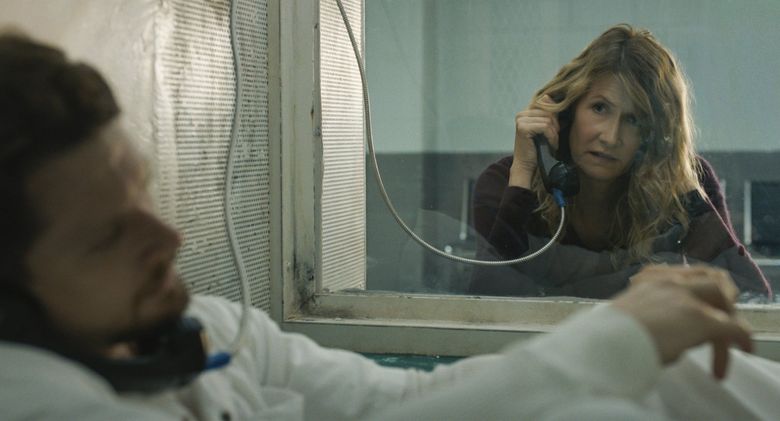
As the film sets it (or us) up, Willingham’s guilty as hell – and just like that, off to death row he goes. The script by Geoffrey Fletcher plays with time and our sensibilities as it goes along. Willingham’s trial lawyer seems competent during the initial defense, but not so in a rewind, and then there are the shifting accounts from eyewitnesses (we saw what they saw, and they tell it differently on the stand). It’s enough to cast doubt but not enough for a retrial. Willingham and the film get a big boost when Laura Dern’s Elizabeth Gilbert (not the “Eat, Pray, Love” author), a compassionate single mother with two teens, embarks on a letter-writing relationship with Willingham and jumps in on his defense. 

O’Connell, a British actor (“Unbroken”) whose stock should rise in the wake of “Trial by Fire,”  does an affectingly palpable job of selling us on his transformation into a more educated and balanced person behind bars. Meade and Dern are likewise commendable. It’s a heavy film with a heavy agenda that lets us know that Texas executes five times as many death row inmates as the next death penalty state, and Project Innocence gets rolled in too. It’s not overtly (and unnecessarily) manipulative until late in the game. Its points about the weaknesses of the justice system are provocative and real considerations to deliberate. 

Rafiki

10 May

‘Rafiki’: Kenyan love story is rife with politics, including a true-life oppression of gay culture


There’s a lot of stuff to talk about before getting to the cinematic merits of “Rafiki.” The film, about two lovers from opposing political families, is reminiscent of “Romeo and Juliet,” and the Swahili title translates to something innocuous and good (“friend”); neither are the reason for the film’s notoriety. “Rafiki,” directed by Wanuri Kahiu, was the first film out of Kenya to make the lineup at the prestigious Cannes Film Festival – and on the uglier side, was banned in that country, Kahiu’s homeland, which still has (but is debating repealing) colonial-era laws making homosexuality illegal, punishable by up to 14 years in jail.

The reason for the film ban wasn’t explicitly those antiquated and oppressive laws, but because it portrayed a same-sex couple in a positive light. “Homosexuality is a reality,” a film board member said regarding the decision, “What we are against is the endeavor to show that as a way of life in Kenya.” Kahiu was asked to alter the ending – but refused and sued. A judge ultimately flipped the decision, writing, “I am not convinced that Kenya is such a weak society whose moral foundation will be shaken by watching a film depicting a gay theme.” 

Beyond the courtroom brouhaha, the film still serves as badge of courage and perseverance for the Kenyan LGBTQ community for residing under such duress. At the heart of Kahiu’s film, which is based on the short story “Jambula Tree” by Monica Arac de Nyeko, are two young women with different ideals. Kena (Samantha Mugatsia) has plans to go to nursing school, while Ziki (Sheila Munyiva), a wide-eyed free spirit blessed with cool, colorful dreads, wants to break out and explore the world. In their first encounter Ziki pooh-poohs Kena’s mundane aspirations and encourages her to raise the bar. It’s love at first witty barb, but if the inherently hostile nature of the social climate doesn’t provide a big enough obstacle, their fathers’ political rivalry jockeying over a council seat threatens their blissful budding even more.

The pair’s palpably felt companionship – the realization of that rare human connection with someone who gets you, thoroughly and intimately – is the heart and soul of the endeavor, and what makes it such a joy. Given the glum setting in “the Slopes,” a term for the seedy outskirts of Kenya’s capital,“Rafiki” would be an entirely different film without this notion of hope. Perhaps it would be as moving (unlikely), but sadly so, as only a reminder of barren prospects and the pointlessness of dreaming. 

It’s a good thing Kahiu didn’t back down on her principles. For Westerners, her portrait affords a look inside a culture and a country we’re not normally exposed to. To all, it’s a potent reminder that such practices of open oppression still exist. And inside that country, it’s most definitely a demand for progress.

Shadow

10 May

‘Shadow’: Things aren’t just black and white for dynasties preparing a bloody red rematch

Image result for shadow yimou

Before Chinese director Zhang Yimou got into wuxia-infused dynasty dramas (“House of Flying Daggers” and “Hero”) he wove provocative, intimate tales of personal struggle (“Raise the Red Lantern,” “The Story of Qui Ju” and “Not One Less”) that edged into the political (one, “To Live” was banned in China). In 2016, perhaps rattled by the ascent of Trump in American politics, he jumped the shark with the “The Great Wall” a cockamamie actioner with Matt Damon and Willem Dafoe checking in as Western avengers of sorts saving China from a horde of ravaging monsters. Yeah. The good news – and it’s relative, mind you – is that Zhang’s latest, “Shadow,” marks a return to form, even if the plot is something of writhing nest of snake to untangle.

Somewhere in an ancient “great walled” country (clearly China, but fictitious, nonetheless) two clans remain at uneasy odds after ganging up to conquer a vying third. The Yan and Pei dynasties decide to settle who rules the lands by setting forth their best warrior in a winner-take-all contest. During that cage match the great legionary for the Pei, Zi Yu (Chao Deng) is wounded severely, but all the Yan take in victory is an impregnable mountainside city.

If that already feels like a lot to chew on, it’s just the backstory. In the now, the Pei king (Ryan Zheng, serving up a wonderful rendering of feverish instability) is something of a delusional fop who favors political appeasement by marrying off his sister (Xiaotong Guan) to the young Yan prince (Lei Wu). It’s an idea she despises, and with cause. To make matters more complicated (can they be?), there’s a more central thread about the Pei king and his “shadow,” a double named Jing Zhou (also played by Chao, pulling off the double duty with aplomb). That’s right, quicker than you can say Jean-Claude Van Damme or “Double Impact,” in a dank subterranean cave, the wounded warlord – slender, hobbled and disheveled, also with a dash of madness – trains his doppelgänger for a grudge match with the victorious Yan warrior. Then there’s the matter of Zi Yu’s wife, Madam (Li Sun) and the budding of a romantic triangle. More plots within plots.

It takes nearly half the film before Zhang delivers the anticipated hyperkinetic goods as the Pei, armed with razor-barbed umbrellas, literally slide into the Yan city and duke it out with their halberd-wielding rivals. What’s most noticeable throughout the film is the palette Zhang and cinematographer Xiaoding Zhao choose: Everything’s dank and drab, black or white or some washed out shade of gray – I’m not sure there’s ever an outside scene when it’s not raining – except for gratuitous spurts of crimson blood. Part of that choice is clearly thematic, most visually obvious when the two warriors fight atop a black and white, yin-yang symbol. The obvious representations of the forces of light and darkness are not, in this case, explicitly just good and evil, but more the nuanced contemplation of madness and corruption versus loyalty and a just rule.

Zhang has cited Kurosawa as major influence, and you can see it clearly on display in “Shadow.” It’s also got Shakespearean bones, but it’s no “Ran.” (Few films are.) While it’s better than an also-ran, the serpentining plots within might give you a touch of head spins before the gorgeous, grand spectacle of battle, dueling zithers and venomous final bow.


Of Start Ups and Pop Ups

8 May

Pop-ups such as Community Phone fill a void where view could be long-empty storefronts


John LaGue, with business partner James Graham, has moved Community Phone, a small phone service provider, into pop-up space in Harvard Square: a former Starbucks on Church Street. (Photo: Tom Meek)

Community Phone, a small phone service provider, has been in pop-up digs in the heart of Harvard Square for three months now, and may be out on the street by midsummer. That might be nerve-racking for proprietors with tightly focused strategic plans and warehoused inventory; the youthful founders of this startup aren’t worried at all. They’re month to month in the old Starbucks coffee shop on Church Street and, like the low-cost cellular plans they offer and tailor to customers’ needs, are adaptable, lean and flexible.

The company, incorporated more than a year ago by James Graham and John LaGue, 20-something Wisconsinites, began hawking its product on the street, but with help from the Harvard Business Square Association and executive director Denise Jillson, reached an agreement with 31 Church St. landlord Janet Cahaly. She had her own motivation: not having a storefront vacant for a long time before finding a longer-term commercial tenant that would pay market rates.“Landlords really do want to do the right thing,” Jillson said.

The Starbucks closed in November, while the Cambridge Artists Cooperative down the street announced in April it can no longer afford to stay in Harvard Square and will be gone by June 30. A basement-level Fire + Ice restaurant that closed in September 2016 has yet to be filled – though its signs are still up. The clothing store LF closed on Church Street, telling The Harvard Crimson that “Harvard Square is not a shopping destination anymore,” while keeping a Newbury Street location in Boston.

Community Phone, whose customers have an average age around 58, has installed a rotary phone to help test customers’ mobile phones. (Photo: Tom Meek)

Community Phone buys service wholesale from cellular networks such as AT&T and Sprint and passes savings on to end users. What’s special is the customer service, LaGue said. “There’s no waiting on a phone or in a long in-store queue. You just walk in and talk to one of us,” he said, literally helping an octogenarian with a cane enter to ask a question. “Plus it’s 100 percent hassle free. You don’t have to do anything – we take care of moving your plan and setting you up.”

The space is inviting, spartan yet cozy, with crate-like barriers and a café ambiance. Up front, a giant stuffed bear – nearly twice the size of an adult – greets customers, and old Starbucks Christmas decorations still frame the large window pane. The store keeps a classic rotary-dial phone (operating off the cellular network) on hand to dial the mobiles they set up, a way to test a plan and phone activations.

Community Phone’s primary aim is to make cellphone use affordable and simple. “Many of our customers are people over 55 who aren’t tech savvy,” and the average customer age is around 58, LaGue said. The other side of the customer base, now a few hundred thousand people, is small businesses and students who aren’t on family plans. The company offers flip phones in the $20 range, but also iPhones and other high-end smartphones with plans as low as $15 for unlimited calls and texting.

The real killer is data costs; LaGue cited an example of couple with a $240 monthly cellular bill. “They had a big data plan but hardly used much of it.” By dialing back the data plan and creating a family account, LaGue was able to cut their costs to less than $40 monthly. There are no contracts with Community Phone – like the company’s housing arrangement, it’s all month to month – and should it disappear tomorrow, the network providers would take over the service and accounts, though costs would likely increase by a small percent.

The company is looking to expand and offer new products, which likely means getting venture funding, LaGue said. For now, it remains on Church Street. “We are actively looking for a new location in Harvard Square, Somerville or possibly Back Bay. We are still trying to find the best way to help the most amount of people, and have several exciting partnerships in the works. No matter what, we’ll be available 24/7 over the phone and online as we always have been for our members in over 30 other states,” he said. Continue reading