Human Capital

22 Mar

‘Human Capital’: A deal goes bad all too quickly, and financial risks rise to demand untenable toll

Human Capital movie review & film summary (2020) | Roger Ebert

An Americanized retread of Paolo Virzi’s 2013 Italian adaptation of Stephen Amidon’s 2004 book about greed and small-town social politics. So it’s an American adaptation of an Italian adaptation of an American story – got it? “Human Capital” lurches out of the gates with a certain amount of swagger, and the casting is something a wonderment, even if the confluence of happenstance and direction squanders the opportunity from time to time.

The setting is a quiet upstate New York hamlet where Drew (Liev Schreiber), a middling real estate agent, drops by the manse of a hedge fund honcho by the name of Quint Manning (Peter Sarsgaard) to pick up his daughter Shannon (Maya Hawke, of “Stranger Things”), who’s dating Quint’s son, Jamie (Fred Hechinger). Quint, none too social, is in the throes of an intense doubles tennis match and irate about losing to his employees. On a whim, Quint flushes his partner and inserts Drew, an aw-shucks kind of guy who doesn’t let on that he played competitively in college. The match immediately becomes a non-contest and, as a show of his appreciation, Quint invites Drew to buy shares in his hedge fund at the reduced “family and friends” rate of $300,000 per share – nothing for even the well off to sneeze at. Drew, as we learn, is hoping for more kids with his second wife Ronnie (Betty Gabriel) and a bit tight on finances, but nonetheless jumps at the opportunity despite the high-wire entry point.

It’s clearly a bad idea, made worse when Drew takes out a loan by fudging his credentials. As if on cue, the fund takes a massive dive. Drew returns to the manse wanting his cash back, but Quint not only denies him, he shuts him out and even threatens legal repercussions. Meanwhile Ronnie’s expecting twins, Jamie develops a major drinking problem and Shannon takes up with Ian (Alex Wolff of “Hereditary”), a reclusive bad boy with a dark past. Don’t forget the opening scene, in which a young man on a bike gets blown off the road by a surging SUV, which comes back to haunt late in the game.

Yup, there’s a lot going on in “Human Capital,” but the script by Oren Moverman keeps it all grimly juggling and spinning – even if you’re given pause at how, in such a small burg, titans of industry (struggling or not) such as Quint and Drew are not acquainted, and why Drew, not being a gambler by nature, would buy in given all the upfront red flags and hurdles. The true power to Marc Meyers’ serpent-in-suburbia drama is Sarsgaard (“Shattered Glass,” “An Education”) who’s always played slippery eels with complexity and nuance. It’s hard to tell here, though, if his Quint is setting Drew up as a mark or if the timing of the deal just happens to be bad. It doesn’t much matter; Quint’s response plays like the former, as the well-heeled stockbroker moves Drew around his plate like a sprig of superfluous parsley constantly in the way. On par with Sarsgaard is Marisa Tomei, who’s not on screen nearly enough as his wife. The two are like hissing cobras dancing with each other as they look to strike, and they’re even less cordial to those who have the misfortune of getting in their way. Hawke too, as Shannon, carries a certain amount of venom that, like the other two, gets directed at Drew, a man whose fate feels predetermined from the first scene.

An Interview with Kelly Reichardt

14 Mar

Reichardt’s ‘First Cow’: Birthed of collaboration found on trail from Miami (with stops at Brattle)


“First Cow” is Kelly Reichardt’s seventh film, and second “anti-western” made in collaboration with the author Jonathan Raymond. (Photo: Tom Meek)

Kelly Reichardt’s latest, “First Cow,” an Oregon frontier saga about two outsiders trying to get ahead, marks her fifth collaboration with writer Jonathan Raymond and her seventh film overall. The film (screenplay by Raymond and Reichardt) is vastly different from Raymond’s novel “The Half-Life,” which, as Reichardt points out, “spanned four decades and two continents and didn’t have a cow in it. John invented the cow for the movie.” A fairly drastic realignment from any point of view, though the director is quick to add that the story still focuses on the bond between Cookie (John Magaro), an introverted cook, and King Lu (Orion Lee) an enterprising Chinese expat – though King Lu is a composite of two characters in the novel. The entrepreneurial endeavor the pair undertake in the book is exporting beaver oil to china; in the film, with the creation of a lone cow at a trading outpost, there’s milk and thus batter to make “oily cakes” (scones), a super hot item in a land where there is only mutton and slop.

Reichardt’s journey to the directorial chair is long and intriguing, with a crucial stop at The Brattle Theatre in Harvard Square. “I grew up in a cultural void as far as art goes, and in a family of cops,” Reichardt said. (The void was Miami.) Her mother was in drug enforcement and her father was a crime scene investigator, though they also opened her eyes to the arts. “My father listened to jazz and gave me a Pentax camera.” Reichardt got into photography, using expired rolls of film her father got her from the crime lab and taking lessons at a studio run by a notorious pornographer. Then the artist Christo came in 1983 to wrap his “Surrounded Islands” in Biscayne Bay. Reichardt, inspired by the grand installation, knew she’d have to go elsewhere to expand her cultural palette and find her calling. She landed with friends in Boston, where she studied art and film at the Massachusetts College of Art and Design and School of the Museum of Fine Arts. “But,” she added, “my real film education came at the Brattle Theatre, which played a different repertory pairing each night.”

tmp-cow

Reichardt met Raymond early in her career, becoming fast “pals” after being introduced by filmmaker Todd Haynes (“Carol,” “Velvet Goldmine” and most recently, “Dark Waters”). Both had collaborated with Haynes (“I was the one flicking the spit in “Poison,” Reichardt says of Haynes’ controversial, career-launching film) and he’s been an executive producer on most of Reichardt’s projects. After 2010’s “Meek’s Cutoff,” about my ancestor leading a posse across the Oregon desert, “First Cow” is the second anti-western by Reichardt and Raymond. “Westerns have alway been about a white man on a horse with all the power. This is about two outsiders finding a safe place with each other. They’re mindful and thoughtful, not physical,” Reichardt said.

Still, to prepare for the film, Magaro (who has a Bob Dylan-esque presence in the film) and Lee had to go through a survivalist boot camp to learn their characters’ skills, including lighting fires without matches and catching fish without hooks. “It wasn’t much fun,” Reichardt says, “because it rained most of the time.” To cast the two “mindful dreamers,” Reichardt interviewed and interacted with each actor via Skype, never meeting either in person until they were pretty much on set. Given the current state of things with the coronavirus spread, that virtual casting call feels eerily prescient: At the time of my interview, Reichardt had just been told her publicity tour for the film was being canceled, and the Harvard Film Archive was limiting the audience for Reichardt’s “in person” screenings on Monday and Tuesday to a max of 99 people. Then it suspended its spring schedule.

“First Cow” opens locally this Friday.

First Cow

14 Mar

‘First Cow’: Risks of frontier entrepreneurship go beyond financial, but milk it while you can

firstcown

For her latest collaboration with writer Jonathan Raymond, Kelly Reichardt heads back to the same Oregon frontier territory that made “Meek’s Cutoff” (2010) so narratively rich and foreboding. The time’s a few years earlier than that existential traverse; it’s the early 1820s as folks spread west, hoping for land, gold and a new way of life. Those dreams are not without hardships along the way. Take Otis Figowitz (John Magaro), a cook signed on with a rugged party of uncouth trappers who hold the threat of violence over him, even though the foraging skills of their “Cookie” are the only thing keeping them alive in the Pacific Northwest wilds. Such aggression (“When this is all over, I’m going to kick your ass for real”) don’t seem to faze Cookie, almost as if he knows something no one else does.

One night, while on a foraging run, Cookie discovers a naked man hiding among the ferns. At first he believes he’s run into a Native American, but no, King Lu (Orion Lee) harks from China and is clearly in trouble. Knowing the hostile inclinations of his fellow trail mates, Cookie provides silent aide and sustenance to King along the way. Eventually the party and King make it to a trade outpost, and that’s where Reichardt’s tale shifts from a frontier odyssey to a startup endeavor and social testament of a micro crime and macro punishment (think those affected disproportionately by drug laws). The heart of “First Cow” is the bond between Cookie and King that grows from that unselfish helping hand in the wilds to the cozy shack nearby that King invites Cookie to share and, ultimately, where they cook up a scone biz.

The “first cow” is the lone bovine on an estate outside the outpost, brought in by a wealthy bureaucrat known as Chief Factor (Toby Jones). Where there’s milk, there’s scones. Each morning Cookie sets up a cauldron of boiling oil and drips honey on his freshly fried “oily cakes” as King takes gold ingot and other tender from the line of frontiersmen hungry for a sweet taste of civilization – but to make the treats, each night the enterprising duo furtively milk Chief Factor’s cow. They’re something of Butch Cassidy and the Sundance Kid by way of Gates and Allen, with King as the brains of the operation and Cookie as his genius creator. King knows this is a limited-time opportunity before more cows and skilled chefs make their way to the remote port of commerce. Also too there’s the prideful Chief Factor who, curious as to why his cow bears no milk, commissions Cookie to make a special cake for a visiting mucky-muck. You know something has to give, but with Reichardt behind the lens you know it’s not going to go in a pat or predictable direction. Her denouements are an art form in their own right, always subtle and never registering more then a murmur on the plot-disruption scale, yet ever resonating in their lingering emotional impact. “First Cow” is no different. It’s a classic Reichardt branding that highlights the talents of Magaro and Lee, who, like Michelle Williams after her collaboration with Reichardt on “Wendy and Lucy” (2008), should see their stock rise. What the three have achieved here is one of the most unique and palpable portraits of male bonding captured on film in recent memory.

The Hunt

14 Mar

‘The Hunt’: Liberals don’t want to take their guns – because they really add zest to the human hunt

tmp-hunt

The film “The Hunt,” not to be confused with the 2012 Danish film of the same name starring Mads Mikkelsen, had been shelved by Universal last year because of sensitivity issues related to the film’s central plot of humans using other humans as prey – nothing new, but back in the day Fay Wray was in “The Most Dangerous Game” (1932) or Cornel Wilde was “The Naked Prey” (1965), Charles Whitman had yet to show the world what human-on-human carnage was really about.

The strategy had been to release “The Hunt” as a horror film; now the curio is being spun as a satire-cum-horror, or something “unclassifiable.” If we hadn’t seen Jordan Peele’s “Get Out” (2017) or “Us” (2019), tagging it as unique, new or groundbreaking might work, but that crossover zone has already been defined and owned. “The Hunt” begins like a “Saw” chapter with a dozen random people waking up in the kind of bucolic field you might find in “Midsommar” (2019), semi-bound and gagged and not knowing where they are. Turns out they’re in a kill zone. Once they find a key to unlock the gags, a helpful park ranger comes out bearing arms. “Why do we need these?” comes a groggy question as semi-automatic pistols and assault rifles are meted out. Before there is any real answer, the asker’s brains are splattered by a high-caliber projectile and it’s game on, with the rest of the crew scattering and taking cover.

The what and why as bullets and arrows fly pull at the minds of those on the run as well as the audience. A trio eventually gets outside the barbed wire confines, muttering something about “Mansongate.” It’s along their journey that we get an inkling of what’s going on: rich liberals hunting deplorables and rednecks for their racially insensitive online posts, denial of climate change and so on. “I bet he used the N-word a lot,” one Richie Rich says. “You fail and we pay,” another says in the middle of hand-to-hand combat. It’s cheeky irony that the East Coasters have set up their slaughter shop in Arkansas, and another wicked barb that filmmaker Craig Zobel and his writers, Nick Cuse and Damon Lindelof (both of TV’s “Watchmen”), have us rooting for the “deplorables,” who in this case seem far less a threat to democracy than rich liberals who want to impose their will with dollars and cents, and, in this case, semiautomatic weapons.

It’s hard to discuss “The Hunt” more without selling the farm, and that’s the real fun of the film: the twists, pitfalls and revelations that confront the hunted as they seek safe ground. I will say that Betty Gilpin of Netflix’s “Glow” cuts a captivating presence as the unassuming waif with kick-ass can-do (think Ripley by way of “Emma”) tagged Snowball (“Animal Farm” tries to factor into the plot, but the convention is oddly inserted). She’s matched by Hilary Swank’s righteously indignant badass, who likes to discuss the delineating factors between a house and a mansion, and Amy Madigan and Reed Birney make a wonderful side dish as a pair of yokels who run a ma-and-pa gas station. The plot’s got a bunch of holes in it, but “The Hunt”’s more about the pursuit, cheeky spoofs and the notion that elitism ain’t pretty no matter what flag you’re waving.

Corona and Film

14 Mar

Harvard Film Archive is closing through April; moviegoers start strategizing for safer seating

tmp-HFAThe Harvard Film Archive will be closed and empty through April, curators said Tuesday. 
With Gov. Charlie Baker declaring a state of emergency after reported Covid-19 infection cases hit 92 on Tuesday, Harvard and the Massachusetts Institute of Technology going online-only after their spring breaks and people encouraged to shelter in place as much as possible, what happens to our public cultural staples – sports, the arts and entertainment? The latest Film Ahead column of special events and local arthouse and repertory programs got halved as the Harvard Film Archive announced its screen would go dark after the Tuesday screening of “Wendy and Lucy” with director Kelly Reichardt in attendance.

The Archive will be closed through April. Films and programs will be rescheduled after a reopening in May. The closing – and suggestion of sports events being played in empty arenas – only triggers questions about other theaters’ response. Kendall Square and Somerville theaters wouldn’t comment; at The Brattle Theatre, the Archive’s neighbor in Harvard Square, executive director Ivy Moylan said it’s business as usual.

For now.

“We are taking it one day at a time. We have instructed our staff on increased cleaning and are staying up to date with city, state and [federal health] instructions,” Moylan said. “We are keeping an eye on things as they change.”

On social media, friends said that they’d be bringing Clorox wipes to the theater or, in theaters with assigned seating, pay the extra dollars for “firewall” seats that add distance from other patrons.

One thing about film: It has always been a great way to quiet the mind in trying times. It may be streaming services from Netflix, Amazon and the Criterion Channel that will more relaxing for some in the coming days. Nothing beats a trip to the theater, but the world cannot live without cinema.

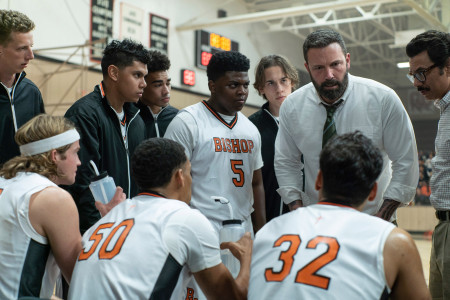
The Way Back

8 Mar
TORRANCE

Watching “The Way Back,” the story of an alcoholic has-been who finds redemption taking the reins of a losing high school basketball team, I was pretty sure I was taking in something based on true events. A quick gander of the press notes and the answer was a solid nay, and somehow I felt cheated. I mean, would “Hoosiers” (1986) resonate as thoroughly if it weren’t true?

Given that the film stars Ben Affleck with his tabloid-chronicled struggles with alcohol, there’s a truth here that you can feel in the actor’s convincing “been there” performance. Affleck has puffed up for the role; he’s boxy and bloated. Gone is the buff Batman physique, and his face is weary and heavy. It’s a lived-in performance that may go down as one of Affleck’s finest, even if the film, while hitting all the requisite marks, feels thin – moving and meaningful, sure, but thin.

We catch up with Affleck’s Jack Cunningham working a construction job in L.A. He’s isolated, a barely functioning alcoholic who pops a can of beer in the shower each morning but at least has the presence of mind to get a ride home from the bar each night. During a tense Thanksgiving dinner at his sister’s house we learn Jack was once an all-state ball player at a small Catholic high school and had a scholarship to the big time, but events sidelined his success and have him separated from his wife, Angela (an effectively sensitive Janina Gavankar). The opportunity for Jack’s “way back” comes in the form of a random call from the head of Jack’s old high school. Turns out the basketball coach had a heart attack; the school asks Jack to step in, even though he hasn’t picked up a ball in 20 years, let alone ever coached.

The crew Jack has to oversee is fairly pat platoon of misfits and castoffs, unable to win a game against a team of gnomes, including the slack showboat who thinks he’s better than he is (Melvin Gregg), the full-of-himself ladies man (Will Ropp), the portly prankster (Charles Lott Jr.) and the team’s taciturn star with home life challenges (Brandon Wilson). The assemblage of coach and kids who need each other screams cliché, but director Gavin O’Connor – who’s been down this path before with “Miracle” (2004) and “Warrior” (2011) – keeps things gritty and realistic, adroitly avoiding what otherwise might have been maudlin pitfalls. The script by Brad Ingelsby (“Out of the Furnace”) may come off as forced and coy in the way it introduces backstory and developments, but to its credit, it moves in directions that are anything but Hollywood. The real buzzer beater here, however, is the chemistry between Affleck and his squad. Sure, they grow as young men and the team begins to come together and win, but it’s more palpably conveyed than just simply checking those boxes. The dynamic with Jack’s sensitive assistant coach (Al Madrigal), a math teacher who’s onto Jack saucing it up in the office, helps deepen the complex nature of addiction and recovery. Overall, “The Way Back” might not be an instant classic, but it is a sobering spin on hopelessness and despair and finding the way forward.

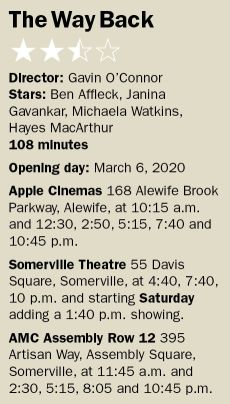
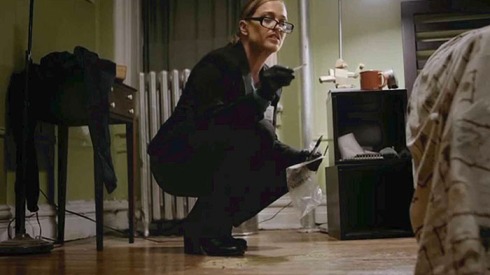
Burden

5 Mar

tmp-burden

With the understanding that the KKK factors heavily in the plot, you’d think the title “Burden” would have something to do with the onus of racism or the dismantling of it. But no, the film, based on true events, is simply about a gent named Mike Burden, a narrow-minded peckerwood who, à la “American History X” (1998), has an awakening to the hate etched so obviously in front of his face. The film, by actor turned first-time filmmaker Andrew Heckler (“Armageddon,” “Ally McBeal”), won the Dramatic Audience Award at Sundance 2018. But “Burden,” despite its prestigious pedigree and firebrand topic, is a fairly straight-ahead narrative that misses opportunities as it checks off social justice boxes.

As Burden, Garrett Hedlund (“Pan,” “Four Brothers”) gets the snaky, snot-snorting, chew-spitting redneck down to a T. The film catches up with Mike in the mid 1990s, just back from a stint in the military and about to pitch in with de facto father figure Tom Griffin (Tom Wilkinson), the grand leader of a podunk South Carolina chapter of the Klan who’s about to demo, remodel and transform the town’s derelict nickelodeon into a KKK gift shop and museum. The gory baubles of violence (knives, crosses and masks) are almost as cringeworthy as the frequent drop of the N-word from the beer-drinking bums who undertake the task. Such a public establishment doesn’t sit well with the Rev. David Kennedy (Forest Whitaker) or any of the African American population of Laurens, rightfully fearful of the Klan – and the law. Protests and violence ensue. Ultimately, because of his developing relationship with Judy (Andrea Riseborough), a single mother with a progressive mindset, and a rekindled friendship with childhood friend Clarence (Usher Raymond), Mike hits a crisis of conscious and wrestles with exiting the Klan. That proves to be a none too easy endeavor, and potentially dangerous.

The cast, most especially (and predictably) Hedlund and Academy Award winner Whitaker, execute Heckler’s vision with ardor and investment. Wilkinson, so good in everything does (“In the Bedroom,” “Michael Clayton”) nearly elevates his villainous Griffin to the realm of human complexity, but Heckler, doing double duty as screenwriter, doesn’t trust the audience enough – the shock of the N-word and notion of bred-in hate gets so overused they become just more drool in the spittoon. No matter, “Burden” in its generic construct manages to raise the flag effectively on racism and a chapter of history that’s too close and relevant to the here and now.

Night Sweats

4 Mar

Edgy thriller with a pulse on the coronavirus scare

tmp-NS1

With the coronavirus (and fear) spreading in the United States, “Night Sweats” checks in not only as a cautionary tale but also as a pretty taut thriller as well. The vast reaching plot centers on an infectious disease break out in New York City that while not a pandemic, confounds public health authorities among others. The lo-fi production casts an ambitious net and smartly makes the most of its cloistered locations—spartan millennial apartments, dive bars and the kind of generic office space that became its own character in Kitty Green’s “The Assistant”— framing it all in tight and embossing the emotional impact.

We catch up with a wide-eyed Yuri (Kyle DeSpiegler) as he meets Mary Kate (Mary Elaine Ramsey) a toothsome wait person at the hip haunt his roommate Jake (John Francomacaro) works at. Sparks fly and soon enough, Yuri and the coquettish object of his desire are back at his place and between the sheets. Handsome people in the throes of the ultimate pleasure are always a captivating spectacle, but before the rise to satisfaction can be notched, mood killing wails ripple down the hall from Jake’s room. The cause of the coitus interruptus? A satanic seizure replete with convulsive vomiting and eyes rolled back into the head and ghastly white. The two young lovers panic as most anyone would but at least have the presence to dial 911. In a freaky twist, the second Yuri hangs up the phone, a mysterious mountain of man claiming to be an EMT comes a knocking and attends to Jake. Just what he does in that brief interlude before the ambulance arrives is unclear and concerning to both Yuri and MK. Days later Jake’s dead, MK’s suddenly aloof and the restless Yuri uncovers a bug planted in Jake’s room inside a trophy from a self help company called True Healing. More cases of the illness crop up, health authorities (Allison Mackie as the lead) continue to pepper Yuri with questions, and Yuri, unsatisfied with the lack of answers, goes undercover as a new hire at True Healing.

tmp-NS2
Rickety in construct, yet riveting in its enigmatic aura “Night Sweats” hits a few plausibility snags along the way. Treading on the notion that fact is stranger than fiction, before the credits roll we’re informed that the film’s based on true events. A delve into the the press notes tells us that one of the writers, Seth Panman, toiled at a shady self help firm that had some dubious endeavors in the works. “Night Sweats”’s clearly a jumping off from there and what holds Andrew Lyman-Clarke‘s ever expanding thriller together are the edgy performances by Ramsey as the barbed lure and DeSpiegler as the dude interrupted, with a can do attitude. The behind the scene stars that help sell it are the moody atmospheric score by John Kaefer that adds pins-and-needles to a scene and Hilarion Banks’s floral yet focused cinematography. It’s not fully incubated but “Night Sweats” does manage to get under your skin.

Emma.

27 Feb

I always find it curious that “Emma” was the last novel Jane Austen wrote before her passing. “Pride and Prejudice” and “Sense and Sensibility” always felt more mature, wise and insightful. They’re also less gleeful and spry. It’s important to note that the title of the film by Autumn de Wilde, tackling Austen in her feature debut, is “Emma.” with a period at the end of the title. One might think it’s to not to be confused with the 1996 version staring Gwyneth Paltrow, or maybe to simply inform cinema-goers that this is the definitive celluloid (well, digital) version – period! However you take it, de Wilde’s vision of 19th century English countryside is a rich one, rooted in details, period dress and the title character’s ever alluring array of earrings. One astute detail is the use of folding panel draft screens, each a piece of period art in their own right, positioned by the help to keep their wealthy estate owners warm as they relax in the living room gabbing and imbibing a cordial or, more mundanely, reading. In one scene, Emma (Anya Taylor-Joy) instructs the helping hands to move two such panels to exact locations to keep her father (the indomitable Bill Nighy) warm. The hyper (draft) sensitive effete is certainly snug and happy, but what Emma has more intentionally done is create space for her and her next-door neighbor (fields and sculpted gardens away), the overly solemn Mr. Knightley (Johnny Flynn), to whisper privately about affairs of the heart.

Emma, it turns out, is a master manipulator, ever so prim on the outside but inside scripting the love lives of the young and unsuspecting roaming the quaint confines of the bucolic burg just a day’s jaunt from London. Those caught up in her matchmaking, besides Knightley, are her tag-along of lower social station, Harriet (a wonderful Mia Goth),  Robert Martin (Connor Swindells), a sensitive, hardworking farmer with a square jaw , the prideful world traveler Frank Churchill (Callum Turner) and Emma’s de facto social rival, Jane Fairfax (Amber Anderson). Most of Emma’s semi-well-intentioned plots (most with a modicum of personal gain attached) backfire with a dour muffled cough. Nothing in Austen’s very staid land ever erupts outwardly, though Flynn’s brooding Knightley feels like a bull in a narrow stall looking to explode. It’s a Heath Ledger-esque performance, understated yet thoroughly compelling. (Interestingly, Flynn in is slated to play rockers David Bowie and Ray Davies in upcoming projects.)

It’s hard to pick a shining star in de Wilde’s opulent period piece. Goth, Nighy and Miranda Hart as Miss Bates, a nonstop chatterbox as sweet as she is annoying, all add perfect bits of garnish to the Knightley-Emma Woodhouse tug-of-war of emotion and desire. Mark one thing: “Emma.” lifts Taylor-Joy over the top as a serious young performer in the ranks of Thomasin McKenzie (“Leave No Trace,” “Jojo Rabbit”) and Saoirse Ronan (“Lady Bird,”“Little Women”). Coincidentally, the name of her occult young woman in her breakthrough, Robert Egger’s “The Witch” (2015), was Thomasin, and she’ll star this year with McKenzie in the Edgar Wright (“Baby Driver,” Shaun of the Dead”) project “Last Night in Soho.” And as much as Joy-Taylor lifts the film with her ebullient, wide eyes that mask mixed feelings, credit for a work that feels like both a fairytale and a master painting goes to de Wilde – amazingly, at nearly 50, notching her first-time shot. The script by “The Luminaries” novelist Eleanor Catton, like Greta Gerwig’s “Little Women,” metes in just the right amount of modern female gaze without unsettling a single apple in Austen’s cart. Flynn and Taylor-Joy have their trajectories mapped, but it’s de Wilde (who got her detailed eye making videos for Beck and Jenny Lewis) that’s the eye-opener here, and the new hot one to watch.

Black History Month – Cambridge Notables

26 Feb

Black Bookmark Project highlights pioneers less known, but all worth taking a page from

An opportunity to remember William Henry Lewis, ‘great man’ of firsts


tmp-BHM1Joyce London Alexander, in an image from the Cambridge Black Trailblazers website.

This Black History Month sees the launch of the Cambridge Black Bookmark Project, giving young readers free bookmarks – photos on the front, biographies on the back – introducing more people to a generation of black trailblazers not yet given physical markers around the city.

The Cambridge Black Trailblazers project adds to and updates work begun by the Cambridge African American Heritage Alliance, which installed 20 markers citywide honoring the achievements of black leaders from the 1840s to World War II, said project coordinator James Spencer, representing a committee of another half-dozen people. The group printed 7,000 bookmarks, of which about 4,000 have been given to the school district. Others have gone to the City Council to hand out and to the families of the people being celebrated; a donation of up to 2,000 of the bookmarks to city libraries awaits permission, he said.

“This has been a labor of love … But this is just the beginning. In order to continue, the project will need additional resources,” said Spencer, a retired civil rights and diversity officer, describing plans for at least 20 bookmarks led by an initial seven.

Movers and shakers

The first batch includes Joyce London Alexander, who went from first black president of the CRLS student council to first black chief magistrate in the United States; Charles Leroy Gittens, the first black Secret Service agent and protector of U.S. presidents from Dwight D. Eisenhower to Gerald Ford before taking charge of all agency field offices; Elizabeth Rawlins, an educator who became a longtime dean at Simmons College; Leon West, who became famous as a chef in New Orleans; Roy Allen, a television producers and director who became the first black member of the Directors Guild of America; Henry Owens, the entrepreneur behind Green Moving; and civil rights activist Gertrude Wright Morgan, who recently got a street named after her in Canbridge Crossing – after work began on the trailblazers project.

“It is critically important that young people, as well as the larger Cambridge community, recognize the selfless and courageous contributions of these individuals in a generational period of painful discrimination,” Spencer said.

“This initial phase of the project was developed, researched, financed and launched by a committee of dedicated volunteers, with support from the Cambridge Historical Commission,” he said, calling sponsors – individual, corporate and philanthropic – vital to move the project forward from this hopeful start. Continue reading