Archive | Review RSS feed for this section

Ray & Liz

11 Sep

‘Ray & Liz’: Harrowing rewind to a childhood where the guardians are ones to watch out for

By Tom Meek
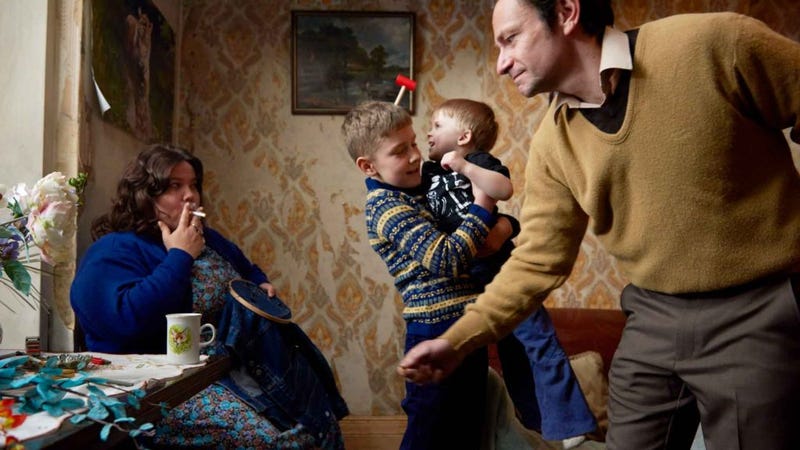
Image result for ray & liz

Photographer turned filmmaker Richard Billingham reworked a photo exhibit he did about his parents and childhood as material for his first feature. If that sounds somewhat bland, consider Billingham’s profession and know that the film is shot in close, aesthetic framings that make such mundane acts as smoking a cigarette or drinking a shot of rotgut enigmatic and alluring. Also know that Billingham grew up under grim conditions in a seedy housing project in Dudley, near Birmingham, England. The film is staged and shot in the same locale. The fact it’s so autobiographical and steeped in neglect and emotional abuse only makes “Ray & Liz” all that much compelling (and hard) to drink in.

The saga of Ray and Liz–as well as a young Richard and his younger brother, Jason–is told in three time shifts. We catch up with Ray (Patrick Romer as the older Ray), a bird-faced man who lives in spare, one-room apartment high up in the projects, where all he does is lie in bed or drink. We never see him leave his apartment; he’s delivered bourbon and rye that are put carefully on a side table so Ray can perch on the edge of his bed and binge. He imbibes so vampirically and rapaciously it’s chilling–I’d take Ray in a drink-off versus a platoon of fraternity boys on a spring break bender. 

More chilling–yes, more chilling–is the dial-back to the 1980s, to a larger flat on a lower level of that project where Ray (Justin Salinger) and Liz (Ella Smith) chain smoke and pretty much demand that the boys (Jacob Tuton and Callum Slater) steer clear and remain quiet or else. A tattooed and ring-adorned (think brass knuckles) Liz bears the countenance of a deeply perturbed bovine ready to charge at the first sight of red; an analogy that comes to life after Ray and Liz unwisely leave toddler-aged Jason in the charge of a cognitively challenged relative named Lol (Tony Way, nailing a complex part with nuance and verve) who, at the goading of manipulative neighbor (Sam Gittins), hits Ray’s liquor stash. When Ray and Liz return, Lol’s vomited all over the apartment and passed out as a naked Jason, covered in shoe polish, runs around with a knife in hand. It doesn’t matter that the dubious interloper may be responsible; Liz’s unquenchable wrath, and its manifestation on the helpless Lol, is a scene that will not soon leave you.

There’s another shift–unlabeled, without overt anchoring, because there’s no need in a film so intimate and even claustrophobic–to a 10-year-old Jason again at risk. It pales by comparison, though it’s unnerving to learn that Ray and Liz manage the boys primarily for welfare benefits. The reunion with the older Ray, higher up, living the sot good life, is at once bleak and empowering the way “Leaving Las Vegas” was back in 1995. What’s wrong with a man doing what he loves, right? The win here is Billingham’s artful delivery–think of the texture painter Julian Schnabel brought to “Before Night Falls” (2000) and “The Diving Bell and the Butterfly” (2007)–and a domestic horror story, told with earnest insight. I’m not sure where Billingham will go next, but I’m there with rapt anticipation.

Aquarela

29 Aug

‘Aquarela’: Stunning environmental images from Kossakovsky might leave you gasping

Image result for aquarela

Had you asked me about four weeks ago, “Once Upon a Time … in Hollywood” would have been the definitive must-see-on-the-big-screen movie. Why? Well, Robert Richardson’s lush era-illuminating cinematography, for one thing, and the amazing sets that re-create 1969 Los Angeles. But the answer changed last week after I drank in a screening of Victor Kossakovsky’s commanding contemplation about water, “Aquarela.” It was an outright obliteration with all the shock and awe that only Mother Nature can deliver when at her extreme-weather fiercest.

“Aquarela” doesn’t have a narrative arc in the conventional sense. It’s more a mounting experience that washes over you. Tagging it as a hybrid of a Godfrey Reggio film (“Koyaanisqatsi”) and an ICA visual art installation doesn’t quite do it justice, but it gets you close. There’s little human dialogue and never any location tags as it slips seamlessly from Siberia to Greenland, California and ultimately, the breathtaking Angel Falls in Venezuela – with a harrowing few moments inside the wrath of Hurricane Irma. Much of the soundtrack too comes from mama nature herself: the perilous pop and crack of vast spans of ice, towering waves crashing down and the harsh, whistling whip of the wind; to take the edginess of this beautifully frightening omnipotence higher, the punk-metal music by the aptly named group Apocalyptical (imagine a Gwar and Nine Inch Nails collaboration) digs into your temples at turns. It’s almost too much, but that’s part of the point. 

The film begins with its most placid, yet harrowing sequence as team of Siberians retrieve a car from beneath an ice-capped lake using just old-fashioned wood and rope tackle. It’s riveting, though a tedious task to observe as they work in near silence, often lying prone to peer through the thick crystal sheet and occasionally crashing through the surface with nonchalant regard. We learn those who drove the car escaped through the hatch – driving on the ice is how these guys get around. Later we see from afar another car cruising the ice, and it too drops from sight. The ensuing scene will not soon leave you.

The film mostly showcases its subject’s majestic indomitableness in aesthetically wondrous framings that are at once hypnotic and eye popping – an exception being a look at those pinned down by Irma and fighting to hold on amid devastating mudslides and massive flooding. There’s no question the film’s a dispatch underscoring climate change and the need for us to clean up our act. Hard to argue, and done so in subtly contemplative fashion the way Lucien Castaing-Taylor and Véréna Paravel’s 2013 locally shot documentary, “Leviathan” and Werner Herzog’s 2007 cold dive “Encounters at the End of the Word” so elegantly did. 

The real power in “Aquarela” is Kossakovsky‘s patiently observant cinematography, which captures some moments that even seem implausible – yet there they are. Kossakovsky shot the film at 96 frames, something of a broadening trend. It’s a true spectacle and wonderment that should taken in its intended natural format.

The Nightingale

8 Aug

‘The Nightingale’: Stalking through outback, prisoner fights back against captor’s brutality


Image result for The nightingale

Jennifer Kent’s follow-up to her surprise indie horror hit, “The Babadook,” is something entirely different (from a mother and her child being stalked by an animated boogeyman), yet every bit as grim and harrowing – perhaps even more so, given that it plays along the lines of the historical. Set in the Tasmanian outback during the early 1800s, when it was still known as Van Diemen’s Land, “The Nightingale” is a power game-turned-thriller following Clare (Aisling Franciosi, who played Lyanna Stark in “Game of Thrones”), a young convict in a penal colony under the charge of a cruel British officer (Sam Claflin, who played Finnick Odair in “The Hunger Games”series).

Whatever the crime landing Clare on incarceration island, it’s not enough to merit the sadism of Hawkins, the man in charge. Initially he only makes Clare sing for him (thus the film’s title), but his demands become more invasive and physical. A flash retaliation by Clare’s husband Aidan (Michael Sheasby) launches a string of grim and mounting disciplinary retaliations that become so barbaric and graphic that the squeamish will likely need to avert their eyes or even take a loo break. (Folks walked out of the Sydney premiere in shock and beyond – feel free to Google it, but be warned that you’ll see some spoilers).

Clare and her husband have an infant daughter, so there’s more at stake than just dignity and doing your time. Not to tell too much, but Clare and Hawkins wind up in the wilderness stalking each other. Hawkins is joined by a small posse of equally malevolent underlings, while Clare follows a reluctant aboriginal guide named Billy (Baykali Ganambarr). Bloody games ensue.

The arc of “The Nightingale” essentially follows a pat revenge narrative, but the innovative Kent once again shoots something masculine and familiar through a different lens. The relationship with Billy, steeped initially in racism (whites shoot indigenous people just for a sideways glance) and necessity (Europeans can’t get a few hundred yards without a guide) blossoms into something more universal and human, casting pleasant shades of Nicolas Roeg’s mesmerizing 1971 Outback drama “Walkabout.” Franciosi and Ganambarr, a dancer by trade, are superb. Claflin is equally compelling, given the merciless nature of his character – though we do learn that the entitled megalomaniac has been slow to rise in rank, a trigger for his fiendish behavior. Also a win for Kent: the lush framing by cinematographer Radek Ladczuk of angry, jagged edges of imperialism and oppression that slice into nearly every frame. Like John Hilcoat’s bleak thriller, “The Proposition” (2005, scripted by Nick Cave), “The Nightingale” is something of a western in which laws, lawlessness, a sense of humanity and amorality all fold in on each other to dark, despairing effect. Kent again conjures up something provocative, disturbing and quite hard to swallow.

Piranhas

7 Aug


Image result for piranhas movie

The mean streets of Naples (Italy, not the retirement destination in Florida) get their due in this gritty portrait of youth born and baptized into mob crime. It’s a vicious circle of too short life where guns and ruthlessness rule the streets. “Piranhas” will call to mind every pack of misguided youth engaging in dubious/criminal behavior film, from “The 400 Blows” (1959) to “The Florida Project” (2017) with flourishes of Scorsese thrown in. It’s not on par with those, but it tries.

The preamble, with two teen gangs bristling and chest thumping over rights to a prize Christmas tree from a mall, is one of the film’s most telling and rewarding scenes. Afterward, in a ceremonial bonfire-cum-initiation rite, we learn that these little fish with sharp teeth are from rival mafia clans. As “Piranhas” builds, it’s not as cut and dried as to who’s the enemy; motivations and codes are murky and fluid and Naples is seedier, more chaotic and far less glamorous than in the “Godfather” films. We follow the cocky, charismatic Nicola (Francesco Di Napoli), blessed with pop-star good looks and full of big plans, but addled by limited acumen. In short, he’s a loaded weapon, and it’s with a cache of automatic-caliber arms and alpha male tendencies that he begins to realize his aspirations – he’ll even dress in drag to get the job done.

The film, directed by Claudio Giovannesi (“Fiore”), who also filmed parts of the hit Italian crime television series “Gomorrah” based on Roberto Saviano’s novel – never quite fully builds out the characters beyond Nicola; they feel like castoffs from better engineered mob movies. Saviano, something of a sensation not only for his works but for the attention they garnered from the capos depicted in it, co-wrote the screenplay with Giovannesi and others from his novel “La paranza dei bambini.” To be certain, it crackles and sparks at points, but it never catches fire. Di Napoli carries it all with his angelic countenance. If only his Nicola, on a well-trodden path, only had a soul to sell.

Once Upon a Time in… Hollywood

25 Jul

‘Once Upon a Time … in Hollywood’: Stardom loses some luster in dusty, bloody wilds of L.A.

By Tom Meek

Quentin Tarantino’s “Once Upon a Time … in Hollywood” isn’t a rescripting of historical events the way “Inglourious Basterds” (2009) envisioned the Nazis toppled by a handful of hard-hitting Jews, but there are definitely some major ripples in time. No, “Hollywood” is more a tongue-in-check, kick-in-the-pants modern fairytale with a hefty side of cinematic homage; it rambles some, to be sure, but it’s more sincere and genuine in execution than the video store clerk-turned-auteur’s last outing, “The Hateful Eight” (2015). It may be Tarantino’s most personal and intimate film to date (tying with “Jackie Brown” on the latter) as the director talks about tapping out after 10 films – which this would be if “Four Rooms” counts, but I digress.

The setting is the late 1960s. Rick Dalton (Leonardo DiCaprio), something of a Clint Eastwood or Chuck Connors, came to fame in a fictional hit television western called “Bounty Law” a decade earlier and now finds it hard to get lead work – he plays mostly heavies on (real) shows such as “The F.B.I.” and “Lancer.” Front and center too is Dalton’s shadow and heyday stunt double Cliff Booth (Brad Pitt), a smooth, angular chap with an aw-shucks facade and a deeply dark side that gets leveraged to glorious and disturbing effect. Because the two are loyal bros, Dalton, during his downward fade, employs Booth as driver and gofer. Dalton also lives next door to Sharon Tate and Roman Polanski – and, yes, on the eve of the Manson family murders – and in a separate silo we get Margot Robbie as an ebullient Ms. Tate looking grand and fabulous as she dances poolside at a Playboy mansion gig and taking in a screening of “The Wrecking Crew,” which she stars in with Dean Martin.  (At the box office, she asks if she can get a free pass, because she’s in it.) Robbie may not say much, but she’s intoxicating in every scene she’s in. Doomed in real life as a Manson victim, Tate is held up by Tarantino as the essence of a sunsetting era.

Continue reading

The Art of Self Defense

18 Jul


Image result for art of self defense images

“The Art of Self Defense” is a stunning little film that comes at you like a well-placed sternum punch in a dark alleyway. It begins with a droll, grim whimper as a wimpy nebbish gets viciously mugged by a gang of motorcycle thugs and subsequently waltzes into a dojo to allay his mounting fear. The set-up feels ripe for something of a comedic “Revenge of the Nerds” payback scheme, but “Self Defense,” directed by Riley Stearns (“Faults”) veers off into areas as shocking and black as such recent needle-in-your-eye edgy fare as “Midsommar” and “Under the Silver Lake.”

Casey, the self-suppressed office wonk on the receiving end of that beatdown (Jesse Eisenberg, in a role that seems tailor made), lives mostly for the affection of his demurring dachshund. The trauma of the event (he’s hospitalized) shakes him, and a chance venture into a martial arts studio sparks a meteoric transformation. The dojo’s owner, known simply as Sensei (a deadpan Alessandro Nivola) gets him on the hook with the cool, casual promise of confidence and control – you’ve gotta learn to punch with your feet. Sure, early encounters with bullies at a shopping mall don’t go so well, but at Sensei’s urging, Casey taps into head-banging metal, stops coddling his pooch and learns German. There’s also that application for a handgun (the store owner who prattles on about checks, the perils of firearms around kids, stats on suicide and the chance of becoming a homicide victim being higher for gun owners than non-owners might be the most responsible merchandiser of instant death ever portrayed on film) and a cold karate chop to his boss’ Adam’s apple over an innocuous invitation to dinner. Beyond swagger, Casey’s found his inner Bronson – and he likes it.

Eventually Casey’s invited to the special late-night classes, and that’s when the film enters “Fight Club” territory. In grim, gruesome detail, faces get punched in, elbows are disjointed and there are missions to confront others on the street – and no, these are not acts of vigilante justice or something even slightly noble. It takes a while to sink in (a noggin banged repeatedly against a cast-iron object helps make the realization for you) just how doubly dark Stearns’ reality-fraying portrait of a dweeb tweaked out on a testosterone high is. 

“Self Defense” may amble along behind a sleepy indie guise, but at the corners it’s throwing jabs that keep you constantly off balance. Just as soon as you think you have it figured out, “Self Defense” grabs you in a cinematic jujitsu hold and throws you in another direction. You can’t fully right yourself – and that’s part of the fun. For some it’ll register as black comedic bliss, for others, the grim, bleak depictions will have you peering through splayed fingers. As gonzo as the film goes, it’s remarkably well composed, and Nivola and especially Eisenberg sell it perfectly. Imogen Poots reinforces the ensemble as Anna, the lone woman at the studio who, in earning her red stripe, reminds us what women have to confront in male-dominated spaces. She’s also one of the fiercest on the mat and the most compassionate off it. If there’s a message or parable to take from “Self Defense,” where “brute force” and “never back down” are mantras, it’s hard to find a humanistic application in these trying times. That said, the journey of empowerment for the meek is just, if just for that alone.

The Farewell

11 Jul

‘The Farewell’: Reasons for a family reunion? Grandma’s going to hear the happier version


Image result for the farewell


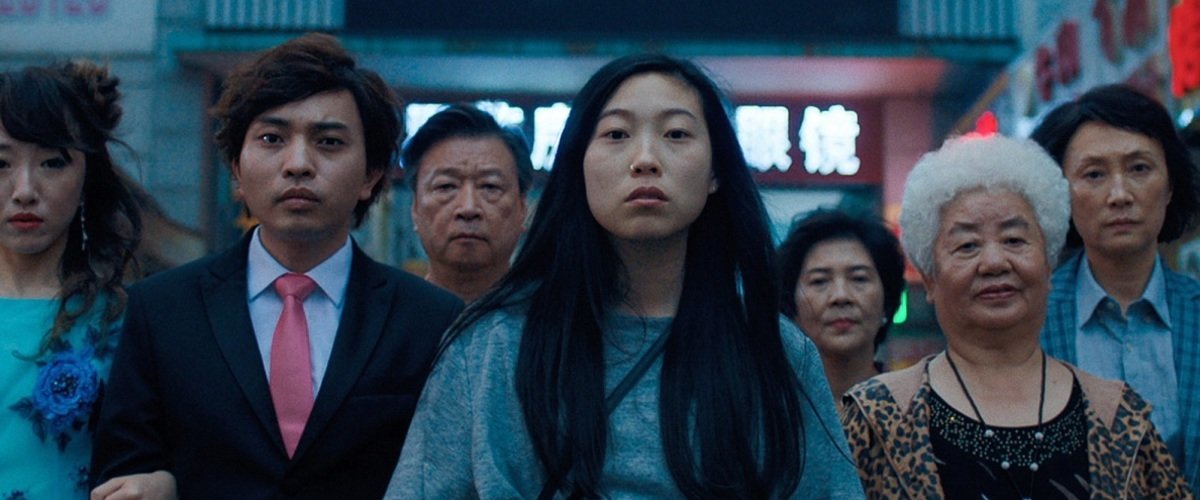
“The Farewell” unfurls a bittersweet emotional journey buoyed by the complicated matter of identity that confronts many immigrants and first-gens when returning “home.” Last year “Crazy Rich Asians”played on that notion with an overlay of rom-com. Here there’s less of both as Billi (Korean rapper Awkwafina, who played a goofball in “Crazy Rich Asians”), a frustrated, out-of-work New York writer, heads back to China for her grandmother’s inevitable passing. As one ingrained traditionalist notes, “Chinese people have a saying: When you get cancer, you die.” The grand matriarch Nai Nai (played with grace and dignity by Shuzhen Zhao), does have cancer, but her family decides to keep her in the dark about the terminal prognosis; even the doctor’s in on it. As for Billi’s and other family members’ sudden presence, which makes Nai Nai purr, it’s explained away as being in town for a wedding of a distant family member. The rub: The family now has to set up and execute said wedding.

The film, as we’re told, is “Based on an actual lie” – on the real-life experiences of writer/director Lulu Wang (she recounted it on NPR’s “This American Life” in 2016). The conflict of Chinese traditional values vs. Western drive finds its way into the corners of nearly every frame, and at certain turns you can feel bits of Ang Lee’s “The Wedding Banquet” (1993) and, even more so, Peter Wang’s forgotten cross-cultural comedy, “The Great Wall Is a Great Wall” (1986), seep in.

Behind the lens, Wang builds the narrative quietly and poignantly in ever-widening strokes, from the narrow confines of Billi’s parents’ Changchun apartment to the grand – almost garish – wedding (which is where images of Lee’s “Banquet” come in). Along the way, one does wonder how blissfully obtuse Nai Nai really may be – could she be alert to her affliction and just playing along? The wedding itself is a strange yet alluring spectacle, an alcohol-infused epic replete with off-key stage performances and emotions gurgling past the brain’s normally sober governor.

The gimmick of a group-perpetuated charade may drive “The Farewell,” but the reason it resonates is its star. The comedian/performer well known for taking things to gonzo heights – just witness her and Ken Jeong (“The Hangover”) go at it in “Crazy Rich Asians” – delivers a surprising, if disarming, performance that many might not have imagined possible. Nuanced and deeply reflective, Awkwafina seems to be pulling from somewhere deep; even more affectingly, she forges a heartfelt synergy with the other members of the wonderful ensemble (Diana Lin and Tzi Ma among them as mom and dad). It’s hard to imagine “The Farewell” won’t mark Awkwafina’s breakout; it might just do the same for Wang. After all, this is her story, and one she got Awkwafina to understand from the inside out.

Marianne and Leonard

11 Jul

‘Marianne & Leonard: Words of Love’: A muse recalled in verse long after the poet moved on


Image result for marianne and leonard

Documentarian Nick Broomfield has tackled some beguiling and controversial subjects during his prolific career, be it Tinseltown escort-turned-entrepreneur Heidi Fleiss (“Heidi Fleiss: Hollywood Madam”), serial killer Aileen Wuornos (“Aileen Wuornos: The Selling of a Serial Killer”) or the enigmatic death of grunge icon Kurt Cobain (“Kurt & Courtney”). Broomfield has a shaggy-dog quality to his approach, tending to insert himself into the story no matter his proximity or relevance, and sometimes oddly so – not overbearing like Michael Moore, but it still can be a distraction. In “Marianne & Leonard: Words of Love,” Broomfield can legitimately ring the bell as a participant; Marianne Ihlen, the front half of the film’s title, was at one point Broomfield’s lover, and allegedly his inspiration for becoming a filmmaker.

The other half of the title is none other than iconic folk signer Leonard Cohen, who had a longtime relationship with the Norwegian-born Ihlen. The two met in the early 1960s at an artists community on the Greek isle of Hydra, back when Cohen was a writer and had yet to meet Judy Collins (he penned “Suzanne”and she made it a hit in ’67) and go on to become a major force in shaping the popular music of the late ’60s and early ’70s. (Hydra was also where Broomfield met Ihlen).

The singer and his muse had a “free” or “open” relationship (thus that brief tryst with Broomfield, who became jealous of another lover on a higher-up rung) that would span decades – several of Cohen’s songs are tributes to her. The film doesn’t center wholly on the relationship, as the title might imply, but more on the after-Hydra days when Cohen decided he needed to do something else to earn a better income. That promising partnership with Collins enters and the focus shifts from Ihlen to Cohen’s musical successes and pitfalls, as well as his self-destructive yen for women and drugs. Cohen aficionados won’t be too much they don’t know (the Hydra chapter may be the exception), but the archival footage – including some newly discovered film shot by famed documentarian D.A. Pennebaker – will hit all the right nostalgia notes and likely educe a new degree of appreciation. Broomfield too tries to layer in his appreciation for Ihlen, even capturing her last, infirm moments, which, because of the remote presence of Cohen, come off more as liberating fist pump than sad, agonizing whimper.

If there’s one thing Broomfield’s deferential redial of a man, a woman and a career does, it’s to show that creative genius does not brew exclusively in one soul, and that nurturing and encouragement from others is needed. There’s also the epiphany that the man, mostly regarded as a cool, croaky crooner with an avuncular exterior, roamed in some dark places chasing artistic self-indulgence.

Midsommar

5 Jul

‘Midsommar’: Hands-on anthropology studies reveal how dark it can get under midnight sun

Image result for midsommar


As a kid I went to this Danish town north of Los Angeles called Solvang where it was Christmas year-round and the waffles were extra large and strangely exotic, and everyone dressed like they were from “The Sound of Music.” I tell you this because Solvang reminds me so much of the Swedish commune where four Americans wind up for a nine-day fertility festival “Midsommar,” the thrilling new chiller from Ari Aster. Everything’s so old school Lapland you half expect to see the Ricola folk or Max Von Sydow among the elders welcoming the group.

Two of the four Americans dropping in – Josh (William Jackson Harper, TV’s “The Good Place”) and Christian (Jack Reynor, the poor person’s Chris Platt) – are anthropology grad students, and the midnight sun rites are fodder for their theses. It helps that stateside buddy Pelle (Vilhelm Blongren) is from the remote village that feels like pieces borrowed from the sets of M. Night Shyamalan’s “The Village” and Robert Egger’s “The Witch” with a bit of Ikea retrofitting tossed in. Rounding out the U.S. crew is loudmouth Mark (Will Poulter, the dirty cop in Kathryn Bigelow’s “Detroit”) and Dani (Florence Pugh, “Lady Macbeth”), Christian’s girlfriend and a tag-along whom the other lads in the posse aren’t so keen about.

The film begins and ends with Dani. There’s a prolonged opening about her clinginess to Christian, her bipolar sister and a family tragedy that would send anyone to therapy in double time– a hauntingly fraught meander worthy of Paul Thomas Anderson. Once up in the Swedish enclave, Dani freaks out on organic hallucinogens, Pelle clearly has eyes for her and the age-old cult ordains her as the dark horse in the May Queen dance-off.

Early on in the anthropological exploration—which doesn’t feel so scientific or methodical—we get a glimmer into just how dark this eternal summer day can get. Once you’re 72 in the commune, you’re ready for renewal, which has something to do with a swan dive onto a stone pallet or a wedding reception line of celebrants wielding a medieval mallet. It’s not easy to drink in, but it’s when Aster – who played on audiences’ sense of comfort and composure with the equally grim “Hereditary” – lets us know shit just got real. The American scholars, as smart as the allegedly are, don’t take note of such omens, even as their ranks thin. But when things begin to feel a bit “Wicker Man” predictable, Aster focuses on the fractured dynamic between Christian and Dani, and the choices the characters make are telling.

The final scene, just as with the reveal of the fate of Dani’s family, is gorgeously framed and flawlessly choreographed. It’s not everyone’s cup of tea, to be sure, but Aster has again put a new, gory bow on a genre we know too well. If you can make it to the end, you’ll walk out on edge and agape.

The Third Wife

5 Jul


Image result for the thirdwife

Recently I had the opportunity to rewatch the taboo, erotic drama “Adore” (2013) starring two very compelling actresses – Naomi Watts and Robin Wright – as mothers having relations with each other’s 18-year-old sons. A hypnotically alluring WTF, “Adore” pulls you in and makes what’s off the moral compass seem rationally right by immersing you in the characters and their desires. The same applies to Ash Mayfair’s compelling directorial debut, “The Third Wife,” though besides the forbidden fruit and foreign soil (it takes place in Vietnam; “Adore” is set in Australia) there’s little other tether: “The Third Wife” takes place a century and more ago, when money and position allow men to have their way, in this case engaging in outright polygamy – thus the title.

The film focuses on the inclusion of May (Nguyen Phuong Tra My) as the new third wife in question, barely a teenager. When we meet her, her husband Hung (Long Le Vu) sucks an egg yolk from her belly before taking her. It’s a painful, erotic and disturbing scene. Set in the rural setting of a silk farm (worms, webs and lush green bamboo imagery fill the screen) during the colonial era, the women are isolated and subjected to the rule of tradition, but Hung is not an overtly oppressive head of house and the three women (the other two wives played by the stunning Nu Yên-Khê Tran and Mai Thu Huong Maya) and Hung’s pubescent daughter Lien (Lam Thanh My) interact freely and forge a knowing sisterhood. 

Other subplots causing friction on the plantation flow through Hung’s son, named Son (Nguyen Thanh Tam), having an affair with his second wife, Xuan, and the budding same-sex attraction between a very pregnant May and Xuan. It’s the kind of quiet tension that so completely filled Zhang Yimou’s fantastic early works (“Raise the Red Lantern” and “Red Sorghum”) or the first film out of Vietnam to earn Academy Award recognition, “The Scent of Green Papaya” (1993). 

Mayfair, who grew up in Vietnam but was Western-educated from an early age, crafts a composition that feels masterful beyond her slim CV in emotional complexity, plot and orchestration. Of course, it helps have on hand artistic adviser Tran Anh Hung (director of “Green Papaya,” and husband of Nu Yên-Khê Tran), formal recognition and support from Spike Lee (the Spike Lee Film Production Award) and Chananun Chotrungroj’s dewy and glorious framing of erotic meanderings amid verdant backdrops. The film stumbled into a bit of a controversy when Mayfair cast a 12-year-old in the role of May. That aside, Nguyen Phuong Tra My and the whole cast deliver deep, heartfelt performances, conveying effectively what the laconic script has intentionally left to thespian heft. If the notion of a 14-year-old bride, or actor roughly that age playing such, disturbs you, think how the women relegated into such roles without a choice felt.