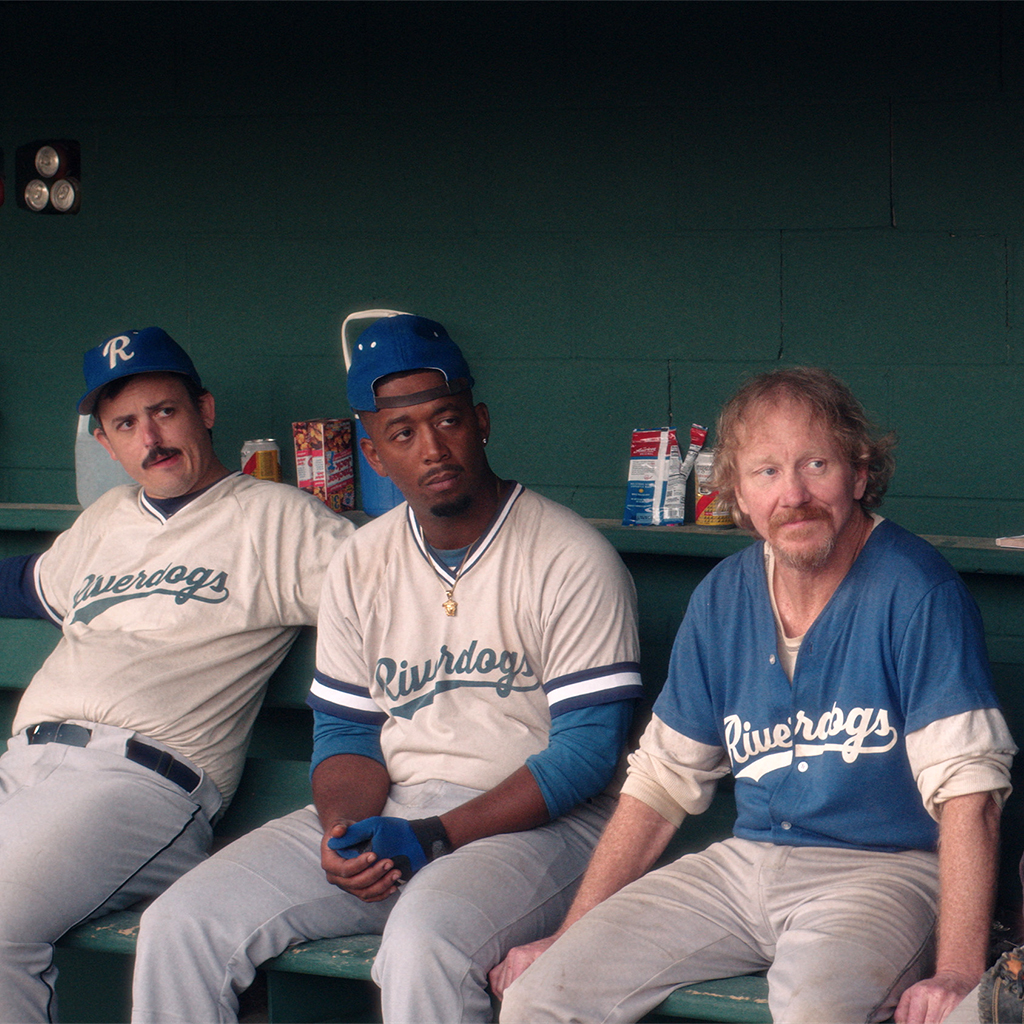
Keith Poulson, Ari Brisbon and David Pridemore in “Eephus.”
Opening day is near. There’s Cracker Jack excitement in the air and a legitimate hope that the Red Sox will return to postseason form. For lovers of the game and team enthusiasts (primed to get their hearts broken) who can’t wait, catch “Eephus,” a nostalgic slow-roller of a film with “Field of Dreams” (1989) undertones. Though it doesn’t play like one, it’s a rookie effort – the directorial debut of Carson Lund, a longtime cinematographer with roots in New England and ties to the hometown team and America’s game.
The Nashua, New Hampshire, native attended Emerson College and had a stint taking tickets and helping out at the Harvard Film Archive (where his film had a sneak peek last month; it’s now at the Somerville Theatre). His cinematic moorings put him in good company with Robert Eggers, a fellow filmmaker from the Granite State (“The Witch,” “Nosferatu”) and, from the halls of Emerson, the Daniels, who rocked the 2023 Oscars with “Everything Everywhere All at Once.”
Lund has been shooting commercials and making independent films for the past 10 years in Los Angeles, where he and Tyler Taormina have formed the Omnes Films collaborative to help finance and launch independent projects. Lund served as director of photography on Taormina’s two critically acclaimed lo-fi features, “Ham on Rye” (2020) and “Christmas Eve in Miller’s Point” (2024). On “Eephus,” Taormina serves as one of several producers.
Lund said that while growing up, he played baseball around all of New England. “I consider Boston my home city. I went to Red Sox games when I was young, and it cemented my love of the game.” When he moved to L.A., he joined an adult recreational league that became the inspiration for “Eephus.” The project took nearly 10 years to get to the plate.

Carson Lund is writer, editor and director of “Eephus.”
Set in Central Massachusetts in the early- to mid-1990s, the heartfelt paean depicts one final game between two old town teams, with many of the the grizzled players in their 40s, 50s and beyond. Lund initially wanted to set the film in New Hampshire – but otherwise promising locales found with online research and a few scouting drive-bys kept having logistical challenges, such as being too close to highways for good sound quality. Through random happenstance, Lund found Soldiers Field, a park that is the very embodiment of old-time baseball, in Douglas, Massachusetts.
“We needed a quiet field that had woods in a certain place and a parking lot in a certain place,” Lund said. “Soldiers Field fit all those parameters perfectly, but I didn’t discover it until the end of my research. Really I kind of just stumbled upon it while driving in that area, and immediately felt like that was going to be the one, if I could just get the town to agree.”
Not only did the town agree; officials and residents went all in. “They moved mountains for us,” Lund said, “and shifted baseball games that were scheduled for that month to another field.”
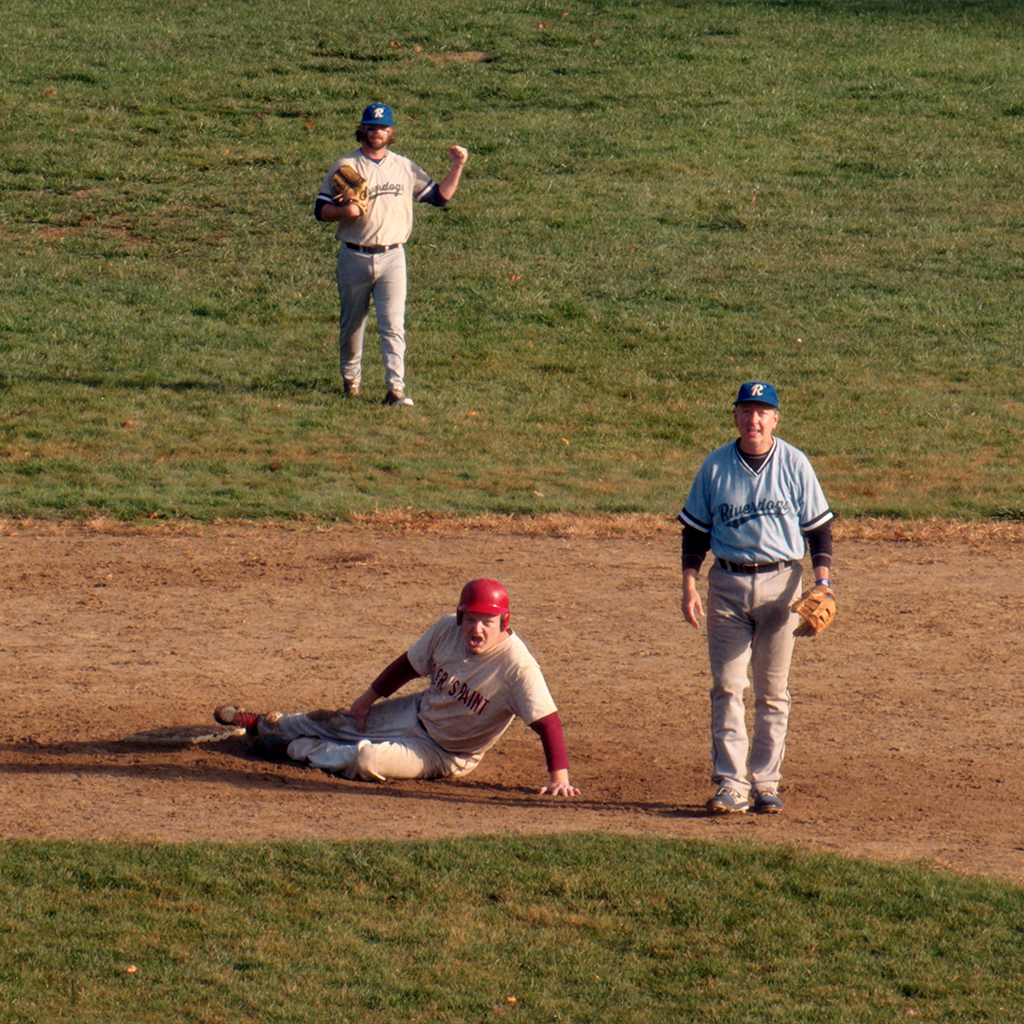
Some homeowners game place in “Eephus.”
Shooting took five weeks in October and November. The narrative arc relies heavily on New England’s transition from summer to fall and its symbolic dying of the light – or dying of a way of life.
“I’m haunted by New England,” Lund said. “I’m based in L.A., but all my projects take place in New England.” He has two projects in the early stages: another sports community drama and a screwball comedy set in Maine.
Lund performs triple duty on “Eephus” as writer and editor in addition to directing. Longtime friend Greg Tango shot the film, and brother Erik Lund served as art director. With its DIY roots and vibe, the film’s budget was “small,” Lund said – he declined to give a specific figure – but the film is impressive in production values and framing. And it has been scoring well with critics. (A Cambridge Day review is here.)
There are recognizable local names in small parts, such as documentarian Fred Wiseman, who provided the voice of the radio announcer (a casting coup, as Wiseman has hardly lent his face or voice to a film in his 95 years), real-life sports radio announcer Joe Castiglione and former Sox hurler Bill “Spaceman” Lee. Many of the convincing actors in the large, tight-knit cast were also found locally, through the firm Boston Casting, while some were friends who flew out from L.A. for the shoot.
The film’s title refers to a pitch that’s seldom used – fewer than 200 times in an MLB season, and unseen at Fenway in my 30-plus years as a season ticket holder – designed to confound a batter by being slow (and with a name bearing Yiddish roots that mean “zero” or “none”).
“It’s a rare and endangered pitch,” said Lund, the auteur behind an in-the-park home run that bodes well for the next times at bat.
 For What it's Worth
Leave a comment