Tag Archives: Review

The Overnight

2 Jul
overnight.jpg

The Overnight is one of those on-the-clock, dark comedies driven by melodrama and sexually charged situations. You’ve been there before with Edward Zwick’s Chicago-based About Last Night and Martin Scorsese’s late-night SoHo carouse, After Hours. The Overnight jumps in as the indie, LA-staged version.

The backbone to writer-director Patrick Brice’s late-nigher however isn’t rom-com relationship hell or a data entry wonk’s midnight sojourn into madness, but 30-something ennui and the notion that the grass may be greener, juicier, and more inviting in the boudoir of someone else’s castle. Meet Alex (Adam Scott) and Emily (Taylor Schilling), a pair of young urbanites recently transplanted to Silver Lake from Seattle. Alex still sports a grunge-style goatee and is a stay-at-home dad while Emily does something techie that fetches enough dinero to live in a nice, somewhat swank neighborhood. And nice is absolutely the perfect word, as Alex and Emily are boringly nice, socially awkward, and a bit stiff.  Continue reading

Terminator Genisys

2 Jul

“I’m old, but not obsolete,” is the new Arnold Schwarzenegger zinger in the “Terminator” franchise reboot, “Terminator Genisys.” “I’ll be back” gets recycled too, and there’s plenty of logic for the aged Schwarzenegger terminator – now affectionately called “Pops” – being gray and wrinkled (his external covering goes like ours). He even gets to confront the young, buff, naked Arnold, so sleek and intimidating as the lethal T-800 prototype back in 1984.

063015i Terminator GenisysMuch of what propels “Genisys” lies in the basis for James Cameron’s game-changing B-film some 30 years ago: the notion of rewinding the clock and altering history and destiny. Wrinkles upon wrinkle in time have changed the game so much you almost can’t tell where rebel leader John Connor (Jason Clarke, with a scar-marred face) ends and Skynet begins.

The ever-churning plot machinations are wild, but don’t offer much bite. Sarah Connor (Emilia Clarke from “Game of Thrones” – the second actress from the series to play Sarah Connor, as Lena Headey starred in the 2008 series “Terminator: The Sarah Connor Chronicles”) is still on the hit list, but knowledge from the future has worked its way back in time, so what was a pat scenario in previous chapters becomes a game of time-hopping chess, with Skynet and the humans trying to out-wrinkle the other.

Not to give too much away, but we begin in the Skynet future from where the young Arnold T-800 (a killer computer recreation) is sent back in time to L.A., exactly like in the ’84 original – but just as he’s about to steal the clothes from a trio of punks, things go off-script from what had been. The year of  Judgement Day (1997) has been pushed to 2017 as well. Why? Well, Skynet has decided the best way to rule the world isn’t an apocalyptic nuclear strike, but a Trojan horse computer virus through the highly sought new operating system Genisys – from a company that’s Apple cool and Microsoft hungry. There’s much more to it too; Oscar-winner J. K. Simmons (“Whiplash”) plays a cop in L.A. and again in San Fran in 2017. He’s a bit of a boozer, so no one really buys it when he says he’s seen time traveler Kyle Reese (played by the handsome but wooden Jai Courtney) and Sarah before.

Continue reading

The Wolfpack

20 Jun

https://player.vimeo.com/video/127823073

Crystal Moselle’s intrigue documentary “The Wolfpack” follows the secluded lives of the six Angulo brothers, who were raised in relative isolation – never leaving their small Lower East Side apartment in Manhattan – for nearly 17 years. Homeschooled and without access to the Internet, the boys drank in such modern crime classics as “The Godfather,” “Reservoir Dogs” and the “Dark Knight” films and recreated them, transforming their claustrophobic confines into a sound stage of sorts.

061915i The WolfpackThe roots for the documentary go back to when Moselle ran into the boys, a.k.a. the Wolfpack, on the street, caught by their eye-catching long hair (down to their waists) and demeanor. What unfolds is talking heads and recreations looking back to their early childhood, when the boys were kept under lock and key. Their father, Oscar, a Hare Krishna who met their mother, Susan, in his native Peru, blessed all his offspring with uber-long Sanskrit names. As a patriarch and a man, Oscar’s more hippie than overbearing despot, but his logic – to lock the boys within the plastered walls of a tenement apartment in the projects to keep them safe from outside harm and violence lurking in the streets – seems odd given the blood-soaked nature of their cinematic diet.

Surprisingly, the boys are all reflective, polite and articulate, and tinged with varying degrees of disdain for a father who ran the family as something of a cult colony – “our own race,” one of the boys says – where his law was long taken as God’s law. You don’t meet Oscar for most of the movie, but when you do it’s a bit of a letdown, given he’s a nonworking, rather unintimidating alcoholic whose great plan was to accrue money in New York and move the brood to Scandinavia where he felt the state would provide a better quality of life. Then there’s Susan, seemingly intelligent and caring, yet complicit. She’s on camera much more more than Oscar. Her big moment comes when she calls her 88-year-old mother, with whom she had not spoken in decades, largely because Oscar forbade it.

There’s a tipping point when one of the elder boys finally walks out on his own – wearing a Michael Myers mask, no less. As tensions in the apartment rise, the film ends on a note of promise and change. But given the enigmatic journey, there feels like some things go undivulged or unexplored, like the Angulo’s sister, who is mentioned as being “special” but is seen only in home movie footage. Then there’s the odd calm when Oscar and the boys are in the same room, starkly juxtaposed with their harshly rebuking him on camera for restraining them. The compelling quality of Moselle’s exploration get a great boost from the motion-creating editing and frenetic metal score, not to mention her caring touch. Perhaps her her objective lens got fogged.

Jurassic World

12 Jun

Jurassic World is bigger and badder than its predecessors, but we really miss the original cast

Jurassic Work

It’s been nearly 15 years since the last Jurassic Park installment, and a lot has changed in the world: 9/11 rocked and divided our nation as the War on Terror took root, smartphones replaced cumbersome cellphones, and GMOs have become talking points at cocktail parties. What’s all this have to do with the revival of the dino-park movie franchise based on the slim yet innovative novel by Michael Crichton and initially helmed by Stephen Spielberg?

The answer is everything. Like the problem of a bigger, meaner and more thrilling wow (read: dangerous) that confronts the conglomerate structure behind Jurassic World, the filmmakers spinning out Jurassic World are saddled with the burden of outdoing what came before. The good news is that the quality of special FX has come light-years.

Today, people caught in the middle of a dino herd don’t look like they’re being shot against a screen and pasted into a jerkily moving computer rendering; they’re now seamlessly in there with the “real” possibility of being trampled or squashed or snatched up by the genetically engineered Indominus Rex, the new badass on the block, cooked up in a lab by a bunch of avaricious DNA jockeys to scare the shit out of money-paying vacationers seeking an adrenaline rush just to know they’re alive.

At the park on a lush tropical island off the coast of Costa Rica, at any time, there are some 20,000 people being run through the vast array of exhibits and rides and fleeced for cash with the rapier efficiency of a Disney or Sea World. Money is a driving force at Jurassic World, and in the birthing lab, there too looms a myriad of hidden agendas and covert, need-to-know data points — like who’s DNA went into good ole Indominus — that breeds malcontent and dubious action.

Continue reading

Results

5 Jun

https://player.vimeo.com/video/129493381

Sometimes having everything makes you empty. Such is the paradox explored in Andrew Bujalski’s “Results,” part fable, part human experiment in desire, fears and means, and perhaps the most offbeat love triangle to grace the screen since Joe Swanberg’s brew-mance “Drinking Buddies.” It’s an apt comparison too, with Swanberg a stalwart of the mumblecore filmmaking movement and Bujalski long considered its godfather with such lo-fi (and low-audio) efforts as “Funny Ha Ha” and “Computer Chess.” With “Results,” however, Boston-born and Harvard-educated Bujalski goes upscale with some A-minus-list actors and a bigger budget – although what that figure is seems to be a secret to all but Bujalski and the NSA.

060515i ResultsBujalski’s first film cost just $30,000 to make (it grossed about $75,000) and starred no-name actors; here he’s blessed with the reliable Guy Pearce, Cobie Smulders (Agent Maria Hill in the “Avengers” movie and “Agents of S.H.I.E.L.D.” television series) and character actor Kevin Corrigan (“Superbad” and “Goodfellas”) who steps to the fore and delivers a knockout performance. “Results” is based on the well-being fad, in which everyone wants to get physically and emotionally fit and fortified. Danny (Corrigan) newly and painfully out of a marriage he didn’t want to exit, transplants to Austin. He’s doughy, rich and angry. He also wants to be able to take a punch, so he signs up for a personal trainer at Power for Life, a boutique health spa run by Trevor (a gaunt and toned Pearce) who pushes the philosophy that wellness is more than physical beauty, even though his crew of crack coaches look like magazine cover specimens. The upbeat but aggressive Kat (Smulders) gets the assign and spends time at Danny’s palatial spread trying to get him lean and buff, but he drags her down into his routine of single-malt scotch and weed. Turns out she’s a bit depressed and angry too. If there’s a deadbeat client, Kat’s more than happy to switch over to into loan collector mode, and boy can she run – look out Lola, she’s on your tail.   Continue reading
Entourage

5 Jun

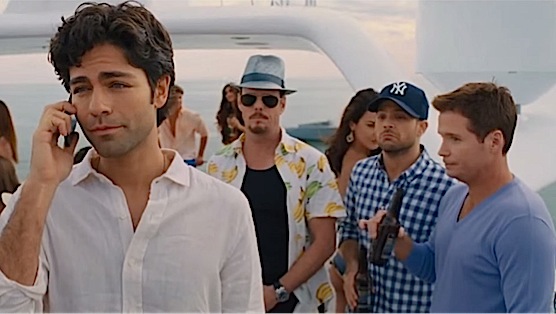
When it comes to wrapping it up, TV shows tend to go out in one of three ways: the dour blaze of glory (The Sopranos, Breaking Bad), sheer hyperbole, a.k.a. jumping the shark (hello Happy Days), or the slow fade to syndication and nostalgic recall of the early years when the writing was tight and the characters sizzled with vivid crispness. For the latter, if the residual market thrives and enough of the show’s talent is milling around, there’s also that shot for a second life up on the big screen. It worked somewhat for Sex and the City and now the lads from Entourage are getting their chance.

The good news is that the whole cast is back and under direction of series creator Doug Ellin. The result is a facelift of sorts from where the HBO series slacked off in 2011. To stretch out the situational hijinks to a feature-length product, Hollywood “it” boy Vince Chase (Adrian Grenier) has hit a mid-career malaise and wants to do something different besides being just another pretty face. Like Clooney, Costner and Eastwood before, he decides to direct. In transition, too, are Vince’s former agent, Ari Gold (Jeremy Piven) now a studio exec, and pudgy bud Turtle (Jerry Ferrara), who has dropped most of the extra pounds and founded a boutique line of tequila. Former pizza slinger Eric (Kevin Connolly), too, has stepped it up, taking the reins as the producer of Vince’s film project, called Hyde (as in Dr. Jekyll and set in a zombie-apocalypse future), and is also expecting with Sloan (Emmanuelle Chriqui), though they’re estranged. The only one who hasn’t had a life-altering realization is Johnny Drama (Kevin Dillon) still fussing over food and living in baby brother Vince’s big shadow.  Continue reading

Slow West

1 Jun

Here’s something: a Western in which a young Scot is guided by an Irishman through the inhospitable American frontier of the late 1800s. That landscape in “Slow West” is breathtaking to behold, mountainous, verdant, fertile and feral, but none of it is truly American – the film was shot in New Zealand in the same wondrous mountains where Peter Jackson staged much of the “Lord of the Rings” films.

052815i Slow WestThe writer/director, John Maclean, played in a retro-alternative band and is Scots himself, so there’s that with the how and why. He also happened to make a pair of short films with the versatile actor Michael Fassbender, whose broad CV includes sci-fi (“Prometheus” and two “X-Men” films) and collaborations with Quentin Tarantino and Steve McQueen (they’ve hooked up three times, including “Twelve Years a Slave”), so enticing the Irish thespian to take up the role of an enigmatic drifter in the mold of Clint Eastwood’s “Man With No Name” for his feature debut must have been a simple dialup of favors among friends.

The re-partnering pays dividends, but for all the grandiose high stakes and murderous guns that loom at every turn, “Slow West” moves more like a dream than your prototypical western, broken and filled with misty motifs that drift by and never fully weave together. The slow quest west get driven by the misguided passion of one Jay Cavendish (Kodi Smit-McPhee, the young boy in “The Road”), a wayward lad imperiled in a foreign land, unaware and lovelorn for a lass from his homeland (Caden Pistorius) who fled to America (from Scotland) to escape a bloody and unfortunate mishap. Luckily for Jay he is happened upon by Fassbender’s Silas Selleck, more than pretty good with a gun and whose services can be had for a reasonable fee. The great peril in their mission isn’t so much that Jay won’t find his love, but the ruthless bounty hunters seeking the hefty fee on the lass’ head and knowing Jay is the only possessor of the few clues as to where she might be.  Continue reading

Aloft

23 May
Paste Magazine May 19, 2015
<i>Aloft</i>

Much of what transpires in Aloft washes over you like a hypnotic dream, with peril and anguish looming at the corners, ever ready to flood the delicate drama at the core of director Claudia Llosa’s film. It’s more a sensual experience than a narrative, and while the dystopian prophecy boasts a concrete plot—or two—Llosa has loftier ambitions. Think The Tree of Life or Life of Pi, but Llosa’s film never quite spreads its wings.

Set somewhere in a slightly alternative reality, in the near future, in a place that’s rooted very much in the here and now, Aloft centers on a French journalist (Melanie Laurent) who’s making a documentary about a reclusive female faith healer living in a remote compound on a frozen arctic lake. She connects with a troubled falconer (Cillian Murphy) with ties to the much sought one, who can harness the power of nature to cure terminal illnesses. Given that such skills in a traditional office park might result in long lines and traffic headaches, the tough-to-reach outpost somewhat makes sense—though, if it’s such a bitch to get to, might not the dying and the needy expire long before arriving at the doorstep of salvation?

In a separate spindle, some 20 years earlier, a single mother (an alluring Jennifer Connelly sporting a rat tail) toils on a pig farm raising two boys. The youngest is sick and without much prospect, while the older, through reckless abandon, constantly puts his feeble younger sibling at risk (joyriding in a pickup truck on thin ice). Connelly’s Nana, desperate, turns to a New Age-y sect, where the head, considered a drunkard and a charlatan by nonbelievers, is rumored to remedy those whose doctors have closed the book on. Continue reading

Black Souls

22 May

‘Black Souls’: This dark mob family drama doesn’t go where you expect, unless it’s Italy

The three brothers in “Black Souls” lead very different lives: Luciano (Fabrizio Ferracane) runs the family goat farm in a remote village in the Italian foothills while Luigi (Marco Leonardi) and Rocco (Peppino Mazzotta) run mob operations in Milan. Luciano wants nothing to do with the new initiative and works tirelessly to steer his son, Leo (Giuseppe Fumo) away from it too. But Leo, who does a little strong-arming on the side himself,  has his sights set on Milan and beyond.

052115i Black SoulsSmall doings carry big ramifications, and quickly Luigi and Rocco, looking to buy influence – 30 keys of coke will do that – and expand, find themselves in the middle of a potential turf war with Leo square in the middle as the agitator between Luigi’s cosmopolitan go-for-broke flair and Rocco’s staid, more conservative approach. It’s easy to see why Leo gravitates toward Luigi’s playboy as opposed to Rocco, who married, has a daughter and, at the root of it all, shares the same conservative sensibilities as Luciano.

As director Francesco Munzi’s weave has it, all parties wind up back at the old family farm, where past meets present and generational sensibilities collide as dark dealings loom at the corners. Much of what transpires feel leaden and reminiscent of “The Godfather” scenes on Italian soil: quiet and purposeful, and steeped in tradition and the unwritten code of the underworld.

There are several junctures where “Black Souls,” for all its somber drive, appears to move in predictable and clichéd directions, but Munzi and his writers – working from Gioacchino Criaco’s novel – smartly never quite go there. The developments add up to something new, unexpected and ominous, though not fully sating. Much of Munzi’s vision hangs on his four principals and on cinematographer Viadan Radovic. Most is asked of Ferracane, whose Luciano becomes the tortured Job of the mountain.

In large, he and the cast all deliver. But Munzi hangs on the emotional residue of a scene far too long, so much so that the magic he and his actors have conjured up begins to settle, and the poignant flourish suddenly becomes stale. There’s no denying Munzi’s hypnotic poetry and simmering macho cadence, but for all its bleakness, “Black Souls” could have been a gangbuster with a touch more soul.

Fury Road

15 May

Ka-chunk, ka-chunk, ka-chunck, back in 1985, the “Mad Max” trilogy unceremoniously sputtered to an anticlimactic halt rather than going out on a furious, nitro-boosted blast. That tepid finale, “Beyond Thunderdome,” would become the post-apocalyptic Outback series’ weak link, an unsatisfactory follow up to its crowning production. That film, “The Road Warrior” (1981), not only elevated Mel Gibson to bankable star status in Hollywood, it seamlessly spun together an odd olio of diverse genres without faltering into camp and boasted some of the greatest real-action car stunts recorded on film. What director George Miller and Gibson revved up was an instant cult classic, a box office smash (it covered its budget in the U.S. in one week) and a can-do mashup from Down Under that would become a model that many would try to copy, but few could emulate. With “Mad Max: Fury Road,”(released May 15) the series is back on track, and boldly so. It took decades to get here, but it’s well worth the wait, something well oiled in lineage and ready to sear into the minds of a new generation of thrill-injected converts.

Continue reading