| GIGLI BY TOM MEEK |
|
Disregard the negative buzz: Gigli is woeful but not disastrous. Ben Affleck’s Larry Gigli (“pronounced like really with a G”) is a hit man assigned to kidnap and house-sit the DA’s simpleton brother (Justin Bartha) so the DA won’t proceed against Larry’s mob boss. Larry’s handler (a bug-eyed Lenny Venito) doesn’t trust him, so he sends in gorgeous back-up Ricki (Jennifer Lopez). She’s a lesbian, he’s a wanna-be player, and because the apartment is so small, they have to share a bed. Written and directed by Martin Brest (Scent of aWoman and Midnight Run), Gigli is a banal exercise in vanity. Yes, Ben looks fetching, and yes, J. Lo gets to showcase her posterior, but the fashion shoot gets tired fast. Their big love scene is tepid and gets upstaged by the inane foreplay banter about turkey (“Time to eat. Gobble, gobble.”) and “heterolingus.” Christopher Walken and Al Pacino lend their mugs to this embarrassment. The one high point is Bartha, whose idiot savant is Rain Man infused with Eminem. |
Gigli
19 Mar
Deep Blue Sea
19 Mar| Deep Blue Sea |  |
 |
| DIRECTED BY: Renny Harlin | REVIEWED: 08-02-99 | |
|
Jaws in triplicate and with brains — that’s the hook behind this horror-adventure vehicle that packs a few good thrills and sleek FX behind its nonsensical premise. Director Renny Harlin, back from the dead after the abysmal Cutthroat Island, places his cast of chum on a techno-cool atoll called Aquatica. The rig is an isolated research facility where the beautiful and brainy Saffron Burrows (The Loss of Sexual Innocence) enlarges the cerebellums of three sharks in search of an Alzheimer’s cure. After one of the lab sharks gets loose, the man with the money, Samuel Jackson, drops in on the clam shack to see how his dollars are working. A storm cripples the structure and everyone sits around waiting to become shark hors d’oeuvres. The battery of piquant characters includes Stellan Skarsgård as the head scientist with a perilous desire to smoke and Michael Rapaport as the nervous technician. As the shark handler, up-and-comer Thomas Jane is an intriguing Mel Gibson-esque variation on Kevin Costner’s mariner from Water World; Burrows is in fine form doing Sigourney Weaver’s Alien bit in her undies; and rapper turned actor L.L. Cool J plays the preachy chef with enough mess-hall ingenuity to take on the watery wolves. Harlin does keep the suspense strung tight, but the über-sharks’ omnipotence borders on cheesy, unintentional camp — though not to the degree of Jaws author Peter Benchley’s made-for-TV flop, Creature. If you want shark-with-smarts guffaws, try to catch the mid-’70s Saturday Night Live skit “Land Shark.”
–Tom Meek
|
||
Any Given Sunday
19 MarR: ARCHIVE, S: MOVIES, D: 12/23/1999,
Any Given Sunday
Oliver Stone’s football fantasy is in some ways a locker-room rendition of All About Eve. Dennis Quaid plays the loyal, aging quarterback, Jamie Foxx is his cocky understudy, and holding the team (the fictitious Miami Sharks, ostensibly fashioned after the NFL’s notorious bad boys, the Oakland Raiders) together is Al Pacino as the old-school coach. Shades of Pete Carroll: the team struggles to make the playoffs and the coach’s leadership is challenged, both on the sidelines by the flashy upstart QB and from above by the franchise’s brassy new owner (a wonderfully bitchy Cameron Diaz).
Stone, for all his frenetic edginess, does a decent job of forging credible relationships among the leads — though Quaid’s QB uncharacteristically steps outside his persona to fuel the plot trappings. Foxx demonstrates a surprising range, and Pacino brilliantly toggles between tenacious warrior and beleaguered once-was. The ensemble supporting cast boasts a who’s who of Hall of Famers including Jim Brown, Lawrence Taylor, and Johnny Unitas. Stone indulges too much of his nauseatingly grandiloquent editing style, which takes some of the zip off the gridiron action. But if Any Given Sunday isn’t quite in the same league asNorth Dallas Forty or The Longest Yard, it’s good pigskin entertainment. Be sure to stick around for the credits; that’s when the film goes into OT and delivers the kicker.
— Tom Meek
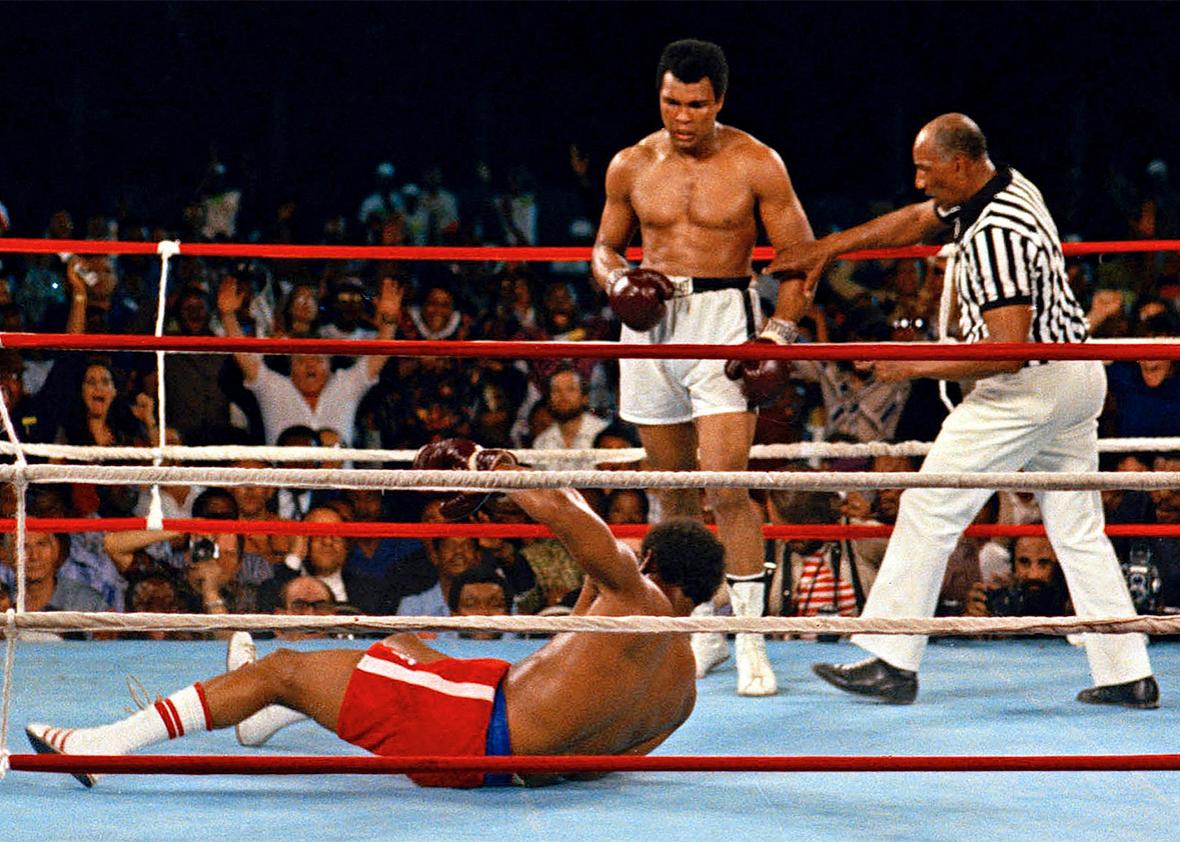
When We Were Kings
18 Mar
When We Were Kings |
|
The Descent
18 Mar
THE DESCENT: Every arterial spray and bone crack makes a point. Few gore fests (including Hostel and Saw) make me cringe, but this one had my stomach on edge even before the team of spelunking sports babes winds up face to face with albino cannibals two miles underground. It’s everything The Cave (2005) might have been and more. Neil Marshall (who mined similar terrain in Dog Soldiers) works masterfully on a small budget to invoke claustrophobia and paranoia as the squad squeezes through narrow pipes and ultimately gets sealed in. Soon after, a fall results in a shinbone grotesquely protruding through the skin, and the women stumble into a dank ossuary of sorts. The ensuing carnage is ample but not gratuitous; every arterial spray and bone crack makes a point. In such circumstances, it might be too much to ask for character development, though Aussie dancer/singer Natalie Mendoza holds her own as the can-do leader, and Shauna Macdonald prevails as the weak link who finds her inner Ripley.
|
The Express
18 MarThe Express
By TOM MEEK | October 9, 2008
 |
Ernie Davis may be the greatest running back never to play in the NFL. He was the first African-American to win the Heisman Trophy, in 1961, and though the color of his skin didn’t break new ground (Jackie Robinson had already suited up for the Dodgers, and Jim Brown preceded him at Syracuse), this bio-pic offers a stark reflection on our not-so-proud past. Gary Fleder, who’s known mostly for pre-fab work (Kiss the Girls and Runaway Jury), and his screenwriter, Charles Leavitt (working from Robert Gallagher’s book The Elmira Express), choose to recount the bittersweet rise to stardom not so much in the big moments (winning the 1959 national championship) as by focusing on Davis’s personal trials and triumphs before he became a household name and those he experienced later, after he was diagnosed with leukemia. It’s a smart call, showing Davis vulnerable as a stuttering youth in the face of bullies and then as a young man challenged by a childhood friend turned radical to use his blossoming star power for the greater African-American political cause.
The Pride of the Yankees and Brian’s Song were poignant depictions of promise, courage, and greatness cut short, and the actors threw their souls into their characterizations. The same holds true here. Rob Brown (Finding Forrester) portrays Davis as torn by optimism and anger. (A scene in which Davis and his black teammates are not allowed to attend the national-championship banquet in Dallas does more in that brief moment to bring to light past racial inequities than the whole of Spike Lee’s Miracle at St. Anna.) And Dennis Quaid’s portrayal of ’Cuse coach Ben Schwartzwalder, a decent man sometimes forced to choose between virtue and victory, personifies the conflicted American conscience of the era.
Cycle Killers
17 MarCycle killers
With its own porn, polo, and personalities, bike culture in Boston isn’t just about getting to work any more
By TOM MEEK | April 30, 2010
From atop their mounts, the participants — some with helmets and gloves, many more in just T-shirts — jostle one another for a chance to whack the ball with their care-crafted mallets from one goal line to the other.
“I want to see some blood!” screams a spectator in fishnet stockings and glittering hot pants as others nod in degenerate agreement.
| VIEW:Photos from Boston bike polo matches |
Clearly, this isn’t the sport of gentlemen unfolding at, say, the Myopia Hunt Club in Hamilton, but rather urban bike polo at a street-hockey pit in Allston. Many are dressed in black and look like refugees from a club Goth night. Participants sometimes wear Mexican-wrestler masks, while others have no shirts on at all. Continue reading
The Final Chapter
17 MarIt’s been 17 years since Rocky V and 30 since the original. This week, Rocky Balboa opens, and you can almost hear the comics and late night TV hosts sharpening their knives. After all this time, why make another beat-the-long-odds boxing movie, especially when the franchise’s star, Sylvester Stallone is 60?“The fifth one ended with no emotion,” said Stallone, looking fit in jeans and a white button down during an interview at the Ritz Carleton. “It did not come full circle. The optimism that is usually associated with Rocky was not there. There was no moral message, nothing uplifting, zero.”
John G. Avildsen (The Karate Kid) directed the first and fifth Rockies, while Stallone, who cooked up the series and penned each script, helmed the others. Balboa, he says, will be the final chapter, and a tone of therapeutic necessity marks voice of the ’80’s icon. “I just wanted to end the series on the right note, and to do that, you’ve got to do it yourself. You go back to basics. If it stumbles, you’ve got nobody to blame but yourself.” Continue reading
Rambo
17 MarRambo
Inadvertent camp
With Rocky Balboa, Sylvester Stallone closed out his pugilist franchise on a sentimental note; here, as director, co-writer, and star of what might be the final First Blood chapter, Sly seems to be angling for the same effect, the difference being that Rambo is devoid of humanity. We catch up with the title nihilist in Thailand wrangling cobras and pythons. A bevy of cloying missionaries entreat him to take them up-river into war-torn Myanmar (formerly Burma) so they can deliver medical supplies. As the film has it, the Burmese army is violating human rights as a matter of policy — rape, land-mine games, and death by pig nibbling are just a few of the gory gems. That shit doesn’t wash with Rambo. Machete-honed, the real carnage begins. Devotees will find rewards in the action sequences; the punch-drunk dialogue, however, reduces matters to inadvertent camp. Let’s hope the fork has been firmly planted.
Rocky Balboa
17 MarRocky Balboa
Solid for 15 rounds
It’s been 16 years since the last Rocky, and even then, most thought of star/creator Sylvester Stallone as a has-been kicking a dead horse. But we’re talking boxing, a sport propelled by kitsch and lore. So into the ring the 60-year-old actor goes again, outdoing George Foreman’s return by nearly a decade and a half, but before the big brawl against the undefeated champion (generic, real-life boxer Antonio Tarver) there’s the Rock update: Adrian has passed (perhaps Talia Shire got tired of being a shrew in the later Rockys), and as we learned in Rocky V, the aging pugilist is of humble means and estranged from his son. Stallone, who also writes and directs, is still able to conjure the rough and earnest underdog with infectious results. And the film is surprisingly wry, especially when Burt Young as Rock’s morose brother-in-law, Paulie, is on screen. It’s no knockout, but it does go a solid, nostalgic 15 rounds.
 For What it's Worth