Remote location, relentless weather had effect on ‘Lighthouse’ filming, not just on characters
Robert Eggers reveals at least one secret behind his stormy new movie

Don’t spend too much time looking for answers about the meaning of “The Lighthouse,” Robert Eggers’ sophomore film, from Eggers himself.
Eggers, interviewed on a swing through town before “The Lighthouse” began screening Thursday at Davis Square’s Somerville Theatre, said he didn’t set out with a specific theme or statement, but “wanted to raise more questions than provide answers.”
The character study of two clashing personalities (Willem DaFoe and Robert Pattinson) tending to a New England beacon far offshore during the late 1800s is in throwback black and white, hard to define – it’s not really arthouse horror or a psychodrama, but a dabble of both and then some – and hits some pretty dark depths. It might not have been made had Eggers not caught Hollywood’s eye with his 2015 Calvinist colonial beguiler “The Witch,” which made a splash at Sundance and won him the Directing Award.

“I had to choose very carefully,” Eggers said of his follow-up, invoking the notoriously fickle nature of the industry. Eggers, intentionally vague, mentioned a flirtation with a bigger project that got made by another filmmaker while “The Lighthouse” came to fruition from a script he and his brother Max had worked on years earlier, inspired by an old Welsh poem and the works of maritime penners of the era such as Melville.
The film, with the provocation, tricks of the light and a dash of the outré now identified as part of Eggers’ signature style, landed two very big fish as its stars with surprising ease. “I didn’t think ‘The Witch’ would find much of an audience, [but] one of its fans was Willem Dafoe, who contacted me and asked me out for lunch – which was like ‘Wow,’ because he was a huge hero of mine. And Robert Pattinson had similarly been in contact with me,” Eggers said. “When they greenlit ‘The Lighthouse,’ I thought, who else?”
Of his journey into film, New Hampshire native Eggers has it down pat: “My dad was a Shakespeare professor at UNH, my mom had a kids’ theater company and I got bad grades – so the only college I got into was an acting school in New York.” Afterward, Eggers joined a theater troupe, where set design became his forte and a skill that ultimately elevated him in the theater and filmmaking industries. Those roots are on display impressively in the “The Lighthouse”; the structure of the title looks like an authentic relic but was built from the ground up for the film. “Anyone who could hold a hammer in Nova Scotia helped out, because we didn’t have a lot of time,” he said.
Because much of the film takes place during a relentless nor’easter that drives the action, that set was erected on Cape Forchu, a rocky peninsula on the southern tip of Nova Scotia that Eggers calls a “the most punishing location we could find that had good road access.”
“It really delivered, but I had never been so cold in my life. I mean, I had experienced colder weather, but the gale force winds on that rock in the North Atlantic were just so relentless, and there’s no respite with all the saltwater spray coming at you,” Eggers said. Many of the scenes are in driving rain – mostly natural, though sometimes driven by a fan and only occasionally helped by a firehose. The short time on location, weather and physical demands of filming meant there was little time for relaxation.
Aside from Dafoe and Pattinson, who give performances worthy of award consideration, the other big star of the film is a clamorous seagull who menaces Pattinson’s newbie with all the brio of the bullish goat Black Phillip in “The Witch.”
“Actually it was three trained seagulls,” Eggers said. “They’re rescue birds, and they’re so smart and clever.” For the scene where the seagull files up to a window and pecks it three times, Eggers thought he was going to have to cut the elements together and maybe use CGI, but the bird did what was in the director’s head on the first take.
Next up for Eggers is “The Northman,” a 10th century viking revenge story staring Nicole Kidman, her “Big Little Lies” costar Alexander Skarsgård, Dafoe and Anna Taylor-Joy (the star of “The Witch”). I had to ask Eggers how he became so obsessed with off-the-grid period pieces. “It’s what rings my bell,” he said. “I prefer to understand where we are and where we are going by exploring where we came from.”
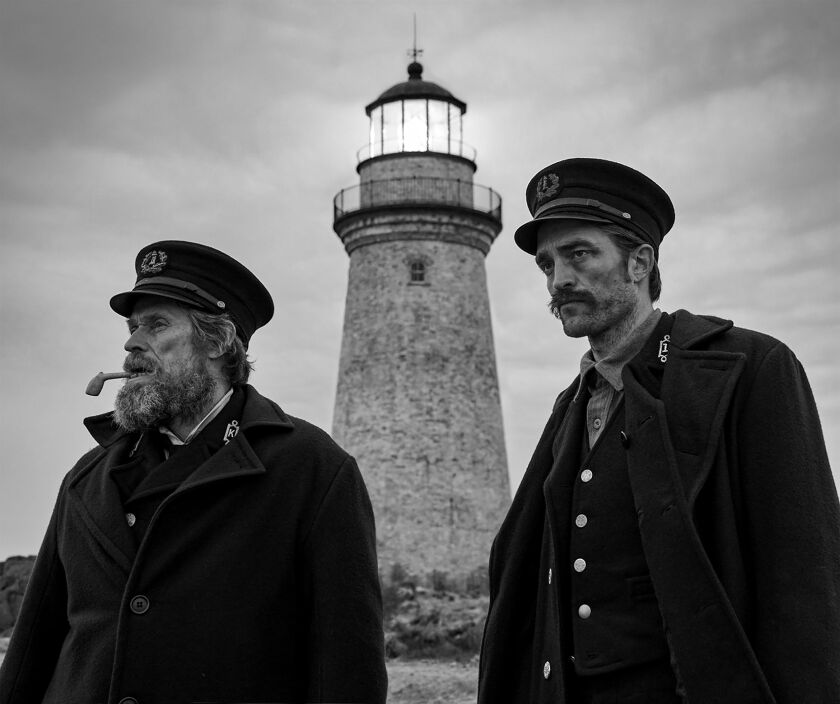
 The narrative the ambience hangs from isn’t quite as sure, but what’s to worry when you have Willem DaFoe and Robert Pattinson? The setup, based on writings by Melville and sea-obsessed others of the era, has two men keeping the flame on a remote isle somewhere far off the New England coast. It’s circa 1890, so there are no cell towers; there’s also no Morse code from the island should something go wrong. The pair are dropped off on the rock for a four-week shift. Dafoe’s Thomas is a salty old tar, Pattinson’s wide-eyed Ephraim the newbie in his charge. The order of things gets laid out early on: Thomas does the all the attending to light, which is kept under tight lock and key, as well as the cooking, while Ephraim pretty much does the backbreaking rest – scrubbing the floors, hauling heavy loads of coal across jagged rock outcroppings, emptying the piss pots and painting the structure from a rickety harness that would make any OSHA official cringe.
 The scene smolders in tight closeups, but before the grim gravity of Nick’s prospects can take root fully – or the psychiatrist can dig any deeper – Nick’s brother Connie (Robert Pattinson) bursts through the door and extracts his sibling. Has Nick been saved? For the moment, yes, but not in the bigger scheme of things. The two are incredibly tight (the Safdies are clearly drawing on their own sibling bond) but pretty much have only each other to draw on and limited financial resources; to keep the pack together, Connie cooks up a plan to rob a bank in the middle of the day, the execution and choreography of which is so hauntingly reminiscent of “Dog Day Afternoon” you half expect Al Pacino to pop out with chants of “Attica.” The lads do make off with the cash, but matters with ride sharing, dye packs and Nick’s emotional instability provide steep obstacles. It’s a riveting game of cat and mouse as the brothers dash down littered alleyways and into a mall atrium with the police a hot breath away. Just as they look to be in the clear, Nick crashes through a glass pane and is taken into custody. Where the story goes next is as unpredictable as its protagonist.
 Pearce plays the barely named Eric, an aloof loner with an ostensible military background. The film opens with the tacit protagonist making a pit stop at an isolated karaoke bar (which looks more like a grimy torture chamber from a “Saw” movie than a place of merriment) for some water and a bite when a speeding truck laden with unsavory lads crashes, and its occupants quickly disembark and carjack Eric’s sleek, lean coupe. That’s it – from there on out, Eric will stop at nothing to reclaim his car. It’s a straight-up one-noter like “Duel,” propelled by Eric’s simmering resolve and the ever pungent question as to what else has to be in that car to make Eric want it that bad.
  For What it's Worth