‘Oppenheimer’: Mass destruction, dirty politics and a messy personal life, down to the atom


At one juncture in Christopher Nolan’s last outing, the mind-bending, time-rewinding spy thriller “Tenet” (2020), a scientist in the future able to weaponize and manipulate the past to alter history is likened to J. Robert Oppenheimer, lead scientist at the Manhattan Project, which produced the nuclear warhead that in effect ended World War II. Foreshadowing for this next project?
That future scientist killed themselves to take their secrets with them and prevent further ripples in time; Oppenheimer, as the Cold War set in, became outspoken against nuclear proliferation and subsequently – with the help of FBI dirty trickster J. Edgar Hoover – had his security clearance revoked by the Atomic Energy Commission. It didn’t help that his wife, lover and several other personal associates had ties to the American Communist Party.
Nolan began work on his “Oppenheimer” in January, shortly after the Biden administration conferred public wrongdoing on the AEC and U.S. government for its lack of process and credible evidence against Oppenheimer, who died in 1967 at the age of 62.
The film plays loyally to its roots, the 2005 biography “American Prometheus: The Triumph and Tragedy of J. Robert Oppenheimer” by Kai Bird and Martin Sherwin, and both embrace Oppenheimer (“the father of the atomic bomb”) as a committed yet complicated man, caught at many crossroads: the morality of mass destruction, the dirty politics of Cold War paranoia and messy personal relationships. As Oppenheimer, frequent Nolan collaborator Cillian Murphy portrays the scientist as a reserved, buttoned-up sort with a kind, demurring affect. He’s charismatic and approachable, with piercing blues and a gaunt sheen clearly deepened for the part; Oppie’s signature wide-brim porkpie fedora goes a long way to cement the image. It’s a bravura performance that rightly sends Murphy, best known for the series “Peaky Blinders” and Danny Boyle’s “28 Days Later” (2002), to the fore after many years of almost getting there. He feels custom minted for the part.
Nolan is a filmmaker who likes to play with time – the brilliant weaving of three timelines that converge at singular moment in “Dunkirk” (2017) as well as “Tenet” and “Memento” (2000) – and works another triptych here: the race to build the atomic bomb before the Nazis at the Las Alamos complex (something of a Western mining town) in the middle of the New Mexican desert; Oppenheimer’s 1954 hearing before the AEC inside a cramped conference room; and the senate proceedings on Eisenhower’s secretary of commerce nominee Lewis Strauss, who had been Oppenheimer’s boss at the commission. The clear but kinetic interweaving that frames the Strauss hearings in black and white and the rest in color is eerily evocative of Oliver Stone’s energetically edited and sharply acted bit of nearby history, “JFK” (1991); in “Oppenheimer,” that then-junior senator from Massachusetts poetically has a small hand in one of the three timelines.
“Oppenheimer” for the most is a deeply internal film, and Nolan deepens our access to Oppenheimer’s mental and emotional state with tearaways to stars colliding in the cold dark universe, people in a celebratory audience suddenly melting in a hot white light and, at one point during his AEC security access hearing, sex with his lover Jean Tatlock (Florence Pugh, fantastic in the small part) and him confessing to the tryst to his wife Kitty (Emily Blunt, fantastic in a larger part). The soul-rattling aural immersion and meticulous imagery by Nolan regulars composer Ludwig Göransson and cinematographer Hoyte Van Hoytema, as well as an ace team effort by the sound department, fill out the spectacular, collective achievement. The cast beyond Murphy and Robert Downey Jr., who manages to make the eely Strauss human, is a long list of potential competing supporting-actor award nods, starting with Matt Damon as general (to be) Lesley Groves, who oversees the Manhattan Project and gets to deliver a fiery back-and-forth that’s almost on par with his indelible rant in “Good Will Hunting” (1997). Also notable are director Benny Safdie (“Uncut Gems,” “Good Time”) as H-bomb scientist Edward Teller; Josh “where have you been?” Hartnett solid as Oppenheimer’s department mate at Berkeley, Ernest Lawrence; Kenneth Branagh as physicist Niels Bohr; Jason Clarke, insidious as AEC special counsel Roger Robb; and Tom Conti (another “where have you been?”) avuncular and dead on as Albert Einstein. The list goes on. Less effective are Casey Affleck as military investigator Boris Pash interrogating Oppenheimer and Gary Oldman as President Harry Truman.
How Nolan pulls it all together is interesting in how much you see – or don’t – of the actual use of the atomic bomb and the devastation it had on Hiroshima and Nagasaki (thought it’s in the corner of every frame) versus the high of the Trinity experiment at Los Alamos (well orchestrated cinematically) and chaotic proceedings in the rooms and halls of government. Ever meticulous, Nolan also does a masterful job of taking subthreads and small gestures and weaving them into surprising and disparate places with subtle poetic panache that doesn’t scream, “Did you just see what I did there?” I wouldn’t want to call them Easter eggs, but …
As to Oppenheimer’s initial reluctance to signing onto the Manhattan Project due to the potential moral and historical implications, one fellow Jewish colleague says, “We don’t know if we can’t trust ourselves with it, but we know we can’t trust the Nazis.” A point well taken, with added personal appeal. Later, after the Germans have been defeated and Truman drops the two bombs, he justifies it by saying it saved American lives and allowed him “to bring our boys home.” Truman, like Strauss, comes off as a bit of a runaway ego (he calls Oppenheimer a “crybaby” when not quite out of earshot) and the film poses whether the bombings were necessary. It’s another good pique, and a complex one for me – this was when my father, a teenage member of the 101st Airborne, had just finished his service in Europe and was on a slow boat to Japan. Heavy stuff all around.
Rewinding back to “Tenet,” Nolan’s tightly controlled 2020 release during the height of the pandemic and the first big theatrical release at a time we were still in masks, eating outside under heater lamps and spaced apart in theaters. That release signaled the revival of the filmgoing biz and a return to normal; with “Oppenheimer” we have Hollywood writers and actors on strike, which could mark a notable damper to the release schedule come holiday season and beyond. For now we have “Oppenheimer,” which is more than a movie or a just a biopic; it’s an immersed contemplation on destiny, control and power, and obligations to the future. Looking at the political shenanigans then and now, it’s easy to see where we came from and where we are. “Oppenheimer” may not quite be an American history lesson, but it is most certainly an American fable.
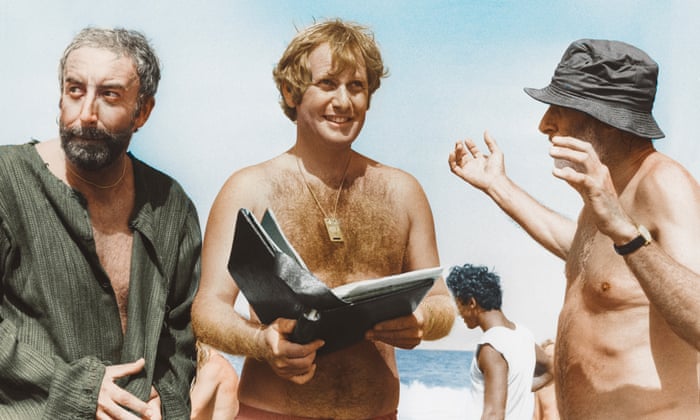
 “The Ghost of Peter Sellers” is something of a therapy session for director Peter Medak, who worked with Sellers on the abysmal 1973 pirate comedy “Ghost in the Noonday Sun.” Medak was an up-and-comer hot off the 1972 hit “The Ruling Class” and chanced into Sellers – the world’s most revered comic actor of the time – and at the “Pink Panther” star’s behest, agreed to helm the film conceived by Sellers’ comedic running mate, Spike Milligan. Medak, 35 at the time, said yes (“How could I not?”) and the film went on to be an unmitigated disaster. It ran well over budget, and has still never fully been released.


 For What it's Worth