Like its topic, this biopic is not short, has epic battles and a Josephine worth the exile
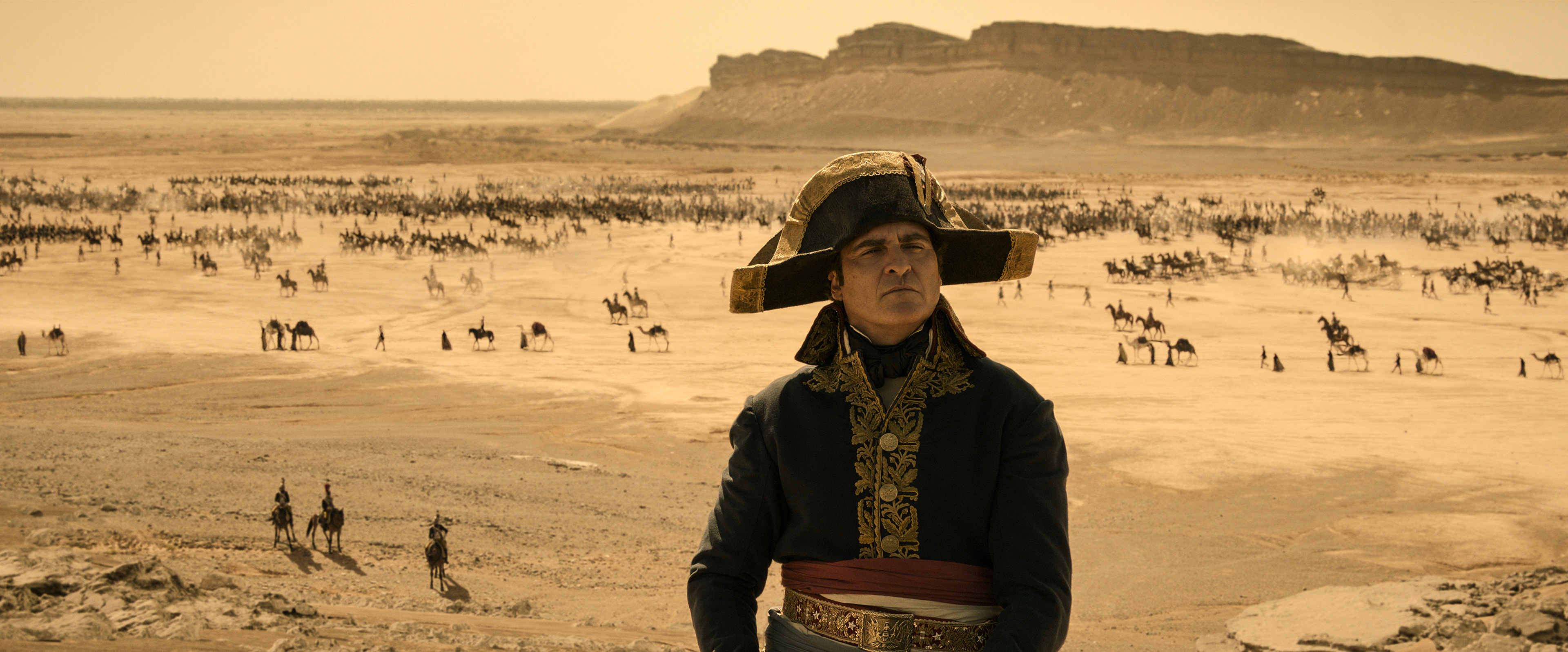

When you think of the films of Ridley Scott, it’s most likely his early sci-fi classics “Alien” (1979) and “Blade Runner” (1982), but the prolific filmmaker’s first effort, “The Duelists” (1977), was a period piece set in France during the Napoleonic wars. In that film (not to be confused with “The Last Duel” from 2021, which Scott made with local guys Ben and Matt), the French emperor’s presence was felt constantly, but Napoleon himself never steps into the frame; it’s with a daub of poetic justice that Scott, nearly 50 years later and with a budget almost 200 times bigger, gets to deliver a biopic epic centered on the historically notorious icon known as much for his hubris and the self-esteem complex named after his alleged diminutive stature and inflammable ego as for his military gamesmanship.
As Napoleon, the usually reliable Joaquin Phoenix (“Beau is Afraid,” “You Were Never Really Here”) feels somewhat subdued. That said, it is intriguing to see him reunite with Scott some 22 years after “Gladiator,” in which Phoenix also played a self-absorbed ruler – a deliciously sniveling fop of a Roman emperor. What’s missing is some of the entitled, mercurial and Oscar-winning zing baked into his mirthless Gotham ghoul in “Joker” (2019).
The film opens with Napoleon witnessing the beheading of Marie Antoinette. The French Revolution is in full swing, and the British are looking to gain a bigger foothold across the channel. To prove his worth to the new republic, Napoleon leads the fierce and tactically astute Siege of Toulon, where underpowered French forces take out a well-ensconced British fort under the cloak of night. It doesn’t help that the Brits are in the midst of sweeping, drunken merriment and caught with their pants down, literally.
Thus begins Napoleon’s ascent from military marksman to iron-fisted ruler as one part of the French Consulate triumvirate and later emperor, and efforts to expand the French empire into Africa and Eastern Europe take hold as well as the long-simmering desire to crush the hated English and their hold on the seas (see “Master and Commander”). The main threads of Scott’s film, penned by David Scarpa (“Man in the High Castle” and Scott’s “All the Money in the World”) focus on Bonaparte’s obsession with besting Russian Tsar Alexander I (Édouard Philipponnat), a handsome man-boy that Napoleon seems to hold in deference, and his capricious relationship with Josephine (Vanessa Kirby). Scott’s orchestration of the Battle of Austerlitz, where Napoleon takes it to Russian and Austrian forces (also called the Battle of Three Emperors), as well as the infamous, post-Elba exile grudge match, Waterloo, are stunning in scope, choreography and gritty grandeur. Kirby, who plays the White Widow in the “Mission: Impossible” films, is no stranger to strong women and fills those shoes well here, yet the relationship and the tempo of its tears and folds is wildly uneven – which is not on Kirby, to say the least. Kirby portrays a woman whose confidence and sensuality are more than worthy of holding the gaze of a man with limitless power and, as a result, after their marriage implodes because of heir matters, remains a regularly sought confidant, counsel and simmering longing. The sex scenes have a cheeky silliness, not too far off from some of Scott’s work with Cameron Diaz and a racy sports coupe in “The Counselor” (2013) and most recently Lady Gaga and Adam Driver in “The House of Gucci” (2021).
Beyond the major battles – epic with a capital “E” – and sticking to the historic record, Scott and Scarpa don’t let Bonaparte off the hook for his actions. His Ahab-esque quests cost needless lives, something the film registers as clearly and coldly as the hoar of the harsh Russian winter. As far as the size thing goes, the record shows Napoleon at just north of 5-foot-6; it’s rumored that the Corsican (a lesser, looked-down-upon ilk to most French noblemen at the time) was surrounded intentionally by taller, statuesque guardsmen. Scott and Scarpa wisely choose not to delve into the matter, but Scott often shoots down on Bonaparte, or up from his POV, lending to the effect.
The picture, which holds one’s eye throughout the 157-minute running time, is opulent but bears the jerky unevenness of Scott’s “Gucci.” Perhaps a Thanksgiving Day viewing will leave visual feasters of all things Napoleonic hungry and searching the streaming universe for the timeless 1927 treasure of the same name crafted by Abel Gance. Seek it out and enjoy the treat. It’s not an either-or, mind you, as Gance’s tale tells of a young Napoleon in school and his early days in the military, dovetailing nicely in time to where Scott’s vision starts.



 If that sounds like the boilerplate to “Taken” or “Taxi Driver,” you’d be right to think so – at least on paper – but for Ramsay, getting at her protagonist’s state of mind and backstory is anything but a linear exercise. In wisps we catch Joe (Joaquin Phoenix) in military fatigues within the confines of a desert encampment feed a candy bar through a chain-link perimeter to a youth who is promptly shot dead by a surprising source. Later, ostensibly in the FBI or some investigative law enforcement unit, Joe uncovers a van full of dead bodies. And then there are the flashbacks to a highly abusive father and Joe’s attempts at suicide via asphyxiation (dry cleaning bags being the impermeable of choice). These images are littered throughout, giving brushstrokes of insight to the enigmatic Joe, bearded, burly and employing the peen end of a hammer to bash his way through his first assignment. To save the senator’s daughter (Ekaterina Samsonov), he employs the same implement – a new one of course, selected carefully from the hanging racks of a Home Depot, Ace Hardware or the like – working his way through the Manhattan brownstone in a more “Old Boy” style than Travis Bickle might consider.
  For What it's Worth