Tag Archives: Christopher Nolan

Oppenheimer

21 Jul

‘Oppenheimer’: Mass destruction, dirty politics and a messy personal life, down to the atom

At one juncture in Christopher Nolan’s last outing, the mind-bending, time-rewinding spy thriller “Tenet” (2020), a scientist in the future able to weaponize and manipulate the past to alter history is likened to J. Robert Oppenheimer, lead scientist at the Manhattan Project, which produced the nuclear warhead that in effect ended World War II. Foreshadowing for this next project?

That future scientist killed themselves to take their secrets with them and prevent further ripples in time; Oppenheimer, as the Cold War set in, became outspoken against nuclear proliferation and subsequently – with the help of FBI dirty trickster J. Edgar Hoover – had his security clearance revoked by the Atomic Energy Commission. It didn’t help that his wife, lover and several other personal associates had ties to the American Communist Party. 

Nolan began work on his “Oppenheimer” in January, shortly after the Biden administration conferred public wrongdoing on the AEC and U.S. government for its lack of process and credible evidence against Oppenheimer, who died in 1967 at the age of 62.

The film plays loyally to its roots, the 2005 biography “American Prometheus: The Triumph and Tragedy of J. Robert Oppenheimer” by Kai Bird and Martin Sherwin, and both embrace Oppenheimer (“the father of the atomic bomb”) as a committed yet complicated man, caught at many crossroads: the morality of mass destruction, the dirty politics of Cold War paranoia and messy personal relationships. As Oppenheimer, frequent Nolan collaborator Cillian Murphy portrays the scientist as a reserved, buttoned-up sort with a kind, demurring affect. He’s charismatic and approachable, with piercing blues and a gaunt sheen clearly deepened for the part; Oppie’s signature wide-brim porkpie fedora goes a long way to cement the image. It’s a bravura performance that rightly sends Murphy, best known for the series “Peaky Blinders” and Danny Boyle’s  “28 Days Later” (2002), to the fore after many years of almost getting there. He feels custom minted for the part.

Nolan is a filmmaker who likes to play with time – the brilliant weaving of three timelines that converge at singular moment in “Dunkirk” (2017) as well as “Tenet” and “Memento” (2000) – and works another triptych here: the race to build the atomic bomb before the Nazis at the Las Alamos complex (something of a Western mining town) in the middle of the New Mexican desert; Oppenheimer’s 1954 hearing before the AEC inside a cramped conference room; and the senate proceedings on Eisenhower’s secretary of commerce nominee Lewis Strauss, who had been Oppenheimer’s boss at the commission. The clear but kinetic interweaving that frames the Strauss hearings in black and white and the rest in color is eerily evocative of Oliver Stone’s energetically edited and sharply acted bit of nearby history, “JFK” (1991); in “Oppenheimer,” that then-junior senator from Massachusetts poetically has a small hand in one of the three timelines. 

“Oppenheimer” for the most is a deeply internal film, and Nolan deepens our access to Oppenheimer’s mental and emotional state with tearaways to stars colliding in the cold dark universe, people in a celebratory audience suddenly melting in a hot white light and, at one point during his AEC security access hearing, sex with his lover Jean Tatlock (Florence Pugh, fantastic in the small part) and him confessing to the tryst to his wife Kitty (Emily Blunt, fantastic in a larger part). The soul-rattling aural immersion and meticulous imagery by Nolan regulars composer Ludwig Göransson and cinematographer Hoyte Van Hoytema, as well as an ace team effort by the sound department, fill out the spectacular, collective achievement. The cast beyond Murphy and Robert Downey Jr., who manages to make the eely Strauss human, is a long list of potential competing supporting-actor award nods, starting with Matt Damon as general (to be) Lesley Groves, who oversees the Manhattan Project and gets to deliver a fiery back-and-forth that’s almost on par with his indelible rant in “Good Will Hunting” (1997). Also notable are director Benny Safdie (“Uncut Gems,” “Good Time”) as H-bomb scientist Edward Teller; Josh “where have you been?” Hartnett solid as Oppenheimer’s department mate at Berkeley, Ernest Lawrence; Kenneth Branagh as physicist Niels Bohr; Jason Clarke, insidious as AEC special counsel Roger Robb; and Tom Conti (another “where have you been?”) avuncular and dead on as Albert Einstein. The list goes on. Less effective are Casey Affleck as military investigator Boris Pash interrogating Oppenheimer and Gary Oldman as President Harry Truman.

How Nolan pulls it all together is interesting in how much you see – or don’t – of the actual use of the atomic bomb and the devastation it had on Hiroshima and Nagasaki (thought it’s in the corner of every frame) versus the high of the Trinity experiment at Los Alamos (well orchestrated cinematically) and chaotic proceedings in the rooms and halls of government. Ever meticulous, Nolan also does a masterful job of taking subthreads and small gestures and weaving them into surprising and disparate places with subtle poetic panache that doesn’t scream, “Did you just see what I did there?” I wouldn’t want to call them Easter eggs, but …

As to Oppenheimer’s initial reluctance to signing onto the Manhattan Project due to the potential moral and historical implications, one fellow Jewish colleague says, “We don’t know if we can’t trust ourselves with it, but we know we can’t trust the Nazis.” A point well taken, with added personal appeal. Later, after the Germans have been defeated and Truman drops the two bombs, he justifies it by saying it saved American lives and allowed him “to bring our boys home.” Truman, like Strauss, comes off as a bit of a runaway ego (he calls Oppenheimer a “crybaby” when not quite out of earshot) and the film poses whether the bombings were necessary. It’s another good pique, and a complex one for me – this was when my father, a teenage member of the 101st  Airborne, had just finished his service in Europe and was on a slow boat to Japan. Heavy stuff all around.

Rewinding back to “Tenet,” Nolan’s tightly controlled 2020 release during the height of the pandemic and the first big theatrical release at a time we were still in masks, eating outside under heater lamps and spaced apart in theaters. That release signaled the revival of the filmgoing biz and a return to normal; with “Oppenheimer” we have Hollywood writers and actors on strike, which could mark a notable damper to the release schedule come holiday season and beyond. For now we have “Oppenheimer,” which is more than a movie or a just a biopic; it’s an immersed contemplation on destiny, control and power, and obligations to the future. Looking at the political shenanigans then and now, it’s easy to see where we came from and where we are. “Oppenheimer” may not quite be an American history lesson, but it is most certainly an American fable.

The Batman

4 Mar

‘The Batman’: The Dark Knight gets darker

By Tom Meek Wednesday, March 2, 2022

“The Batman” is a dark, deeply emotional affair that’s got a lot going for it and a lot going on – perhaps too much. (It’s almost three hours long.) We could also call it version 3.5 of the cinematic dark knight, with the Tim Burton and Joel Schumacher films in the 1990s and Christopher Nolan trilogy being 1.0 and 2.0 and Ben Affleck’s donning of the cowl in the “Justice League” films the 0.5 splitter. It may be 4.5 if we take into account the spoofy, goofy BAM! POW! fun of the Adam West television series.

What drives this reboot is a succession of grim murders of municipal higher-ups, beginning with the mayor and working its way over to the heads of the police and district attorney’s offices. Personally, if I was orchestrating such sinister deeds I would have saved the top cat (the mayor) for last – it just feels more operatic. The thing that links the macabre deaths are the signatures left at each crime scene: a riddle punctuated with a giant question mark, an encrypted cipher, a card addressed to “The Batman” and some spray painted (or blood painted) messaging about a web of lies or some such thing.

Given that Paul Dano plays The Riddler, you can probably guess who’s behind the acts that play out in sadistic fashion like a sin-atoned-for in David Fincher’s “Se7en” (1995) or a Jigsaw trap from one of the “Saw” films. The Riddler here just may be darker and more demonic than the spins on Joker performed by Heath Ledger and Joaquin Phoenix: One clue leads to a thumb drive with a severed thumb attached to it, so those recovering it can unlock it via thumbprint, and it clearly takes a lot of work to be that twisted. But wait, this film’s about the bat, right? Well yes, and you get plenty of Robert Pattinson in the beefy Kevlar suit, which turns out to be a bit of a double-edged sword. We get to embed with him more, but the tease of enigma that has been the traditional draw dissipates. Director-writer Matt Reeves (“Let Me In,” “Cloverfield”), co-writer Peter Craig and Pattinson paint their Batman/Bruce Wayne as a deeply tortured soul, a monomaniacal tool of vengeance with no trace of mirth or joy and no bifurcation of personalities; what we drink in is all dour, sullen anger, underscored by the incarnation’s theme song, Nirvana’s broodingly depressive “Something in the Way.”

What carries the film are the sly intricacies of The Riddler’s misdeeds, the mysterious intent behind them and the stunning set designs that range from the crowded, rain-slicked streets of Gotham to the gaping Batcave and an Edward Hopper-styled diner lit in green neon. The cumulative effect is a strange, wonderful fusion of Walter Hill’s “Streets of Fire” (1984) and Ridley Scott’s future noir, “Blade Runner” (1982). The other aspect of “The Batman” that largely works is that our bat here is something of a master sleuth, a tech-age Sherlock Holmes, if you will. It’s a little off-putting to see him sniffing around a live crime scene CSI style, but part of the joy comes in looking beyond the obvious, going one level deeper and admiring the acumen of our hero. Caught up in the mix too is the updated version of Catwoman (Zoë Kravitz), though she simply goes by her birth name of Selina and works in a nightclub owned by Oswald Cobblepot, aka The Penguin, played beguilingly by Colin Farrell under gobs of makeup. He’s something of a brotherly incarnation of Robert De Niro’s portly Jake LaMotta in “Raging Bull” (1980).

The rest of the impressive supporting cast includes a perfectly coiffed Andy Serkis as a dutiful Alfred who’s killer at decoding ciphers, John Turturro as the local crime boss all trails seem to lead to, Peter Sarsgaard as the sleazy DA and Jeffrey Wright, channeling his cagey investigative reporter from “The French Dispatch” (2021) as Lt. Gordon, the guy who fires up the bat signal and may be the only clean cop on the force. The new take on the Batmobile is something of a throwback to the muscle cars of the 1970s; it’s like someone bat-tatted a classic Dodge Charger and strapped on a jet engine turbo boost like one of those nitro-infused junkers in “The Road Warrior” (1981).

Pattinson and Kravitz look fetching together, and given their raw charisma you’d think the two would click together like Legos (there is that “Lego Batman Movie”), but the romantic undercurrent between them feels postured and unearned. Then again, this is a brooding, relentless lad who takes his mission as a higher cause – “I am vengeance” gets tossed around a lot. Batman’s most genuine connections are those with Gordon, who for reasons not on screen trusts him emphatically, and his lifelong loyal butler and caregiver Alfred, though that ultimately gets challenged as “the veil is pulled back and the lie’s exposed.” I grew up near Connecticut cities where corruption scandals were an annual “wait for it” event that didn’t disappoint, and of course we had infamous mayor Buddy Cianci just down the way in Providence. Gotham’s not much different: dirty cops with drug money washing political hands. What it does have is that dashing millionaire orphan who likes to dress up, break out the bat toys and take out the trash.

Tenet

14 Sep

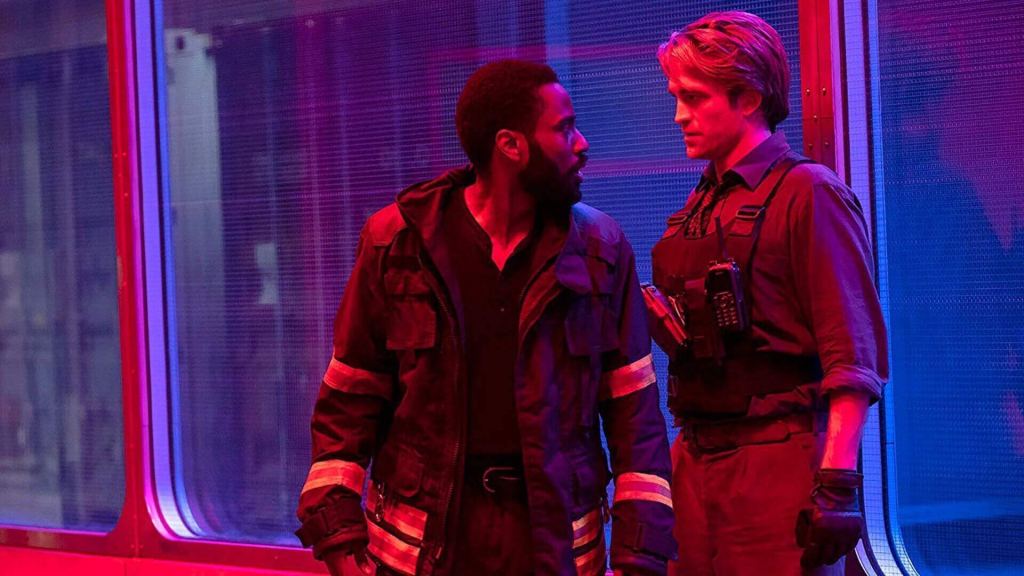
‘Tenet’: Time travel caper by Christopher Nolan chooses its moment, masked against apocalypse

By Tom Meek

Well, I did it: I went to a theater and saw “Tenet.” Would I recommend you to? That’s a personal call. For me it didn’t feel too risky, but read on. I attended a 4 p.m. show at Landmark’s Kendall Square Cinema. I bought my ticket online, but still had to wait in line to show the usher behind a plexiglass shield my emailed barcode and get a printed ticket. I saw only three other people at the theater, all folks asking for senior discounts – in short, those in high-risk categories but clearly desperate for an in-theater experience, as was I. Landmark offered no snacks, and masks had to be worn 100 percent of the time. Every two seats in the theaters are blocked off, and management asks you to sit in alternating rows – something, I did not need to worry about. I was the only person at my screening. (Apple Cinemas near Fresh Pond and Alewife is showing it too, since reopening Friday.)

This being a Christopher Nolan film, seeing it on a big screen is kind of a must – in the very least for the imposing, driving score (by Ludwig Göransson, though it feels and sounds a lot like Hans Zimmer’s work on Nolan’s 2010 “Inception”) and the impressive camera work by Hoyte Van Hoytema, Oscar-nominated for Nolan’s WWII time scramble, “Dunkirk” (2017). Playing with time and space is Nolan’s thing; he did it with “Memento” (2000) to tell a murder mystery in reverse, and “Interstellar” (2012) as space travelers who go through a black hole where decades of Earth time pass in minute. Here time is imbued into objects sent back from the future. Sounds zany, right? It’s one of the things you just let wash over you, because no matter how hard Nolan and his characters try to explain, you feel like you’re just not getting it. The best I can do is that you can rewind history and insert yourself into the action – in essence, altering the future – but the catch is everyone else is moving in reverse while you’re going forward. People walk backward, cars go in reverse, and bullets get sucked back into their gun. 

Continue reading

Is it safe to see a film in a theater?

2 Sep

Kendall Square Cinemas has reopened quietly, with fare such as ‘Tenet’ for up to 25 in theater

By Tom Meek
Tuesday, September 1, 2020

Two weeks ago, I penned a column about movie screens staying dark in Cambridge and Somerville because of the pandemic, even as AMC, ShowPlace Icon and other theater chains opened in and around Boston. Friday that all changed: the Landmark theater in Kendall Square had something of a stealth opening.

“Face masks at all times, limited seating and no concessions at this time, per state guidelines,” theater manager Howie Sandler said in an email. “Also we are cleaning throughout the day, and after each show we wipe down chairs. We have signs up all over the place stipulating masks and social distancing, and we have markers on the floor leading you to buy tickets.” (State guidelines actually allow prepackaged foods.)

The limited seating measures including every other row being blocked off in the bigger theaters, “and we ask folks to leave two chairs between them and another party. Smaller theaters have seats blocked off in each row to spread people out,” Sandler said. A maximum 25 people are allowed in the larger theaters, and 16 to 24 people in Kendall Square Cinemas’ three smaller ones.

For now, The Brattle Theatre in Harvard Square remains closed to public screenings but is available for private rentals – most of which have been to couples, according to the “Brattle Film Podcast.” Apple Cinemas in Fresh Pond also remains closed, like the Somerville Theatre in Davis Square and Harvard Film Archive.

The Kendall Square theater is playing traditional arthouse fare such as “The Personal History of David Copperfield” and “Tesla,” but also Charlie Kaufman’s latest “I’m Thinking of Ending Things,” which caught me by surprise, as my press kit says it’s coming to Netflix on Sept. 4. What’s also interesting is that this week Landmark will open “Tenet,” the latest big-screen extravaganza from Christopher Nolan (“Dunkirk,” “Inception”). It’s a shift for Landmark, though its sister theater Embassy Cinema in Waltham plays more mainstream box office fare.

Nolan’s film has been a sore point for critics; many say they won’t go to a theater yet and prefer to get screener links. No links were given out for “Tenet,” so if you didn’t go to theater-staged press screening, you did not see it. Some media outlets (including The Washington Post) won’t run reviews for theater-only releases; others (including The Boston Globe) that get screener links for theater-only releases will post a safety caveat. I’m still struggling with the “Do I review a film in the confines of my house and recommend it to you when you can only see it in the theater” conundrum. I missed the “Tenet” press screening due to a personal conflict, so if you see a review here from me, you’ll know I went to the theater just as you would. I have to say Sandler’s precautions at Kendall sound thorough – but it’s still an indoor space.

In response to this whole Covid-19, get-back-to-normal limbo, studios take different approaches. “Bill & Ted Face the Music” was released simultaneously theatrically and through online streaming (for $20). The live-action “Mulan” from Disney will be released this weekend on the conglomerate’s streaming platform Disney+ for $30.