Tag Archives: charlestoncitypaper

A Most Violent Year

28 Jan

Jessica Chastain and Oscar Isaac have edgy and steamy chemistry in A Most Violent Year

 Much of director J.C. Chandor’s latest film, A Most Violent Year,lives up to its title. There’s armed hijackings, masked gunmen setting upon an isolated house, and winding car chases. If that’s not enough, it bears the indelible sheen of the films that Martin Scorsese and Francis Ford Coppola tapped out during the 70s, where the sudden and brutal eruption of violence became an art form.

A Most Violent Year is set around that time too — the New York City of 1981 — when crime and inflation were at near all-time highs. At the center of such chaos presides Abel Morales (Oscar Issac) a Colombian immigrant who owns an oil and heating company that is no easy beast to wrangle. We never get to see Abel down in the trenches, but we know instantly from his stoic posture, dress-for-success flare, and steely intensity that he’s done his time and earned his post — an assumption that folds back on itself as the story develops.  Continue reading

Whiplash

22 Jan

J.K. Simmons (right) leaves behind his affable persona to play a hot-headed jazz chair who berates his musicians, most commonly Andrew (Miles Teller, left) in Whiplash

J.K. Simmons, the gummy affable bald guy who frequently crowds your TV in those semi-humorous Farmers University Insurance ads, has been a long-toiling character actor waiting for his thick slab of meat. In the interim, he has projected a similar amiable persona as the dad in the indie hit Juno and conjured up something a bit more cantankerous and angry as the news editor J. Jonah Jameson in Sam Rami’s Spider-Man trilogy. With Whiplash, Simmons finally gets his steak, and a hunk of Kobe at that.  Continue reading

Björk: Biophilia Live

13 Nov
A 50-year-old Björk gets celestial in the new concert film: Björk: Biophilia Live

Outlandish Icelandic performance artist Björk has long been a polarizing figure. When we think of the now-50-year-old musician, there are two things that cannot be denied. For one, the singer’s warbling high-pitched wails never fail to enchant. And two, she seems as youthful now as she did with the Sugarcubes nearly three decades ago.

Current generations may not remember the Cubes or even Björk’s foray into acting in Lars von Trier’s Dancer in the Dark, for which she won best actress at Cannes in 2000. Perhaps more notable is the notorious swan dress she wore to the Oscars in 2001. That dress, a bellwether of the singer’s fashion sensibility, is a benign infraction compared to the strange frock she dons in her new concert film, Björk: Biophilia Live. It looks like melted and oozing human breasts fused together. Think of the raw garishness of Lady Gaga’s meat dress, and you’d be close to imagining Björk’s latest foray into fashion freakiness. In the concert flick, she also sports a dramatic orange wig, reminiscent of Erykah Badu’s ‘do in Dave Chappelle’s Block Party. Björk is a baroque caricature, but her appearance is no longer a distraction once a song begins.  Continue reading

Frank

6 Nov

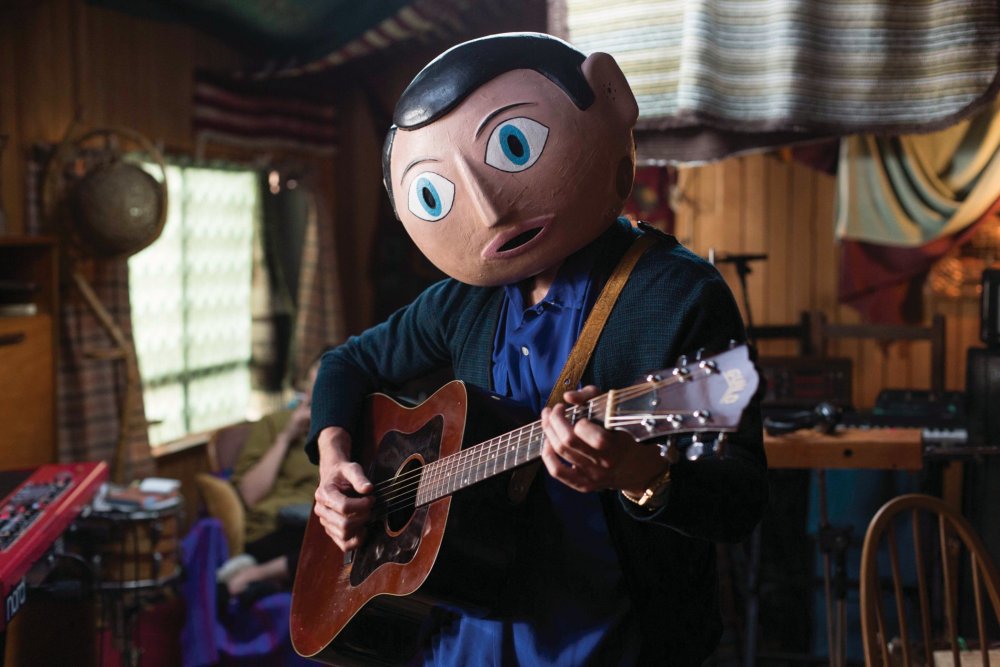
Gimmicks get you gigs, or at least that’s the implied mantra for novelty acts like GWAR and KISS, where garish garnish generates spectacle, buzz, and ticket sales. The same might be said of Soronprfb, the band with the intentionally unpronounceable name in the movie Frank, where the lead singer wears a giant papier-mâché head bearing a blue-eyed boyish countenance. Soronprfb however doesn’t seek fame and fortune; they desire artistic respect and only produce work that reflects their values and integrity.

Just what those values are remains murky, but you can’t deny their commitment to this esoteric tenet. Playing to handfuls in random dives, eschewing promotion (social or otherwise), and lacking cash, might be setbacks and poor decisions to some, but for Soronprfb it’s a badge of honor and a starving artist rallying point. And when the time strikes to record a new album, the group turns-off, drops out, and cloisters away to a quaint lake-side lodge somewhere in the Irish north, where they resign to remain until the necessary inspiration descends and the new disc is pressed from their argumentative malaise.

Continue reading

The Judge

9 Oct
Robert Downey Jr. brings some snark to his role in The Judge, while Robert Duvall lights up the screen with his bravado

Robert Downey Jr. brings some snark to his role in The Judge, while Robert Duvall lights up the screen with his bravado.

Sometimes you can add all the right ingredients, but if the base you’re working with isn’t properly blended, you can’t make it work. That’s the case with The Judge, where all the star power helps to make the film enjoyable but doesn’t erase the abounding clichés in the uneven courtroom drama. And despite revolving around a trial, the flick is really more about the personal interactions of the players outside the crucible of justice and how those relations season the unbiased proceedings. John Grisham-lite or Nicholas Sparks with some gravity might be the best way to describe The Judge. The film’s a bit of a genre switch too for director David Dobkin as he cut his directorial teeth with screwball comedic fare like Wedding Crashers and The Change Up.

By construct, The Judge is rife with conflict and paradox that come in the form of well-worn archetypes like past versus present, country versus city, and the father railing against the son who just won’t see things his way. The film’s most beatific blessing however, beyond the gorgeous bucolic setting (Shelbourne Falls, Mass. subbing in for small town Indiana), is the casting of Robert Downey Jr. as Hank Palmer, a slick Chicago attorney who does nothing but win and has a wife with abs and a derrière you could bounce quarters off. But, as we shortly find out, Mrs. Palmer (Sarah Lancaster) has been bored and wandered with one of her fellow gym rats, something Hank is unceremoniously informed of. All this news comes at the same time Hank learns that his mother has died after a long battle with cancer. Clearly Hank is detached from the family out in the heartland, and for us, the viewer, he gets a few automatic demerits for not being there with mom at the end — his quick reprieve lies in his fatherly compassion towards his seven-year-old daughter Lauren (Emma Tremblay).  Continue reading

Gone Girl

2 Oct
Ben Affleck's smile at press junkets caught director David Fincher's eyes and helped him get the role of Nick Dunne

How does one even have a go at Gone Girl? Anyone who’s read Gillian Flynn’s wildly popular novel — she penned the script as well — knows there’s some pretty well-laid change-ups within the story line, and we’re not even talking about the plot twist that comes sailing in at the end of the book. No, we’re talking about subtle turns of the screw that change and redirect context and the viewer’s orientation, forging an ephemeral, yet enjoyable immersion into the rapture of intrigue. So, I’ll tread carefully.

As the title implies, a woman goes missing under some curious circumstance and her husband’s innocence or culpability in the matter hangs in the balance. Gone Girl, much like Denis Villeneuve’s dark and foreboding Prisoners (2013), isn’t so much about solving the mystery at the fore, but the potpourri of personalities that drive and shape it. It’s an interesting comparison too, because the bleak rainy sheen that Villeneuve renders inPrisoners conjures up ominous shades of some of David Fincher’s more macabre works, namely Zodiac and Se7en.

Given Fincher’s running success with cinematic adaptations of bestsellers (Fight Club, The Social Network, The Girl With the Dragon Tattoo) the pairing would seem perfect, but invariably an assembly of ideals doesn’t always guarantee a victory. That’s not to say Gone Girl doesn’t work — far from it — but it is somewhat hampered by the continual churn of machinations and the inherent contrivances imbued in Flynn’s yarn. That said, the vestige of under-the-table trickery is aptly scant, and Fincher is far too accomplished a director to stumble into cliche. At his core, he’s a stylist who’s mellowed over the years. The frenetic flash cutting that generated smash-mouth kinetics in Fight Club and Se7en have been supplanted by the haunting aural moodiness composed by Trent Reznor and Atticus Ross, who won an Academy Award for their collaboration with Fincher on The Social NetworkContinue reading

The Disappearance of Eleanor Rigby: Them

18 Sep
Jessica Chastain stars as the titular Eleanor Rigby

The notion of there being two sides to every story isn’t a new one. And Ned Benson’s The Disappearance of Eleanor Rigby: Them isn’t the first film to explore the two perspectives of a couple, even more so if the duo is in turmoil. Right from the start The Disappearance of Eleanor Rigby: Them sets the table as the titular Eleanor (Jessica Chastain) and her husband, Conor (James McAvoy), appear to be a perfect couple doing the casual fine-dining thing in a swank New York eatery when they decide to up and split on the bill. It’s not that they can’t afford din-din, it’s just their united expression of freedom, frolic, and a strange sense of foreplay. The scene is short and sweet, then in the next scene, and at some future time, we catch Eleanor (so named affectionately after the Beatles’ song) walking her bike across a bridge. She’s despondent and troubled, and, in a flash, she’s over the rail. It’s a strong visual juxtaposition of how relationships can change, almost seemingly at the drop of a hat.   Continue reading

To Be Takei

20 Aug
George Takei's personality carries the documentary To Be Takei

The flick begins as a lazy fandom hagiography of sorts, but it develops into something much more as Takei, taking the narrative reins, delves into his struggles: first, as a young Asian male in America and his perseverance through the injustice he suffered as a Japanese American during the Second World War and later, as a gay man coming out to support Proposition 8 in California.  Continue reading

The Congress

9 Aug

 An animated Robin Wright gets real in The Congress 

Meta-Mation

Robin Wright takes on ageism in Hollywood in the animated film The Congress

Robin Wright takes on ageism in Hollywood in the animated film The Congress Folman, who held willing audiences rapt with his Oscar-nominated animated tale of an Israeli incursion into Beirut(2008), goes in an entirely different direction with this wide-ranging contemplation about individualism, control, ageism, and the dynamics of Hollywood.

“Different” is loosely how Folman described his goal with The Congress at the Cannes Film Festival earlier this year, but in reality, the two films bare much in common. Both rely heavily on dream sequences and alter-realities to convey horror and meta themes, and both are animated in the same flat, textual style that is piquantly elegant, spare, and cartoonish all at once.

Folman’s latest takes its cue from the Stanislaw Lem novel The Futurological Congress and doesn’t really get to any of the plot elements or themes of the satirical 1971 future-scape until it transitions into an animated format about halfway in. The preamble before is a pat, but intriguing affair with the actress Robin Wright playing a fictionalized version of herself. The faux Robin lives a strange, yet cozy existence in a converted DC-9 hanger on the perimeter of an airport. Her son, Aaron (Kodi Smit-McPhee) for unexplained reasons enjoys flying a boxy red kite over the fence and into regulated airspace, which draws the ire of authorities not to mention two vicious German shepherds, an occurrence that bodes far heavier in the animated future world. Aaron too is ill and losing his hearing and sight, a condition that opens Wright up to a suggestion from her agent (a needling Harvey Keitel) to undertake the ultimate sellout: body, mind, and soul — screened into a computer so Hollywood can do with her as they like — even put her in a sci-fi movie, something the actress abhors.

Continue reading

A Most Wanted Man

25 Jul
Philip Seymour Hoffman commands attention in A Most Wanted Mman, one of his last performances

Philip Seymour Hoffman commands attention in A Most Wanted Mman, one of his last performances

Sadly, 2014 has become the year of goodbye performances from Philip Seymour Hoffman. Earlier this year the talented actor who tragically left us far too early appeared in John Slattery’s directorial debut God’s Pocket, and now the release of A Most Wanted Manadds to Hoffman’s posthumous big-screen farewell. (He’ll still appear in the final two films of The Hunger Games series.)

It’s somewhat fitting too, as Hoffman’s role of Günther Bachmann, the head of a spare German intelligence unit charged in the wake of 9/11 to suss out radical Islamic terror cells, requires range, nuance, and an accent — which by many accords, you could see a lesser actor botching to a campy awful degree. The film, based on spymaster John Le Carré’s 21st novel, takes place in Hamburg, where Mohammed Atta set up the 9/11 attacks allegedly because intelligence was weak or nonexistence. Bachmann and his ragtag team take to their task very seriously and are dogged in their pursuit of new assets. Like most characters in Le Carré novels, Bachmann harbors a troubled past (an oversight in Beruit gets some unfortunates killed) and has little time for anything but work, except good scotch of which he consumes plenty. Continue reading