Tag Archives: Brad Pitt

F1: The Movie

29 Jun

Powered by Pitt just as ‘Maverick’ was a matter of Cruise control

“F1: The Movie” is an entertaining spectacle populated by the ever-whizzing whine of Formula One race cars zipping by at jet speeds and some really tight editing that makes it feel like you’re in some next-gen, sensory immersion experience at Universal Studios. The vrooming crescendos that rise and fade with such regularity linger in the ears when you leave the theater – so much so that if you close your eyes, you can practically play it back.

The story in “F1” is pretty lightweight stuff: Old, has-been lion teams up with cocky prodigy who can’t get out of their own way as they seek pole position on the concourse of greatness. Pulling a bit from the Michael Bay playbook of cinematic bombast, “F1” is more “Days of Thunder” (1990) or “Gran Turismo” (2023) than “Ford v Ferrari” (2019) or “Rush” (2013); but what it lacks in emotion and gravitas it makes up in energized big-screen rendering. The cast, meanwhile, brings enough nuance to deepen the trope-driven premise bolted together by director Joseph Kosinski and writer Ehren Krueger. The duo pretty much made the same movie with wings and foils three years ago, when “Top Gun: Maverick” became the defibrillator shock that jolted the box-office back to life post-Covid.

Continue reading

Short Takes: “Will & Harper” and “Wolfs”

6 Oct

‘Will & Harper’ (2024)

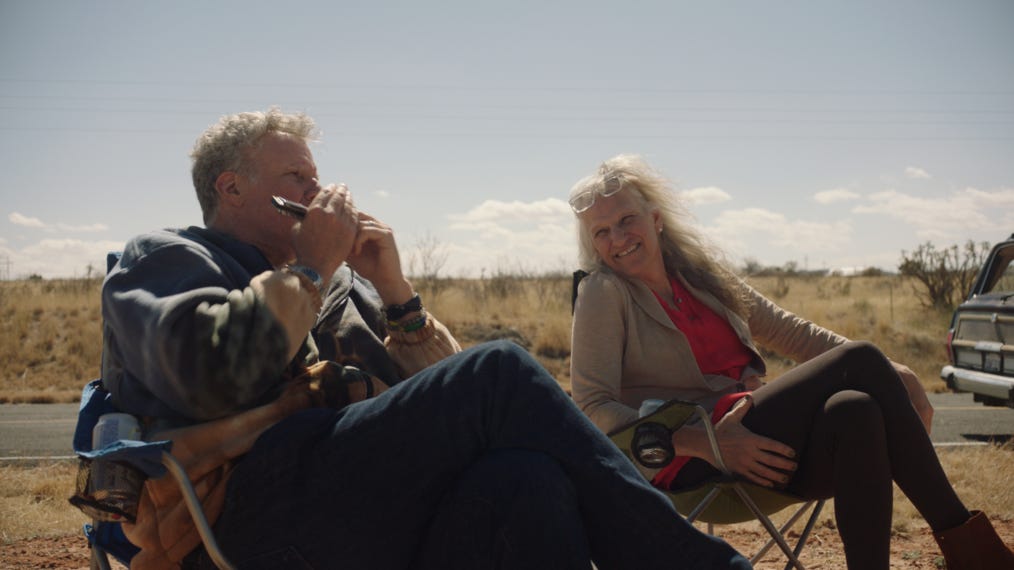
The Will of the title in Josh Greenbaum’s documentary is “Saturday Night alum” and Ricky Bobby portrayer Will Ferrell; the Harper is a longtime Ferrell pal and former SNL writer who has transitioned at the age of 61. One of the things Harper loved to do as a man was driving across the United States, stopping along the way to drink in various different quarts of Americana in their raw and organic state. The fear is that as a trans woman that might not be as possible. Ferrell, to support his friend, packs two collapsible lawn chairs into a classic old Jeep Wagoner and together they set off. Their conversations are candid, and Harper is incredibly forthcoming with information on the whys of transitioning later in life and the fears that come with it. That said, these two are funny together and know how to play to the camera. Ferrell’s celebrity brings unintended consequences when they go to a Texas steakhouse so Ferrell can try to down a famous 72-ounce steak (that looks like a grim, oily brick) that’s free if you can eat it in under an hour. He strides in with great pomp, dressed as Sherlock Holmes, which draws social media posts by those at the packed steakhouse – which mostly viciously target Harper. The gives pause not only because of the hatred on display, but because the film pushes matters where it feels unwise and even unnecessary. In quieter, more intimate moments, the relationship between Ferrell and Harper is endearing, as is Harper’s journey. It’s clear Harper is in a better, more comfortable place and had a solid support system to make the transition. Whether that translates for others is not explored by the film. Still, “Will & Harper” illuminates challenges, and it warms earnestly. Because of the stars’ comedic origins, there are some pretty well-earned grins to boot. 


‘Wolfs’ (2024)

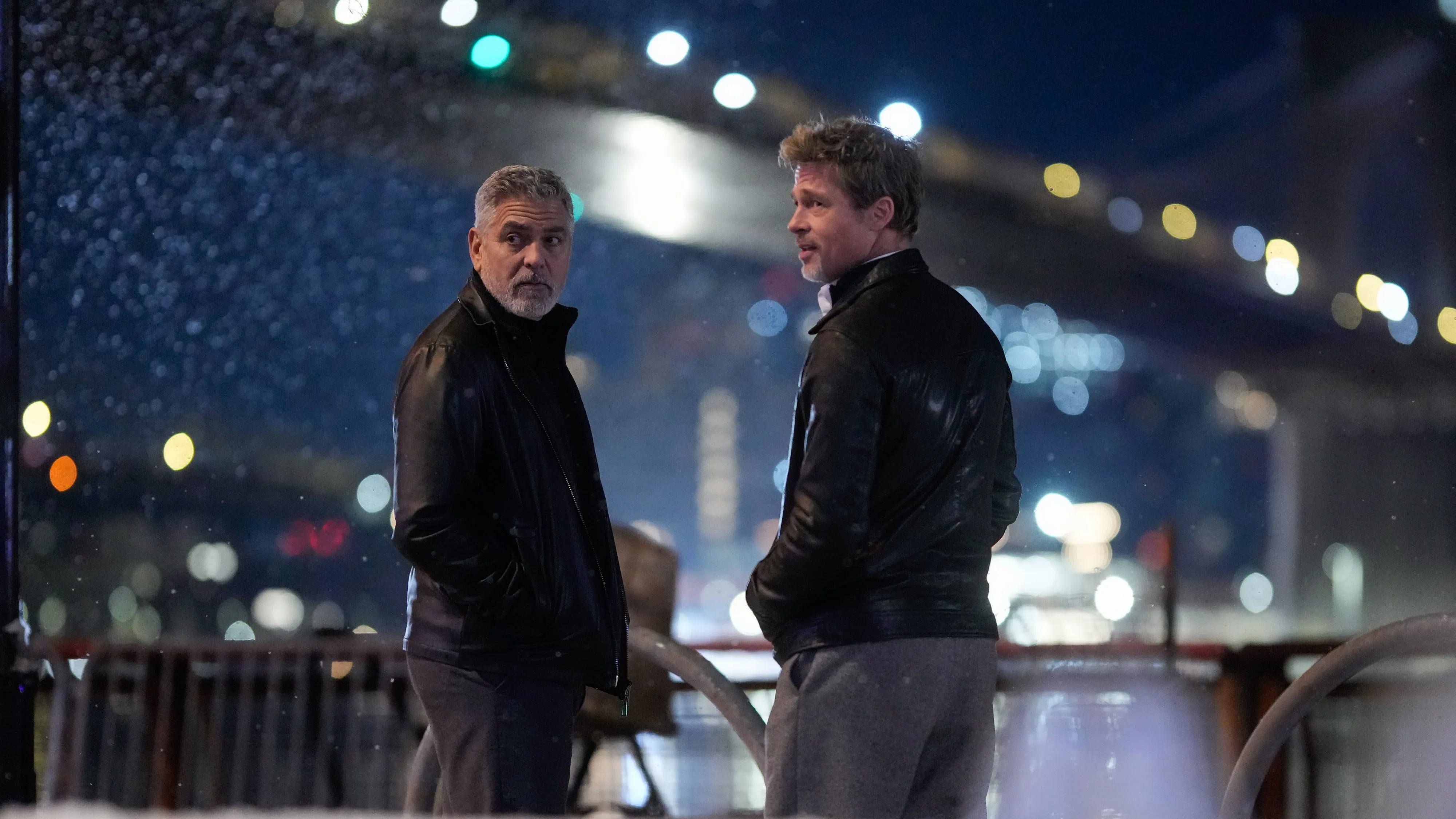
The charismatic Brad Pitt and George Clooney have teamed up multiple times onscreen, as co-stars in those quirky “Ocean’s” heist capers to Pitt’s minor role in Clooney’s 2002 directorial debut “Confessions of a Dangerous Mind” and voicing animated characters in the movie “IF” this year. Here, in a reference to Harvey Keitel’s character Winston Wolf in “Pulp Fiction” (1994), they play cleaners hired by different agents to remove a body from an uber-posh New York City hotel penthouse. The MacGuffin that drives the film is a well-respected district attorney, Margaret (Amy Ryan), on her way home to her family one night who, for whatever reason, decides to stop for a drink that turns into a tryst with a young, college-aged kid. There’s barely foreplay when the fling-thing winds up dead on the bedroom floor of a suite that likely costs $10,000 a night. In a panic, Margaret calls a number a fixer-connection gave her and summons Clooney’s cleaner (listed in the credits as “Margaret’s man”). Minutes later Pitt’s grease jobber  keys in even though Margaret tells the knock at the door she’s all set, because he’s employed by the hotel (listed as “Pam’s man,” because Pam, voiced by Frances McDormand, runs the hotel) and it turns out there are cameras everywhere. After much back and forth about who’s going to clean the room (lone wolves like to work alone) Pam insists that the two pair up and just get it done. Job No. 1 is to get Margaret out of her bloody clothes and on her way home to hubby and family. That’s the easy part. Then there’s the body and the matter of four bricks of high-test drugs. The two are dragged out in the dark winter night to chase down a loose end and get the drugs to their owner, keeping the DA and the hotel out of the equation. There’s more gunplay as the film builds, though first comes one long and wild foot chase in which the two pursue a target clad in just briefs and socks through the snow-dusted night. At its core, “Wolfs” is a reluctant buddy flick that’s best when Pitt and Clooney are playing off each other through dialogue and one-upmanship. That works well in the beginning, before the film – directed by Jon Watts (of the recent “Spider-Man” films) – forms into an increasingly pat actioner with some unlikely twists. It’s a neat pairing of talent that could have used more bite. 

Babylon

24 Dec

Old-timey Hollywood debauchery, indulgent chaos of Biblical proportions

There’s been a lot of self-indulgent film projects this year – “The Fabelmans,” “Amsterdam,” “Bardo,” “Avatar: The Way of Water” and “Top Gun: Maverick” to name a few – and just in time for Christmas, here comes the cherry on top: “Babylon,” from director Damien Chazelle, who with this what-did-I-just-see spectacle of seems hellbent on topping that awe-invoking opening scene in “La La Land” (2016) by any means possible. The film, something of a love letter to the silent-to-talkie crossover era in Hollywood, begins with a torrid gush of a pachyderm’s fecal matter on the head of a some poor Hollywood underling, then ups the stakes with a raucous flapper rave turned pseudo-orgy, replete with a midget riding a giant penis pogo stick that ejaculates. No, I am not making this shit up.

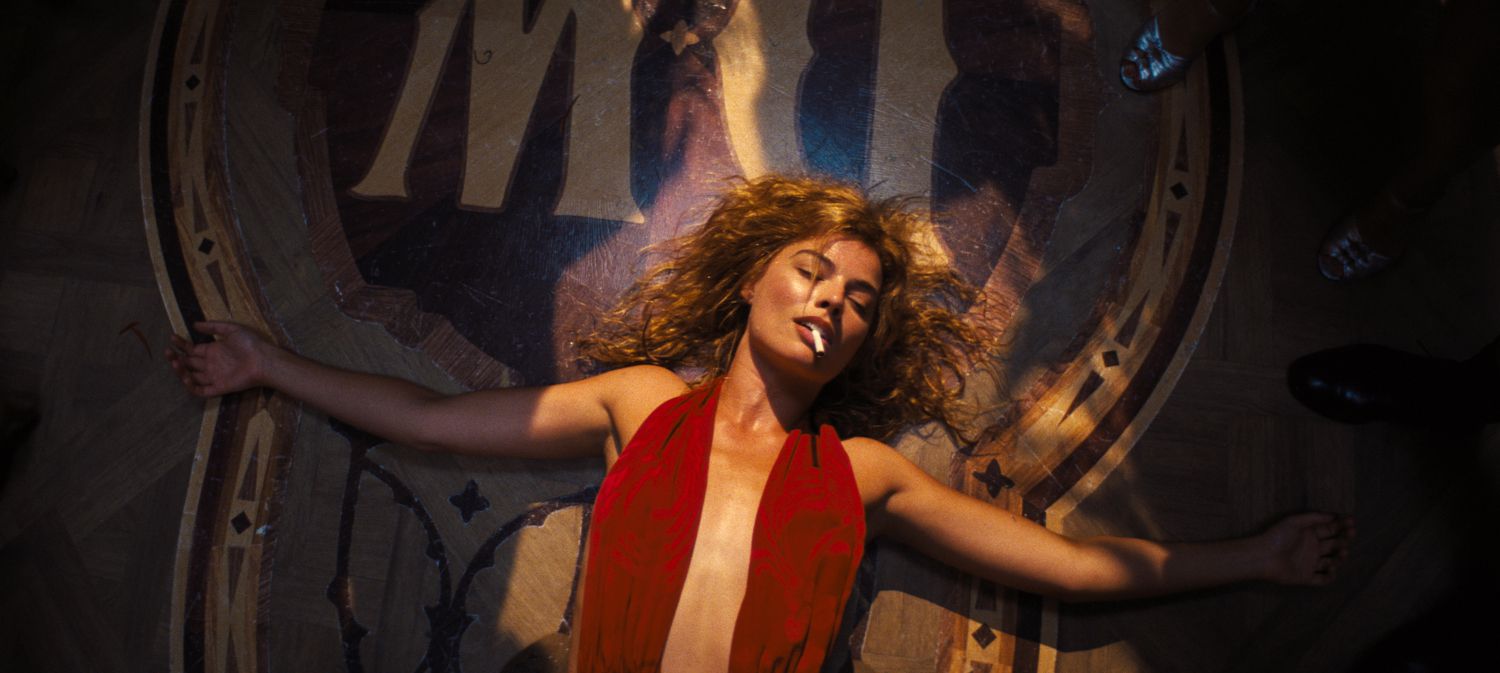
Once there’s a moment to catch your breath and the gonzo, hyperkinetic hedonism comes to a post-coital rest, the film trains its lens casually on a trio right out of central casting: Brad Pitt (“Fury,” “Inglorious Basterds”) as the movie star Jack Conrad, a blend of Fairbanks and Clark Gable; Margot Robbie (“The Suicide Squad,” “The Wolf of Wall Street”) as the Clara Bow-esque modeled Nellie LaRoy, who gets her big break taking center stage at the aforementioned bash; and Diego Calva in a breakthrough turn as Manny Torres, a studio errand boy and fixer (he’s the one who fetched the elephant, but not the one showered by it) who rises in the Hollywood ranks through his happenstance relationship with Jack.

The cast is more than game, the production values are through the roof – every shot screams opulent cinematic artistry – but something’s amiss in all the mayhem and madness. Tarantino’s “Once Upon a Time … in Hollywood,” which also starred Pitt and Robbie (this their third teaming, “The Big Short” being their first), was also steeped in a Tinseltown transition (Golden/TV era to New Hollywood), but that film had soul and flawed characters up against time and imbued with genuine vulnerability. Here Jack and Nellie party 24/7 and never have a hair our of place when on set. Also too, they’re not that interesting, they get their moments at the top and sulk once the sun sets on them.

The film spans a 26-year period, with Manny’s ascent becoming the heart of the film. It’s easy to root for Manny even as he becomes involved with Nellie and shackled by her overindulgences in gambling and cocaine. From there the film goes to some very dark places – I’ll just say that there’s a subterranean party with S&M, a strongman geek and a crocodile that makes that first fete feel tame. In the vast cast there’s a lot of zesty personas hanging on the fringe: Tobey Maguire as a red-eyed fop who runs the numbers game, Eric Roberts as Nellie’s opportunistic father, Red Hot Chili Peppers bassist Flea as a buttoned-up studio exec, director Spike Jonze as a maverick director in the vein of Eric von Stroheim and Li Jun Li, who steals every scene she’s in as the commanding chanteuse Lady Fay Zhu. The rest of the vast cast includes Any Warhol regular Joe Dallesandro, Jonah Hill, Olivia Wilde as one of Jack’s exes, Max Minghella as the real-life Irving Thalberg (the blend of real and fictionalized is curious) and Jovan Adepo as a Black band leader whose narrative thread weaves throughout but never carries much heft. Themes of race, here and with Manny, are largely left unexplored.

And about the title: I’m not that up on my Bible, but clearly the film takes its name from the city that in Biblical lore was the locale for the erection of the tower to reach God that resulted in our vast array of world languages. Later, its licentious activity was the target of God’s ire, as Sodom and Gomorrah were. The metaphor perhaps being that the talkies and the formal studio system were the cleansing of the silent era’s excess? The one going to indulgent extremes, however, is Chazelle. “Babylon” is a clear passion project and it shows. It rivets and dazzles, but forgettably so. 

The Lost City

28 Mar

Romancing the same

By Tom Meek

Swashbuckling rom-coms tend to work (“Romancing the Stone”) or not so much (“Jungle Cruise”) based on the chemistry between the leads, the cheekiness of the supporting cast and some deft plot twists. “The Lost City” has plenty of the above, even if it runs out before the end. The set-up has reclusive romance novelist Loretta Sage (Sandra Bullock) – don’t call her Danielle Steel – tired of churning out product and even more so of doing publicity tours with hunky cover model Dash (Channing Tatum, whom you can call Fabio; he’s riffed as such, replete with flowing blonde locks). The rub with the latest book comes when Loretta, bored with the process and grieving the death of her husband, gets kidnapped by an eccentric billionaire with the benevolent-sounding name Abigail Fairfax (Daniel Radcliffe, excellent in the mercurial fop role) to decode ancient hieroglyphics so he can obtain the unobtainable: an ancient crown of jewels in the buried enclave of the film’s title.

The whole shebang’s pretty much a McGuffin so Tatum and Bullock can engage in a rom-com romp on a tropical island. There’s leech removal from personal parts and a sequined unitard that just won’t die. What’s a real blast is Brad Pitt in a cameo as a zen extraction expert (allegedly the idea came on the set of Pitt’s “Bullet Train” – coming this year – in which Bullock had a cameo, and this was the payback) and Patty Harrison as Loretta’s boozy social media publicist, not to mention Da’Vine Joy Randolph as the stressed-out, brash-talking tour manager and Oscar Nuñez as the the quirky cargo plane pilot who often interprets words a bit too literally.

Tatum and Bullock have solid chemistry, but the film runs out of pomp and verve as plot ends need to be tied up and things become a bit too predictable. Don’t get me wrong, the film has plenty of “didn’t see that coming” moments – it’s just they’re front loaded. No matter. “The Lost City” will serve as a nice studio-produced calling card for the brotherly directing team of Adam and Aaron Nee, who until now have mostly toiled together acting, writing and directing indie fare such as “Band of Robbers” (2015) and “The Last Romantic” (2006). Next up for the Nees is more action and adventure with the big-screen take on He-Man, “Masters of the Universe.” Pro tip for “Lost City”: Be sure to sit through the credits.

The Gentlemen

26 Jan

‘The Gentlemen’: Guy Ritchie gangster crew hashes out their differences to deadly ends

The Gentlemen' Is an Early Contender For Most Stylish Film of the Year

Video PlayerIt feels somewhat weird that this boldly minted Miramax offering from Guy Ritchie hits theaters just as the Harvey Weinstein trial kicks off in New York. Miramax, for those with short-term memories, was the studio Harvey and his brother founded back in 1979. The name remains synonymous with the notorious abuser, which is why in Ritchie’s return to the British gangster romp it’s so strange to see the moniker not only up there in lights, but as part of the plot. Perhaps the studio thought of it as something of a whitewash, but the timing makes the connection just too hard to shake.

That bit of ignominious history aside, “The Gentlemen” is quite entertaining, sharper and more focused than Ritchie’s “RocknRolla” (2008) though not in the same class as “Lock, Stock and Two Smoking Barrels” (1998) or “Snatch” (2000). (Also hard to believe Ritchie just helmed the recent “Aladdin” adaptation). The ensemble here is a stroke of genius, with Matthew McConaughey as Mickey Pearson, an American transplant who runs a half-billion-dollar cannabis operation, Hugh Grant owning the picture as a conniving P.I. and aspiring screenwriter named Fletcher and hunky hot ticket Henry Golding as Dry Eye, a foot soldier with big ambitions. Then there’s Colin Farrell as “Coach,” a saucy sort who runs an inner-city gym, and Charlie Hunnam as Ray, Mickey’s fixer. The uber-twisted plot essentially rides on the rails of Mickey in the process of selling his business (because of his criminal past, when weed goes legal he likely won’t get a seat at the table) to a fellow American (Jeremy Strong). From there, the chess match of double dealings and plots within plots spews forth, the whole endeavor framed brilliantly by some deliciously dicey dialogue between Fletcher and Ray over a few bottles of scotch and Wagyu steak – what’s that in your freezer, the son of a Russian oligarch? Continue reading

Joker

3 Oct

‘Joker’: Phoenix tries to hold it all together, but eventually film lets loose, breaks down

Image result for joker images

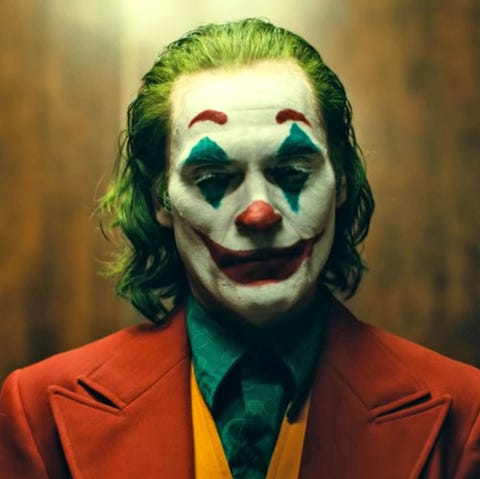
Throughout Batman’s long history, the Joker’s been played by some pretty mighty performers. Standouts include Jack Nicholson, who pretty much hijacked Tim Burton’s “Batman” (1989), and Heath Ledger, who won a bittersweet, posthumous Oscar for his deeply felt portrait of derangement in Christopher Nolan’s “The Dark Knight” (2008) – and let’s not forget the comic genius of Cesar Romero during the 1960s TV series. Nolan and Burton felt like the right hands to shepherd a dark superhero/villain origins tale, but Todd Phillips, with such swinging steak comedies as “Old School” (2003) and the “Hangover” films to his credit? Odd as it may seem, it’s a somewhat logical evolution from drunken vomit awakenings to blood-splattered foyers with a panicked dwarf who can’t reach a chain bolt to escape.

The real reason Phillips’ “Joker” succeeds is simple: Joaquin Phoenix makes the anti-antihero psycho-saga all his own. There’s also the script by Phillips and Scott Silver that plays with the Batman mythology artfully without getting bogged down in the bigger picture – though we do briefly see Bruce Wayne at a young age, when dad and mom are with us – but without Phoenix, I don’t think “Joker” takes flight. It’s a bravura go, and Phoenix should be right up there at year’s end (like Ledger was) with Brad Pitt and Leo DiCaprio when Oscar nods are called out. With maybe the exception of Ridley Scott’s “Gladiator” (2000) it’s hard to find a movie in which Phoenix doesn’t shine with brilliant quirk and dour doses of menace. He delivers all that here and more; it’s a total immersion. For the part of clown turned Gotham icon and sociopathic perp, Phoenix lost a ton of weight, something done with equal austerity by Christian Bale (who took up the bat cowl for Nolan) in Brad Anderson’s “The Machinist” (2004) or, inversely, when Robert De Niro added 50 pounds as Jack LaMotta in “Raging Bull” – and if as on cue (send in the clowns), the Martin Scorsese-forged actor shows up in “Joker” as beloved late night TV show host Murray Franklin, whom Arthur Fleck (the Joker’s birth name) and his not-quite-all-there mother (Frances Conroy, excellent in the small complicated part) watch religiously. Continue reading

Judy

27 Sep

‘Judy’: She knows there’s no place like home, but can’t get any closer than stage in London


Image result for judy garland movie

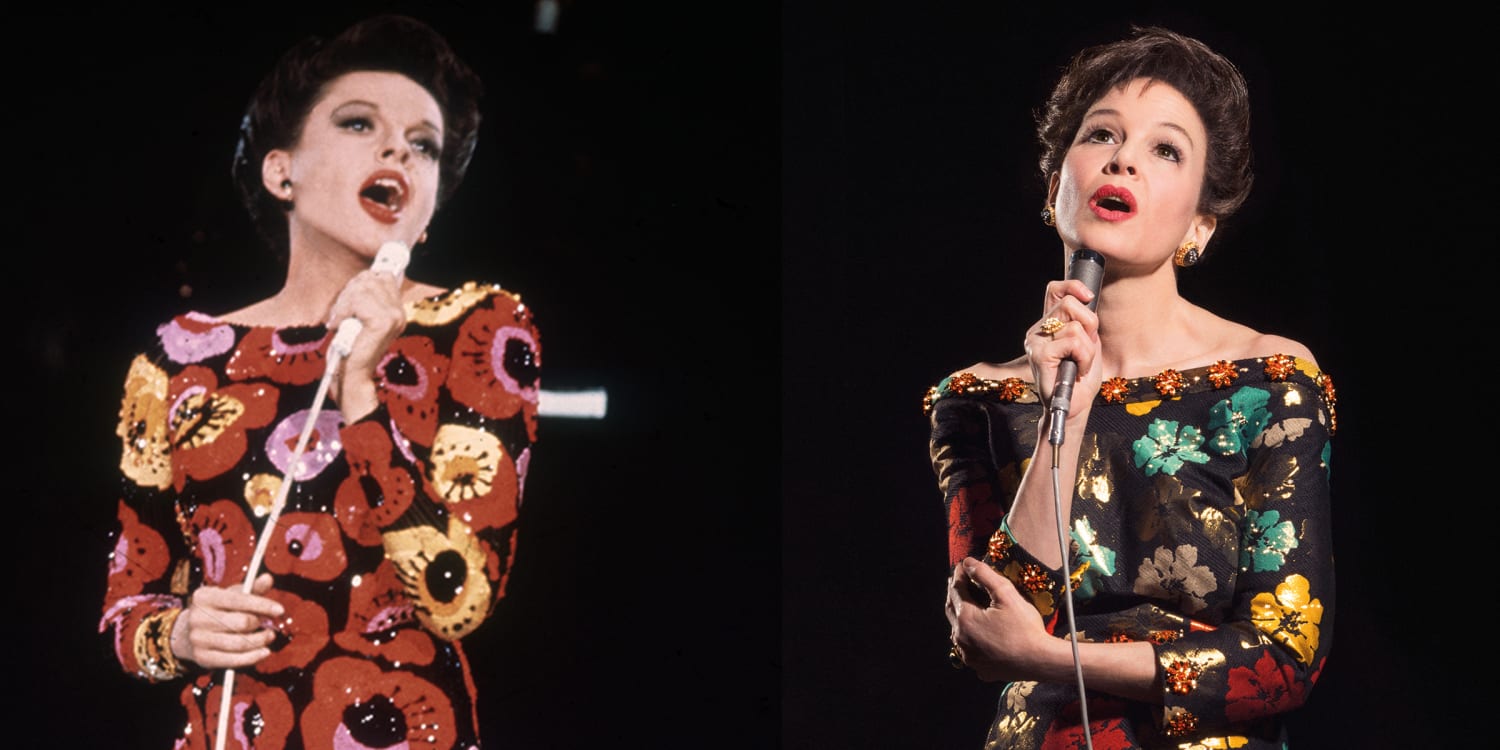
“Judy,” the biopic about stage icon Judy Garland, is just right focusing on her “hot mess” last chapter as an in-residence performer at a London theater club, her better days interspersed through deft editing and seamless narrative framing. It is a tad oversentimental at times, but overall a bittersweet pill that finds its mark effectively, and three-time Oscar nominee and one-time winner Renée Zellweger knocks it out of the park as the it girl whose star has faded; she’s about as sure a bet to be in Oscar talks as Leo DiCaprio and Brad Pitt.

The script, written with purpose and verve by Tom Edge (“The Crown”), sets us up with Judy and her two youngest, Lorna and Joey (played by Bella Ramsey from “Game of Thrones” and Lewin Lloyd) circa 1969, being evicted from their hotel digs. She’s broke and broken and just wants to be a mother to her children, but there are bills to be paid, no one in the states who will give the unreliable pill-popper a role or a gig and a custody battle brewing with ex-husband Sid Luft (Rufus Sewell). Before London calls there’s a brief L.A. house party with older daughter Liza Minnelli (Gemma-Leah Devereux – stunning) and an uplifting but ultimately unfortunate encounter with a mod hipster Mickey Deans (Finn Wittrock), who would become her last husband.

The whole saga is sad, with fleeting moments of uplift: Judy is always “on” when on stage or talking to an adoring public, but her own worst enemy sodden with booze and pills after the curtain drops. In flashbacks to her younger days (Darci Shaw crushes it as the young Judy), she’s simultaneously given an avuncular embrace and manipulated malevolently by MGM head Louis B. Mayer (Richard Cordery) on the set of “The Wizard of Oz,” where studio handlers forbid her food and feed her uppers and downers instead; and men in general attach themselves and milk her throughout her life. About the most love and respect the star gets beyond her progeny comes from her stiff-upper-lip handler in London, Rosalyn (Jessie Buckley) and her young bandleader, Burt (Royce Pierreson). One of the film’s more whimsical and fun moments comes when Mickey comments in a bar about a new, experimental Beatles album – and floats the idea of Judy performing with The Rolling Stones. The crowd is nonplussed, but Judy drinks up hungrily the shot of possibility and confidence.

Director Rupert Goold, who’s mostly orchestrated stage theater, and cinematographer Ole Bratt Birkeland stage and frame the performances stunningly, especially in the use of light and closeups, and with engrossing intimacy. Of course, it all hangs on the star who’s on in every take. One telling scene comes during a TV interview, when a journalist tries to dig in on the former starlet about her “unreliability” and messy custody proceedings and gets blowback: “I’m Judy Garland for one hour on stage and then I’m a member of family just like anybody else.” Sadly, that never really became the case, and you can feel that palpably in Zellweger’s performance. 

Fictional films such as “A Star is Born” (Garland starred in the 1954 version with James Mason) and “All that Jazz” tackle the toll of stardom and its perils, but “Judy” lives it, and through it, you live it too. It breaks your heart, not from the usual distance, but deep down inside with the painful desire of someone who just wants to be loved unconditionally.

Ad Astra

19 Sep

Ad Astra Is the Year's Most Gorgeous Movie | GQ

The film begins with a bravura sequence (worthy of “First Man” comparisons) where, in the not too distant future, Roy is working on an antenna projecting up and out of earth’s atmosphere that gets struck by a rogue energy wave. The massive spire implodes, collapsing back to earth in a long, slow chain of events that call eerily to mind the 9/11 attacks. Roy, with some cool thinking, survives, but more than 40,000 people are killed by the surge from somewhere out in the galaxy.

The purpose of the tower, we’re told, is to communicate with other intelligent life, because humans cannot survive much longer on their own – the implications being that we’ve messed up the planet and are looking for someone to bail us out, though that’s never really articulated. If you’re thinking the Tower of Babel or “Contact” (1997) you’d be correct, but with the death toll from the wave and more on the way, phoning ET gets dropped as the surge and its source become job numero uno. Naturally the brass at Space Command (a branch of the military) pick Roy (can anyone ever pass over Brad Pitt?) for the need-to-know mission, and also, what’s that? Those in the know think the shockwaves are coming from Neptune, where some years earlier Roy’s father (Tommy Lee Jones) led a mission and may still be alive.

Yup, daddy issues run deep, but not with much emotional effect. The journey to Neptune is a damn fine amusement ride, beginning with the running of a gantlet of pirates on the dark side of the moon to the abandoned spaceship where a lab experiment has gone wildly amok and the penultimate stop, Mars, run by an effete with a mini-man bun and myriad agendas. But it’s there on Heinlein’s precious planet and beyond that the film begins to drift. The mission and the stunts lose their importance, the sense of urgency and peril get nipped, and all we’re left with is something of a stripped-down existential quest, a diet lite posturing of “Apocalypse Now” (1979) or “Interstellar” (2014) without a credible force (or fully baked cause) to reckon with (i.e., Brando’s Kurtz or Matt Damon’s rogue astronaut). All of a sudden, the slog to the outer limits feels all for naught. Also challenging to logic and scientific principal, these guys hop planets like catching the noon Greyhound to Penn Station. There’s no warp speed, wormhole or stasis sleep – in short, the sense of time and space feels distorted, if not ignored.

Gray, who cut his teeth with gritty crime thrillers such as “Little Odessa” (1994) and “We Own the Night” (2007), last turned in “The Lost City of Z” (2017), an account of British explorer Percy Fawcett’s quest to find signs of early civilization in the Amazon. That film, another journey into the vast unknown, feels like boilerplate for “Ad Astra.” It’d be fair to call it a Z-peat, but in the real-life account, Fawcett always seemed one fateful decision away from ruin. Here, Pitt’s Roy, while steeped in palpable, reflective soulfulness, is so can-do capable that Kryptonite has no shot of buckling a knee. Pitt, for better or for worse, has become something of an icon and a brand, like Tom Cruise (impossible to separate the celebrity from the performer) – and while that worked to everyone’s advantage (shirtless scene and all) in Tarantino’s Tinseltown fable, Gray never imbues his hero with enough vulnerability, or even a hint of it. “Ad Astra” is like a 5 Hour Energy drink: a sharp, pure blast of wow, until you come down and it leaves you empty and wanting.

Once Upon a Time in… Hollywood

25 Jul

‘Once Upon a Time … in Hollywood’: Stardom loses some luster in dusty, bloody wilds of L.A.

By Tom Meek

Quentin Tarantino’s “Once Upon a Time … in Hollywood” isn’t a rescripting of historical events the way “Inglourious Basterds” (2009) envisioned the Nazis toppled by a handful of hard-hitting Jews, but there are definitely some major ripples in time. No, “Hollywood” is more a tongue-in-check, kick-in-the-pants modern fairytale with a hefty side of cinematic homage; it rambles some, to be sure, but it’s more sincere and genuine in execution than the video store clerk-turned-auteur’s last outing, “The Hateful Eight” (2015). It may be Tarantino’s most personal and intimate film to date (tying with “Jackie Brown” on the latter) as the director talks about tapping out after 10 films – which this would be if “Four Rooms” counts, but I digress.

The setting is the late 1960s. Rick Dalton (Leonardo DiCaprio), something of a Clint Eastwood or Chuck Connors, came to fame in a fictional hit television western called “Bounty Law” a decade earlier and now finds it hard to get lead work – he plays mostly heavies on (real) shows such as “The F.B.I.” and “Lancer.” Front and center too is Dalton’s shadow and heyday stunt double Cliff Booth (Brad Pitt), a smooth, angular chap with an aw-shucks facade and a deeply dark side that gets leveraged to glorious and disturbing effect. Because the two are loyal bros, Dalton, during his downward fade, employs Booth as driver and gofer. Dalton also lives next door to Sharon Tate and Roman Polanski – and, yes, on the eve of the Manson family murders – and in a separate silo we get Margot Robbie as an ebullient Ms. Tate looking grand and fabulous as she dances poolside at a Playboy mansion gig and taking in a screening of “The Wrecking Crew,” which she stars in with Dean Martin.  (At the box office, she asks if she can get a free pass, because she’s in it.) Robbie may not say much, but she’s intoxicating in every scene she’s in. Doomed in real life as a Manson victim, Tate is held up by Tarantino as the essence of a sunsetting era.

Continue reading

Greta

28 Feb

‘Greta’: Good deed introduces a mother figure, who must be survived with a surrogate sister


Image result for greta movie

Neil Jordan, who’s always existed somewhere between the arthouse and the cineplex, is responsible for such notable films as “Mona Lisa” (1986), “The Crying Game” (1992) and “Interview with the Vampire” (1994), for which, he famously paired heartthrobs Tom Cruise and Brad Pitt. The Irish filmmaker hasn’t produced a feature film in more than six years (since the 2012 female vampire foray, “Byzantium”), so it’s something of a relief that we get “Greta,” a boilerplate psychological thriller that flirts deliciously with camp but sadly enjoins cliche.

At least Jordan has Isabelle Huppert, Chloë Grace Moretz and Maika Monroe, who leave it all up on the screen. Moretz, so lethally infectious in “Kick-Ass” (2010), stars as the object of obsession, Frances McCullen, a recent Smith College grad from Boston living in a swank New York City loft and working at an even swankier midtown eatery. The wished-you-lived-there pad comes courtesy of Frances’s bestie from Smith, Erica (Monroe) whose dad bought it for her as a graduation present or something. Life’s good, and even though this duo don’t seem to want for much, they’re relatively down to earth – maybe with the exception of Erica’s predilection for avocado colonics.

Trouble comes in the form of a Kate Spade or Gucci handbag (I can never tell them apart) that Frances finds on a subway car and returns dutifully to its owner, a widowed French woman named Greta (Huppert) who lives in a quaint country-styled bungalow tucked down a dingy back alley. It’s an odd juxtaposition, to say the least; a Hobbit shire in the middle of the Seaport (which, given the harbor shots from his office, is where Frances’s father works) might be less conspicuous. Nevertheless, little of the action takes place on the streets of NYC; “Greta” is an intimate and cloistered affair.

Not to give away too much, but the bag’s a plant by Greta, who’s not even French (she pretends to be, even through she’s from Hungary) and leverages the return to sow a motherly bond with Frances (who coincidently just lost her mother) and wheedles her way into every aspect of her surrogate daughter’s life. What begins as cute and a tad clingy becomes creepy real fast. You could think of it as “Single White Female” (1992) – the mother edition – or “Unsane”(2018), where a frustrated stalker begins to take on the ubiquitous and near-superhuman qualities of Michael Meyers.

Much hangs on Huppert, who casts a long, menacing shadow over Frances. The French actor, who rightfully earned an Academy Award nomination for her 2016 performance as a stalked woman in Paul Verhoeven’s rape-revenge psycho-sexual thriller “Elle,” has been making films since the 1970s. She’s played opposite France’s other great thespian export, Catherine Deneuve, in François Ozon’s murder-comedy, “8 Women” (2002) and appeared with Kris Kristofferson and Christopher Walken in Michael Cimino’s epic, post-“Deerhunter” letdown, “Heaven’s Gate” (1980). But my favorite Huppert film to date has to be France’s 1983 Best Foreign Language nominee, “Entre Nous,” about two women trying to survive occupied France during the World War II.

Moretz holds up her end of the film. Her Frances is more actively resilient and nuanced than most victims in these types of endeavors, though plot wise she’s more the focal point for Huppert’s maniacal moonshot to orbit. The real revelation here is Monroe, who might feel like a fresh face but appeared in Sophia Coppola’s “Bling Ring” (2013) and more notably, anchored the quirky cult chiller, “It Follows” (2014). Here as the compassionate can-do roomie she exudes a tang of Sharon Stone moxie, but the real win is the sisterly bond she and Moretz form on screen – a touch of Huppert and Miou-Miou in “Entre Nous.” It’s genuine enough to raise the stakes and Jordan, clearly aware he’s playing with genre, tries to avoid the usual trappings. For the most part he does, but not completely.