Deerskin

2 May

‘Deerskin’: Georges’ fancy new jacket doesn’t fit, but adrift and sad in the hills, he’s a good fit for it
tmp-deer

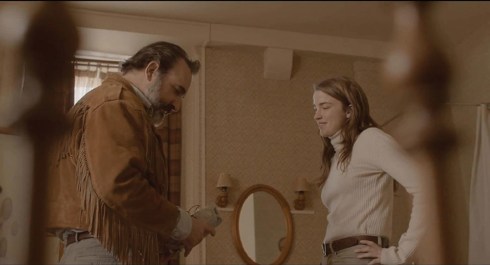
A trippy arthouse horror film that’s tedious and arousing at the same time – what would one expect from the director who made “Rubber” (2010), a dark comedy about a homicidal tire that goes on a killing rampage? This one’s about a suede jacket made of (can you guess?) deerskin and its obsessive owner (Oscar winner Jean Dujardin), who appears adrift and in need of direction. Once he gets it, the outré drama set in the alluring French mountainside turns très dark as bodies quickly start to pile up.

About halfway into “Deerskin” you begin to wonder if the protagonist, Georges, is mad, and perhaps an unreliable narrator. He does pay 9K for the fringed garment of the title, which doesn’t quite fit (too small) and, as part of the odd deal (the old coot who sells it to Georges is played by Julie Delpy’s father, Albert) gets an antiquated video camera. From there, the content yet forlorn Georges settles into a nearby hamlet where he postures himself a filmmaker and quickly makes the acquaintance of a young bartender (Adele Haenel from “BPM” and “Portrait of a Lady on Fire”), an unemployed film editor – talk about convenient circumstance.

To echo the internal malaise of Georges, director and cameraman Quentin Dupieux (also writer and editor) shoots everything in flat, washed-out hues. We’re informed early on that Georges has been spurned by his wife and left destitute, but we’re given little else to go on. Dujardin, who rolled to international fame with the 2011 silent-era Oscar winner, “The Artist,” bears the weight of the world as Georges, with eyes that are sad, heavy and weary; they also show flickers of devious inner workings. It’s a performance that carries the film through the meandering buildup, but as gears shift, Dujardin’s nuance gets submerged in the bloody boil of black comedy. There are scenes at night when Georges lies in his boardinghouse bed and talks to the jacket – and it talks back. Yes, we are in the slightly surreal realm that made “In Fabric” (1918) a lingering curiosity, but Dupieux, who moonlights as a techno-pop star, can’t fully rectify the character study of Georges with the rushed, final bloody pages. Haenel’s bartender-turned-collaborator is a game player, and deepens the stakes. She’s no waif in waiting, but a strong observer who’s onto Georges. Their collaboration on Georges’ macabre footage is unfortunately far too brief. A similarly themed curio, “Man Bites Dog” (1992) had a film crew following a serial killer on his weekly hunts. It was dark, devilish and a biting reflection of society’s obsession with grim happenings. Here those moments go by in a fast-forward montage. Questions linger and burn, and only the napped suede jacket seems to know the answers.

The Wretched

2 May
tmp-wretch

The IFC Midnight collection often rides that fine line between arthouse chiller and mainstream horror hash, such as the “Grudge” and “Annabelle” series. “The Wretched” isn’t any different, layered with grim, ghoulish visuals (bloody, feasting mouths and disjointed body parts) gurgling under small-town idylls.
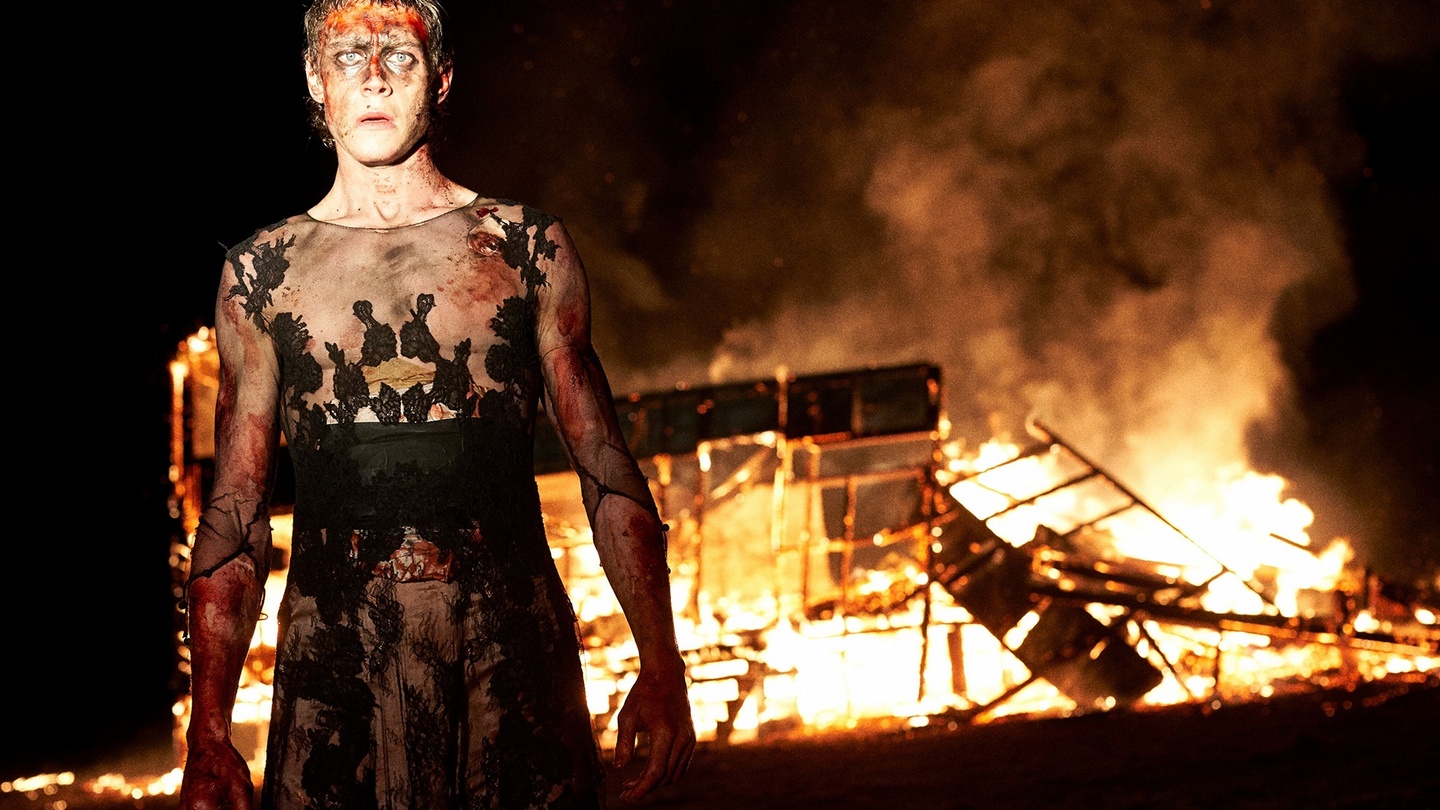
The film begins with a sharp hook as a babysitter, arriving at a home for her shift, can’t find her charge but hears strange noises in the basement – the kind of flesh- and bone-crunching noise that says “Don’t come down here.” But she does. (Not that she sees it, but the basement door bears an occult symbol.) From that happy opener we rewind five days as we settle in with Ben (John-Paul Howard), whose life as a young teen (his parents are recently divorced, and he’s making youthful forays into romance, or not) is more interesting than the freaky shenanigans of Abbie (Zarah Mahler, who does demonic effectively enough), his next-door neighbor who skulks about at night in silk gowns with an evil glower in her eye. Ben doesn’t pay her wacky wanders too much attention at first. Then her son, Dillion (Blane Crockarell), terrified of his mother, comes running to Ben one night.

The film, written and directed by Brett and Drew T. Pierce (billed as the Pierce Brothers, who collaborated on “Deadheads,” a zombie flick that has nothing to do with the trippy 1960s rock band) slide into “Stranger Things” territory as Ben does some googling about witches of the woods and finds a strange, gnarled tree with an underground lair. As things hit their gory, blood-splattered crescendo, the Pierce lads pull in as much as they can from the classic goo-steeped transmutation scenes in “Alien” (1979) or “The Thing” (1982) – which those films did better. The big miss here is Ben’s angst-filled existence in a township of privileged jerks, bullying jocks and elusive coeds out of his league. In one such scene, a comely partygoer entices Ben into the pool and coerces him to get naked, only to have the intimate moment quickly exposed for what is: a planned group prank. Then there’s Ben’s relationship with Mallory (Piper Curda), a coworker at the local marina; their late-night phone calls as Ben spies on Abbie are more compelling in what they say about each other and the character of the town than the weirdness Ben is drinking in. “The Wretched” feels like a melding of two films: one I’ve seen ad infinitum, and another that begs empathy and intrigue.

True History of the Kelly Gang

1 May

‘True History of the Kelly Gang’: In the outback for a bloody, convoluted crime tale, clad in tulle

True History of the Kelly Gang: How an Irish bandit became Australian  antihero

The film, based on an award-winning 2000 novel by Peter Carey that played it loose with facts (“Nothing about this is true,” reads an opening overlay) the film is broken up into chapters: “Boy,” “Man,” “Monitor.” In “Boy” we get the lay of the land in two quick shakes as the young Ned (an angelic and androgynous Orlando Schwerdt) drinks in the sight of his mother (Essie Davis, Kurzel’s wife and the star of “The Babadook,” giving a fierce, compelling turn here) performing fellatio in a grimy barn on an expectant officer (Charlie Hunnam). Ned’s cuckold pa (Ben Corbett) who likes to dress in ladies wear, pulls the boy from the sight. Kurzel’s outback, like Jennifer Kent’s Tasmanian territory in “The Nightingale” (2019), is a grim, sexually charged place where violence seems on the edge of erupting in every frame.

Eventually Ned comes under the tutelage of Harry Power (a gruff, effective Russell Crowe), a notorious outback criminal – known as a bushranger, the equivalent of Old West outlaws in the United States. It’s horse thievery that puts the Kellys at odds with Hunnam’s officer and later, and far more drastically, with a sadistic constable (Nicholas Hoult) named Fitzpatrick who ingratiates himself to Ned and the Kellys while quietly poisoning them.

The dance with the law is a dicey one, but ultimately Ned falls outside it and forms a brigade of foppish fancies (as Carey’s book has it) who take no issue in cutting down quarry in lipstick and tulle. As depicted, Ned’s both Robin Hood and cold killer; Kurzel clearly wants to romanticize Ned while bathing him stylistically in blood, scene after scene, which is where the film begins to lose its hold on Ned the human being, sliding into ritualized retaliatory strikes. Kurzel takes some chances with the soundtrack with its occasional infusion of modern rock, and with chaotic body cam POVs that disrupt the gorgeous framing of the lush yet spare outback by Ari Wegner (“In Fabric”). MacKay as Ned is starkly overshadowed by Davis’s fuck-all mother and Hoult’s cunning manipulator – the scene where the two confront each other in tight confines late in the film is a powder keg of tension. The nearly final chaotic shootout, like “Butch Cassidy and the Sundance Kid” with Ned and crew in metallic headgear made from farm plows, is done with gorgeously hallucinatory imagery rendered between bullet flashes and accentuated by a balletic rat-tat-tat. It’s one of the many alluring shards of the “Kelly Gang” that envelop the viewer for a moment, but never collectively get to the soul of the man at the epicenter.

Silent Panic

27 Apr

Don’t Open the Trunk!

tmp-silentP

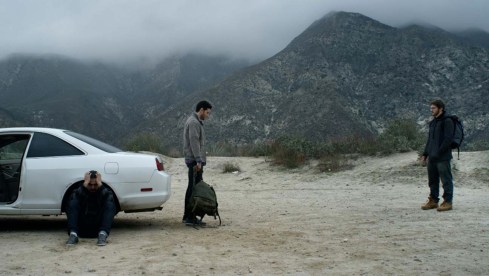
Kyle Schadt’s nicely composed thriller “Silent Panic” rolls out of the gate with some sharp teeth; there’s a dead body in the trunk of a car and none of three buddies who discover it at the end of a weekend camping trip knows how it got there. Naturally they all freak out about the what to do and because one of the trio’s a recent ex-con, they decide not go to the cops and leave the dead goth girl in the car as they banter about numerous plans to dispose of the body and hopefully rid themselves of its burden. The problem with “Silent Panic” then becomes that Schadt and crew don’t know how take it north from there and what ensures is a maddening meander of ridiculously poor decisions, and not the edgy kind that made “Uncut Gems” (2019) such a burner, but inert middling inanity that makes you want to pull your hair out.

As positioned, “Silent Panic” feels like Schadt envisioned something of a character driven film, but most of the trio lose their edge after the humorous campfire debate over who was Broadway Joe (Joe Montana or Joe Namath?) and if Genesis was better with or without Peter Gabriel. Plus the three really don’t seem like they have much in common. Eagle (Sean Nateghi), the ex-con is the snarling alpha male wannabe of the group while Bobby (Joseph Martinez), remains pretty much a wall flower until we learn he’s got some hard core drug use in his past and may be using currently, and then there’s Dominic (Jay Habre), the mealymouthed aspiring writer who occasionally gives us weak noir-ish voiceovers from his personal journal entries.

The most intriguing element of the plot besides the initial discovery, comes when the car suddenly goes missing—Eagle’s wife Robin (Constance Brenneman) has taken it for a spin and later, Bobby decides to store the corpse in his bathroom. As more and more people learn of the body—“River’s Edge” this is not—the gravity of what’s at stake for the main three begins to sag. Schadt unfortunately becomes far too focused on feeding us his character’s backstories—and they’re not all that interesting. The most unspectacular of which being Dominic’s dull dating life. When his girlfriend signs dumps him, you feel an immense sense of relief for her and barely a teabag of sympathy for him. The film finds its footing again as things come to a climax, but by that time, the macabre and edgy “Shallow Grave”-esque promise has become something slack and near comical, akin in tone to “The Trouble with Harry” or “Weekend at Bernie’s–the difference being those films set out to be dark forays of whimsy.

Restaurants in the time of Covid-19

24 Apr

Season to Taste, Pagu mix it up after Covid-19, giving to-go meals the flavor of improvisation

Robert Harris prepares a to-go meal Tuesday at Season to Taste in North Cambridge. (Photo: Tom Meek)

Before the Covid-19 crisis, we were preparing to profile two semi-finalist James Beard best chefs from Camberville: Tracy Chang of Pagu and Carl Dooley, over at Table at Season to Taste (the other locals on the list, Seizi Imura of Cafe Sushi in Harvard Square and Cassie Piuma, serving up Turkish infused plates at Ana Sortun’s Sarma in Somerville, are repeat nominees). Both shut down before Gov. Charlie Baker’s St. Patrick’s Day mandate to close restaurants. But the ovens have remained hot, reflecting where we are and where we are going.

While Table at Season to Taste remains shuttered, chef-owner Robert Harris has continued to evolve catering at umbrella company Season to Taste. “I’ve got a plan to get us back to normal,” said Harris, who was on a ski trip in Colorado when the mandate came down. He returned to Cambridge to lay off 30 employees. Part of his plan is to make Season to Taste’s traditionally “bespoke” catering for corporate events, weddings and parties – with menus dictated by the client – into a Season to Go, a food pickup service at the 2447 Massachusetts Ave., North Cambridge, storefront. Continue reading

Other Music

17 Apr

‘Other Music’: Coolest music shop in New York, capturing the moment in a corporate shadow


Virtual theater releases are about to become a thing. They are already happening at the Somerville and Coolidge Corner theaters, and come to the Brattle this week with “Other Music,” a cozy but somber documentary about a small alternative record shop in New York City’s East Village that shuttered in 2016. The store was so tiny, one manager says there was a height limit, because anyone too tall would hit their head; and all the record and aisle labels were handwritten by the staff, who had encyclopedic knowledge of cutting-edge music. Filmmakers Puloma Basu and Rob Hatch-Miller capture not only this quirkiness, but the social and cultural relevance of the venue, where staff was so sharp and knew their customer’s taste so well they often would get “pick ’em” requests from loyalists such as actor Benicio del Toro.

Defiantly, Other Music opened in the ’90s across from a Tower Records – and outlived its overshadowing titan. It never carried the latest from Dylan or Oasis; it was all about curating the next wave. Acts that would go on to soar nationally, including St. Vincent, Vampire Weekend and Neutral Milk Hotel (playing the classic acoustic “Two-Headed Boy”) played the store’s cramped confines, as seen in footage that is grainy and wonderful; Interpol, looking to get recognition early on, sold their handmade CDs at Other Music on consignment. Co-owner Josh Madell jokes that he and his early partners often invited dates to come in to the store to listen to music, then steered them toward tasks such as working the cash register. Testimony from myriad near-famous talking heads cites the store’s reputation for inclusivity before such notions ever became a woke battle cry.

One thing you can’t help but take from the film from a local standpoint are the parallels with beloved Stereo Jack’s Records on Massachusetts Avenue between Harvard and Porter Squares. It’s eerie, uncanny and undeniable, but also a statement about Stereo Jack’s existence and Other Music’s longevity, which speak to a culture beyond the bottom line – it’s all about the music and the community it infuses.

It’s not mentioned in the film but there was also a cousin Other Music store on Winthrop Street in Harvard Square, part of the Crimson Galeria, now a Shake Shack. That store shuttered in 2002.

Never Rarely Sometimes Always

4 Apr

‘Never Rarely Sometimes Always’: Pregnant, finding guys are manipulative jerks, Part II

Never Rarely Sometimes Always' Review: Pointed Film Stays With You Forever  : NPR

Eliza Hittman’s short list of films have focused on teens involved in strange sexual relations with adults, be it a girl looking to blossom by hooking up with a ruffian in “It Must be Love” (2013) or a boy in “Beach Rats” (2017) seeking to discover himself by meeting up with older men he encounters online. Hittman’s latest, “Never Rarely Sometimes Always,” is something more subtle, yet equally dark in its exploration. The narrative structure here is lean and simple, buoyed by emotional depth and a pair of outstanding performances.

We meet up with teen Autumn (newcomer Sidney Flanigan), who likes to play guitar and sing and hang out with her cousin, Skylar (Talia Ryder,) in a podunk Pennsylvania burg. After a talent show we learn that tensions are high between Autumn and her stepdad (Ryan Eggold), who seemingly has it out for the eldest in his house, and that Autumn is pregnant and heading into her second term. The identity of the father is never laid out explicitly – there are a few possibilities, such as one boy who heckles her during the talent show, or another who makes a lewd, public sexual comment in a pizza shop; there are other less pleasant (relatively) prospects, as well. Besides her cousin and her clueless but caring mother (musician Sharon Van Etten) there doesn’t seem to be a lot of love for Autumn in the Mid-American strip mall of a town. When she goes to a clinic to confirm she’s pregnant, the practitioner plays a religious right anti-abortion PSA on teen pregnancies.

Autumn’s path takes her to New York City, where a minor doesn’t need parental permission to obtain an abortion. She’s got her cousin in tow and her mother in the dark, and you fear the city will eat them up – they don’t have much money, and the only person they know is a goofball by the name of Jasper (Théodore Pellerin) whom they met on the bus.

The meaning of the film’s wordy title: possible responses to a questionnaire at a clinic that give us insight into Autumn’s past. Hittman’s style here is so on-the-street and in-real-time, the film feels like a documentary, which gives “Never Rarely Sometimes Always“ a gritty, honest edge deepened by chemistry forged between Flanigan and Ryder (who will be in the upcoming Steven Spielberg “West Side Story” production) and their immersion into their respective characters. The unspoken bond of sisterhood and the weight of the world Autumn seems to bear go far behind the topographical anxiety in Bo Burnham’s satirically sharp “Eighth Grade” (2018).

Also this week I reviewed “The Other Lamb,” a curio about a cult of women led by an enigmatic Jesus figure. In that film, a young woman by the name of Selah (Raffey Cassidy) struggles with matters of sexuality and fertility under male-held reins. In countenance, and the intense pondering in her eyes, she’s Autumn’s kindred – trying to comply while trying to break out, fighting for her identify as she blossoms into womanhood.

The Other Lamb

4 Apr

‘The Other Lamb’: Lesson from cult life in woods is largely that guys are manipulative jerks, Part I

tmp-otherlamb

With the Covid-19 state of emergency and shutdown of movie theaters, we’re highlighting new streaming options for people stuck in their homes by social distancing.

“The Other Lamb” is a twisted tale about a cult in the deep woods, dwelling in yurtlike structures adorned with pagan markings and living off the land, all female but led by a man known simply as the Shepherd (Michiel Huisman). The Shepherd lives well: His “Handmaiden” flock wash him and feed him, and the young women he selects get the can’t-say-no opportunity to “receive his grace.” The Shepherd, bearded and benevolent in countenance, evokes Jesus, but when things don’t go his way he acts like Machiavelli, relying on his divine righteousness and religiously obedient groupthink to ensure he gets what he wants. And then there’s that flock of sheep always nearby, peppered with a few anxious bull rams huffing and snorting with pent-up sexual energy, as if they want in on the fertility rites too.

In texture, the postured “Other Lamb” feels a lot like Robert Eggers’ 2015 Calvinist tale of the occult, “The Witch,” but at one point early on we get an incursion from the outside world and learn that we’re not toiling in a primitive, pre-electricity era. The main focus of the film is a young woman by the name of Selah (Raffey Cassidy, so good as Natalie Portman’s daughter in “Vox Lux” and a simmering realization here as well) whose mother had been a member of the cult and perished recently amid curious circumstance. Budding on the cusp of sexual availability, she’s eyed continually by the Shepherd, but Selah’s interested in learning what happened and stepping outside the confines of the cult. It’s such coming-of-age anxiety that gives the film a simmering tension beyond the raw sexual energy that’s heaped out there from frame one with “Wicker Man”-esque dankness.

Things meander as the group is forced to find a new Eden. The odyssey builds the character of Selah, and reveals other things at play beyond the Shepherd’s mercurial nature and the ever-present, heavy-breathing rams. Take the cult’s social order, which has the older women (Selah’s mom was one) referred to as “broken things” or “cursed wives,” both mentors and outcasts. And even though there’s the pronounced tang of Puritanism, the scene of the Shepherd baptizing young women in scanty albs would likely set the testosterone tinder of spring break bros afire once the anointed in their little-left-to-the-imagination garb are raised from the watery depths for air. It’s a weird, haunting modulation between austere religious regimentation, the Shepherd’s enigmatic id and the women’s individual freedoms offset and undercut by the power of group coercion. 

The film’s big win, besides Cassidy, is the gorgeous cinematography by Michal Englert (“The Congress”) rendering the vast Irish highlands as both foreboding and liberating. Overall, Polish director Malgorzata Szumowska delivers a confident and poised composition, crafting a spectacle of a man justifying entitlement by claims of divine right, even if feels done before.


Resistance

31 Mar

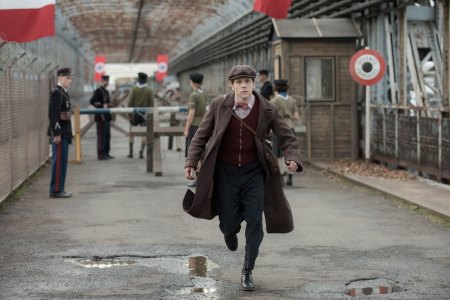
‘Resistance’: You know mime Marcel Marceau, but this is when clowning stopped to kill Nazis


Resistance

Many know Marcel Marceau as one of the greatest mimes who lived, but he also was also part of the French Resistance during the Nazi occupation of France, helping hundreds of orphaned, mostly Jewish children escape to Switzerland. His father was Jewish and as the film “Resistance” has it, none too keen of his son wanting to be like Charlie Chaplin, calling him “a useless bum who wants to be a clown but has the muscles of a ghost.” His father, a butcher, would end up being put to death in a concentration camp, and Marcel would change his last name as he and his brother joined the fight.

Jonathan Jakubowicz’s self-important film is framed with Gen. George S. Patton (Ed Harris) citing Marcel (Jesse Eisenberg) for his heroics to a crowd of U.S. soldiers after the liberation of France. It’s an awkward, out-of-place device – as is much of the film awkward. Harris, normally dead-on in his male bravado, is a mouse stepping into George C. Scott’s shoes, and Eisenberg, while game, struggles with the subtlety of mime and the nuance of an actor feigning composure under the masochistic boot of Klaus Barbie (a scene-chewing Matthias Schweighöfer, a pleasing, malevolent distraction) trying to shake down an escape plot. The film’s told with a Holocaust thriller edge, yet it never quite thrills nor enlightens, especially given the rich historical material at hand.

Just what drives Marcel – or Jakubowicz’s plot – is hard to say. He’s so enamored with Chaplin and breaking out as a performer, it’s hard to know if protecting children or a way of life is more important. Then there’s the sullen but determined Emma (French actress Clémence Poésy), who’s in on the cause and a romantic interest; many of these seeds never fully sprout, leaving the realization of Marceau and his legacy as something of a muddled miss.

Jakubowicz’s choice of title is austere but irrelevant. Yes, Marceau served in the Resistance, but the movement and his time in it are not the film’s major thrust, making it another aspect of the film that raises more questions than it ever answers. One of the very best films (if I may suggest) about the French Resistance is Jean-Pierre Melville’s dark and daunting “Army of Shadows” (1968). Due to the famous May 1968 civil rebellion against the presidency of Charles de Gaulle, the film, with its favorable portrayal of de Gaulle, was not widely embraced; it didn’t get a theatrical release in the United States until 2007. It’s well worth seeking out.

Blow the Man Down

22 Mar

‘Blow the Man Down’: Sisters in a small town share secrets, but small town outdoes them

By Tom Meek

Blow the Man Down' Review: Women, They Get the Job Done - The New York Times

“Blow the Man Down” is something of a noirish whodunnit set in a sleepy little fishing village in Maine by the name of Easter Cove. In look and feel Easter Cove has the small-town intimacy that buoyed “Manchester by the Sea” (2016), but the plot that unfurls upon its docks, dark country roads and placid bays is something else, far darker and more akin to a Coen brothers offering – say “Blood Simple” (1984) or “Fargo” (1996).

The movie begins with the funeral of Mary Margaret Connolly, whom we quickly learn has left her two daughters with a meager fish market, the house they grew up in and a mountain of debt. Mary Beth (Morgan Saylor of “Homeland”), the sassier, redheaded younger of the two, had to drop out of college to help care for her mother, while Pris (Sophie Lowe), the dutiful one, pretty much lives up to her overtly wholesome name. Later that night, to drown her miseries, Mary Beth takes up a stool at the local watering hole and ends up throwing back a few pints with a dubious yet good-looking ruffian named Gorski (Ebon Moss-Bachrach). The two share a few snorts of coke, a car crash into a cherished town landmark – and then there’s the discovery of human hair and blood in the trunk of an old beater as the evening takes some very fateful turns. After it all, there are two bodies floating in the harbor, with Mary Beth and Pris both victims as well as in power to provide the police with details, though the police in this case are totally out in left field and no one is interested in them solving the crimes, let alone the fact that the police chief (Skipp Sudduth) is corrupt and on the take. A critical bag of cash and scrimshaw knife bob around as well.

The film, directed by the first-time tandem of Bridget Savage Cole and Danielle Krudy, is driven by the kind of female outside-the-law energy that propelled “Thelma and Louise” (1991) and is further embossed by the women dominating the ensemble beyond the Connollys (Saylor and Lowe form a palpable sisterhood invaluable to the film’s success). That includes the intimidating Enid Nora Devlin (Margo Martindale, so perfectly unassuming at first), who runs the Oceanview Inn, your classic New England quaint spot that’s a veneer for bordello operations, and a moralistic trio of harpies (June Squibb of “Nebraska,” Marceline Hugot and Annette O’Toole) at odds with Enid and all having something to do with the Connolly matriarch back in the day. Not to mention, the most at stake in the ever-shifting tides of Easter Cove is Alexis (Gayle Rankin), one of Enid’s girls who’s always looking over her shoulder – and with just cause. The score by Jordan Dykstra and Brian McOmber is sets the mood well, and there’s a reoccurring chorus of fisherman singing sea shanties that comment on the action. It’s a worthy little thriller that hits some swells of credibility here and there, but overall the ebb and flow holds us captive.