Archive | Review RSS feed for this section

Richard Jewell

14 Dec

‘Richard Jewell’: Stopping ’96 Olympics bomb put do-gooder in the crosshairs of FBI, media

By Tom Meek

tmp-r-jewell

In talking with a friend about “Two Popes,” the excellently acted and well-shot papal bore-fest, one point that came up about films dealing with “true events” was that flawed characters and quirky happenings on the fringe often made for a more compelling narrative. Take “Sully” (2016) or “I, Tonya” (2017). The former did an end run around on Miracle on the Hudson pilot Chesley Sullenberger, chronicling the hero’s personal hell while being investigated and under suspicion by the Federal Aviation Administration, while the latter peeled back the mask of villainy on the scorned figure skater for her husband’s misguided hit on a publicly adored rival.

Clint Eastwood directed “Sully” and Paul Walter Hauser played one of the goons who took a lead pipe to Nancy Kerrigan’s knee in “I, Tonya,” so it’s fitting that the two pair up for “Richard Jewell,” about the surreal ordeal surrounding the portly security guard of the title, once under investigation for a bombing in Centennial Park during the 1996 Olympic Games in Atlanta. Nicely, the story bookends with the relationship between Jewell (Hauser) and Watson Bryant (Sam Rockwell), a snippy, dismissive lapdog of an attorney. It’s at his law firm that we first meet Jewell as a mail delivery clerk, before he moves on to pursuing his dream of being a law enforcement officer and ends up at Centennial Park.

Up to the bombing – which comes midway through – the character illustration of Jewell is quite something. Sure he’s got the countenance of a rube, lives at home with mom (Kathy Bates, perfectly understated) and has buddies with mullets who look like white supremacists, but his expressed desire to serve and protect comes off as genuine. It’s hard to fault a man with ambitions – that is, until you learn that as a college campus security officer, Jewell’s something of an overreaching megalomaniac, pulling over students on the highway outside campus when suspected of drinking and driving and barging in for dorm room searches. At once, you pity Jewell and see the seeds of George Zimmerman. Continue reading

Knives Out

27 Nov


tmp-knives

“Knives Out” is a good, old-fashioned whodunnit with a healthy serving of droll comedy. Yes, comparison to classics such as “Murder by Death” (1976) and “Clue” (1985) are apt. That first film had Truman Capote, Peter Sellers and Peter Falk (not to mention the voice of Fay Wray) among its eye-grabbing cast; here we have Chris Evans trading his “Captain America” duds for J.Crew gear as a slack, spoiled preppy, as well as Michael Shannon – who, as General Zod in another universe, could have been Cap’s foe, Jamie Lee Curtis, dandy Don Johnson, Toni Collette and the impeccable Christopher Plummer. The real centerpiece, however is Bond boy Daniel Craig as a private gumshoe named Benoit Blanc who, while not quite Clouseau wacky, is imbued with scads of quirk, overconfidence and a twangy, near-Southern drawl. It’s such a radical departure, you can’t stop gawking at Craig in every scene he’s in.

The film, shot in and around Boston, marks something of a changeup too for director Rian Johnson, who’s done everything from quirky indie (“Brick” and “Looper”) to big budget blockbuster (“Star Wars: Episode VIII – The Last Jedi”). Living in a quaint New England manse, renowned murder-mystery scribe Harlan Thrombey (Plummer) celebrates his 85th birthday and then dies when his nurse Marta (Ana de Armas, Ryan Gosling’s comely virtual love interest in “Blade Runner 2049”) gets his medications mixed up. Is it suicide, an accident, Harlan acting out one of his plots or something more nefarious? 

That’s the game afoot, and while it’s not particularly grabbing in its own right, there’s a rich potpourri of bloodsuckers who stand to benefit from Harlan’s departure and are thus prime suspects, be it his snarling son, Walt (Shannon), in charge of the publishing empire; his sister, Linda (Curtis), married to the self-righteous Richard (Johnson); their aloof son, Ransom (Evans); or Joni (Collette), wife of Harlan’s late son, who still holds a prominent perch. It’s not the plot providing the fun as much as the rubs of the twee and the entitled coming off with biting satire. Harlan is so dignified and magnanimous you can almost hear him bellowing from his grave as his blood squabbles around the remains.

As the crew stays around to hear the reading of the will, Craig’s Blanc sleuths about with varying degrees of success, but endless dry wit. The script by Johnson does what it needs to,. with just the right amount of red herrings, plot twists and deft humor. The best is the family’s insistence on the inclusion of Marta as “one of them,” yet none can remember if she’s from Colombia, Ecuador or Nicaragua. It underscores the absurdity of the insincerity of the well-off. In consumption, the film may be a touch overbaked – in length, and holding itself a little more grandly than it should – but still, as served, it’s great holiday entertainment if you just want to feast, fill up and let someone else take the wheel.

Dark Waters

27 Nov

‘Dark Waters’: Corporate lawyer finds a cause in redemptive tale you may have heard before

By Tom Meek

tmp-darkwater

Who knew Todd Haynes, the man behind such curios as “I’m Not There” (2007), “Safe” (1995) and “Velvet Goldmine” (1998) would settle down for a by-the-numbers courtroom drama? Sounds improbable, but “Dark Waters” proves it so. Any quirky touch you might hope for or expect from Haynes, check that at the door.

You can think of “Dark Watters” as akin to “A Civil Action” (1998), a serviceable true-life legal chase plumbing the evils of Big Chemical poisoning the residents of a working-class enclave who lack the resources to fight back. That film dramatized the leukemia-linked cases against W.R. Grace not too far north of here in Woburn, back in the early 1980s; “Dark Waters” steps into something deeper and more sinister as the folk of a small West Virginia town raise a fist against DuPont for dumping teflon into their water supply.

“Dark Waters” catches its swell mostly from its impressive cast, namely Mark Ruffalo on point as Robert Bilott, a big time corporate lawyer who one day in 1999 has an incensed farmer (Bill Camp, wonderful in a limited yet pivotal role) show up at his Cincinnati office with a box full of videotapes. Turns out that vociferous aggie, who goes by the name of Wilbur Tennant and knows Bilott’s grandmother, has evidence not only of mad cow disease (literally – cows so on the edge, they go berserk and charge) but a freezer full of frozen mutant organs that would give even David Cronenberg reason for pause. Piqued by Tennant’s pleas and taking it as an opportunity to pop in and see his nana, Bilott takes a drive to Tennant’s farm to see the mass bovine graves and denizens with black-stained teeth. A bigger rub facing Bilott as he begins to dig is the fact his law firm has represented DuPont, and powers begin to amass against him from inside. His higher-up (Tim Robbins) is intoxicated by big dollars but possesses a left-leaning sense of social justice; his pedagogical diatribe in a tightly packed conference room feels so out of place and so over the top that it nearly flips the film on its head. 

As you can assume, “Dark Waters” follows a fairly well-worn path. The David vs. corporate Goliath drama has become something of a cinematic staple. Besides “A Civil Action,” “Silkwood” (1983) and “Erin Brockovich” (2000) told against-all-odds struggles of the little guy against nefarious corporate powers seeking to keep the truth at bay and. Those films were also helmed by competent veterans changing it up (Mike Nichols, Steven Soderbergh) and got knockout performances from their stars (Meryl Streep and Julia Roberts). Ruffalo here is pretty impressive as well. As the case wears on for decades, with seeming victories turned into setbacks, the burden – financial mental and professional – is recorded in Bilott’s face as it grows heavier and chubbier, his hair thinning and edged with gray. The sense of weariness and ruin is palpable, hammered home by Bilott’s dutiful wife (Ann Hathaway, nearly unrecognizable in a Carol Brady bob) trying to hold the family together. The best, however, is Camp’s cantankerous old bull, unrelenting and ready for one more fight. At first his fire-and-brimstone rants seem like that of someone who’s not quite right. He’s not: He’s sick, and one quick scan of Parkersburg, West Virginia, illuminates his righteousness and the evils of loopholes that allow corporate entities to knowingly effect the death of nearby residents.

Waves

21 Nov

‘Waves’: In haze of dazzling Florida sun, tragedy threatens to pull a family under

tmp-waves

Like the entity of its title, “Waves” moves in crests and crashes, mostly that of the fates and emotions of its characters, and the profound and lingering impact of those actions. Wunderkind filmmaker Trey Edward Shults (“Krisha,” “It Comes at Night”) immerses us in the ebbs and flows of life of an African American family in South Florida in a way that feels like cinéma-vérité, but the beginning and end – a girl riding a bike along a serene esplanade – bookends the film with poetry and purpose.

Following that scene of tranquil innocence, we jump into a car full of teens joyriding across a bridged expanse, the sky above and water below both impeccably blue as music blares on the radio. The camera, seemingly hung disco ball style from the roof of the SUV, swirls around and around as we catch glimpses of happy faces singing along and legs, arms and heads lolling out the window. It’s a scene of pure, energetic joy, but glorious and uplifting as it is, there’s an imminent undercurrent of fragility and peril.

Two of the teens, Tyler (Kelvin Harrison Jr.) and Alexis (Alexa Demie, from the TV series “Euphoria”) make a tumultuous pair. When it’s good, it’s great, but ripples in the relationship lead to bigger ramifications. Tyler’s a rock star of a wrestler with a shot at a college scholarship, something his controlling father, Ronald (Sterling K. Brown), drills into him on a daily basis, making him do extra weight training after practice and breaking down his technique ad infinitum – after one or two of these life coaching lecturers, you too will want to slip away to your room. The first setback for Tyler comes in a potentially career-ending shoulder injury that leads to the use of alcohol and drugs to cope. Then Alexis mentions the words: “I’m late.”

How that conundrum is wrestled with (and it takes wildly unexpected turns) arrives early in the film; then there’s a dramatic focal shift to Tyler’s kid sister, Emily (Taylor Russell), who struggles in the aftermath but ultimately finds comfort and romance in the company of Luke (Lucas Hedges), another wrestler and something of a goofball romantic despite having his own issues (mom died when he was young, and he’s estranged from his father).  For all the natural and architectural beauty Shults finds in South Florida – the setting for other notable recent indie greats as “Moonlight” (2016) and “The Florida Project” (2017) – it is not the happy place it appears to be on the outside.

Like “Moonlight” – and comparisons between the films are inevitable, though they are very different – the matter of race in “Waves” is not embossed or underscored. But it’s there, subtly and provocatively. About the most overt the film gets is when Ronald, who along with his wife (Tony winner Renée Elise Goldsberry, “Hamilton”) has provided the children a spacious and nurturing environment, tells Tyler solemnly, “ We are not afforded the luxury of being average. Got to work 10 times are hard just to get anywhere.” It lingers.

Of “Waves,” not enough can be said about the cast. Brown’s prideful patriarch commands the screen so throughly that I can’t imagine he’s not in the Best Supporting Actor conversation come year end; but the whole tsunami of emotions doesn’t crest or swell without Harrison Jr., seen this year in “Luce.” His once hopeful character goes through a gantlet of external and self-imposed torment – a bravura performance from such a young actor who has to hit such a wide range of emotions, so high and so low, and something he takes to the mat each time, giving Shults’ middle American saga its brine and soul.

The Irishman

15 Nov

‘The Irishman’: De Niro, Pacino, Pesci, Keitel – Scorsese saga gets the ol’ mob back together

tmp-irish

Al Pacino edges Robert De Niro by one with eight Oscar nominations, but De Niro has taken home two of the coveted gold bald statues to Pacino’s one. The pair are two of the greatest actors of a winding-down generation who, in “The Irishman,” the latest from mob movie maestro Martin Scorsese, get a shot at putting a crowning jewel on their storied careers. Both had parts in Frances Ford Coppola’s timeless “The Godfather: Part II” (1974), in which De Niro played the youthful version of Vito Corleone (gold statue numero uno) and Pacino played his future son, Michael – and the two were never onscreen together. Some 20 years later they shared the screen as cat and mouse in Michael Mann’s “Heat” (1995) with Pacino’s dogged cop getting the better of De Niro’s quiet criminal. Here, where the two play real-life mob enforcer Frank Sheeran (De Niro) and labor leader Jimmy Hoffa (Pacino), there’s a something of a payback. (To do full and accurate accounting, the icons took a hit for their part in the tepid 2008 cop drama “Righteous Kill.” Not that you needed to know, but.)

Much will be made of the (near) three-and-a-half-hour runtime of “The Irishman,” but it goes by in a blip as it hops around a 50-year period, with much of the focus on the Hoffa years – the early ’60s to 1975, when the labor lord went missing. The cause and culprit remain an American mystery, though Scorsese and his talented screenwriter Steven Zaillian (“Schindler’s List” and “The Girl with the Dragon Tattoo”) work from Charles Brandt’s book “I Heard You Paint Houses” to offer up a theory with strong conviction (Brandt’s book was based on interviews with Sheeran, who died in 2003). The implied question of the book’s title is a polite way to ask a tough guy if he does hits; a casual “yes” is how De Niro’s Frank responds in the film. Continue reading

The Report

15 Nov

‘The Report’: It’s CIA ‘enhanced interrogation’ put to post-9/11 test in page-turner of a movie‘The Report’: It’s CIA ‘enhanced interrogation’ put to post-9/11 test in page-turner of a movie

tmp-rpt


Scott Z. Burns has been mostly known as a screenwriter on such Steven Soderbergh projects as “The Informant!” (2009), “Contagion” (2011) and “Side Effects” (2013). Here, in this dark delve into recent U.S. misdeeds, Burns not only writes but takes the director’s chair, with Soderbergh as producer. The simplistic title “The Report” represents something more complex and foreboding – “The Torture Report,” with that middle word crossed off as soon as it spills across the screen in the opening credits. The report in question concerns waterboarding and other “enhanced interrogation techniques” employed by the Bush administration in the wake of 9/11, and is deeply redacted by the CIA.

If you haven’t seen “Zero Dark Thirty” (2012), Kathryn Bigelow’s brilliant take on the hunt for Osama bin Laden, there’s a scene early on demonstrating the use of the interrogation techniques. It’s throughly unpleasant, and“The Report” dials the discomfort up from a 9 to, say, an 11. The film begins with U.S. Senate aide and researcher Dan Jones (Adam Driver) consulting with a lawyer about possibly treasonous charges against him for “relocating” a CIA document, then winds back to when Jones, who toiled in counterintelligence after college, lands on the staff of U.S. Sen. Dianne Feinstein and is tasked to lead a U.S. Senate Intelligence Committee probe into the CIA’s use of torture after 9/11.

It’s mostly a paper trail chase, but a riveting one – think “All the President’s Men” (1976) replete with a mini-me version of Deep Throat. Jones and his team are granted access to documents in a secure basement vault on CIA turf, but no documents are to leave the chamber, and Jones and associates aren’t allowed to interview any of the operatives involved. Meanwhile Feinstein (Annette Bening), solemn and serious, applies pressure to agency leaders under the Bush and Obama regimes, finding the desire for it all to go away is clearly bipartisan.

Through documents (which lead to dramatizations of events) we learn of contractors James Mitchell (Douglas Hodge) and Bruce Jessen (T. Ryder Smith), slithering sorts and former military intel who sell a fictitious (or composite) CIA honcho named Bernadette (Maura Tierney) on enhanced interrogation even without proven results. From the PowerPoint presentation alone, viewers’ eyebrows will raise, but for Bernadette it’s a key weapon in the war on terrorism – Geneva Conventions be damned. As a pair, Mitchell and Jessen are something of a disturbing chuckle, lapping up taxpayer-bought scotch aboard jets and going about their business like Kidd and Wint in the Bond flick “Diamonds are Forever” (1971). Through it all Tierney’s dutiful top cop promises results to her higher-ups and sits and watches the heinous shenanigans (naked men being beaten and sleep deprived by heavy metal music played at eardrum-bursting levels) with cold steely resolve, forever waiting.

The definition of “torture,” as explained in the film, is complicated: It turns out that if you can extract information that can save lives, how you got it doesn’t matter; if not, enhanced interrogation is a human rights violation, and you’ll be left out to dry. Burns orchestrates some nice juxtapositions in setting: Most of the film takes place in dark, windowless rooms, be it that basement vault where Jones and crew toil away in, the subterranean hellholes on foreign soil where Mitchell and Jessen perform their dirty deeds or the soulless conference room on Capital Hill that serves as a boxing ring for Feinstein and CIA Director John Brennan (Ted Levine).

From top to bottom, the performances impress. Bening shines as the fiery Feinstein demanding accountability, and Linda Powell brings similar intensity as loyal Feinstein staffer Marcy Morris; John Hamm adds rational cool as Denis McDonough, the Obama chief of staff trying to hold the middle ground. Of course, the film hangs from Driver’s dogged research wonk, whose focus and commitment to the task and idealism is imbued with a heaviness and signs of fraying over the long-fought years. Words matter – in this case, a very specific one.

Ford v Ferrari

13 Nov

‘Ford v Ferrari’: Keen to outrace the Italians, team’s truer enemy is signing their paychecks

tmp-fordVFerari

Friendship and faith abound in this take on the fast and furious arms race between an automotive giant and chic auto boutique on the boot of Italy. Back in the late ’50s, Carroll Shelby won the grueling Le Mans 24-hour auto race, something few Americans up to that point had ever done, as the race had long been dominated by Team Ferrari. After winning Le Mans, Shelby (Matt Damon) is informed of a cardiovascular condition that will prevent him from racing while Ford, the mega conglomerate, is looking for ideas to jump-start the brand. The automaker’s upper echelon, painted as a collection of stiff, square suits, has recently kicked off the Mustang line – thanks to Lee Iacocca, played by Jon Bernthal – but wants to appeal hipper to the blossoming Boomer generation by taking down the glamorous and glorious Ferrari team at the French-hosted, daylong drive fest. For the cause, and for a lean and efficient approach, Ford taps the maverick Shelby to build car and team.

Based on true events, “Ford v Ferrari” revs across the finish line mostly because of the yin and yang relationship between the affable Shelby and his driver, Ken Miles (Christian Bale), and the external pressures put on them by Ford. Ken’s a hothead and a family man, and both he and Shelby face crushing financial pressures – over at shop Shelby, the renowned race car driver sells the same sleek collector’s item to multiple buyers on the same given day, with the mantra “Get the check but don’t let them drive away with it.” Extreme auto wonks Shelby and Miles go about their work with innate knowhow, lightening and quickening the car – Ford loads the initial GT with a clunky computer for diagnostics, which Miles unceremoniously rips out and opts for scotch tape and yarn to determine drag. As it turns out, it’s Ford that’s the film’s biggest villain with higher-up Leo Beebe (Josh Lucas, nailing the smarminess) a creepy control freak sharking around who wants Miles out (he’s not a Ford man) and Shelby to bow to him on every decision. Even more telling is Ford’s botched acquisition of Ferrari (viva la Fiat!) and the overbearing, near Trumpian portrait of Beebe’s boss, CEO Henry Ford II (Tracy Letts).

Directed serviceably by James Mangold (“Logan” and “Girl, Interrupted”) “Ford v Ferrari” marks one of the better (not that there’s a bevy) of recent racing flicks. It’s akin to Ron Howard’s surprising “Rush” back in 2013 as it careens along the roadway of friendship and rivalry at top speed. The race scenes and era are recreated impeccably, but “Ford v Ferrari” goes on a bit too long (two and a half hours) for its own good. Damon’s game thinker and Bale’s mercurial Brit carry the film from start to finish with a juicy contribution from Letts (the scene in which Shelby takes Ford II for a spin in the GT40 is priceless, though a bit over the top) and a more somber and uplifting turn from Caitriona Balfe as Miles’ wife, Mollie. Bernthal’s Iacocca, however, feels a bit lost as the film seems to wrestle with the icon’s legacy and complicity in Ford II’s tyrannical leadership. I’m sure the scion’s family and the current corporate brass at the automaker may have different takes; as told, the division from within proves the biggest obstacle to job No. 1.


Jojo Rabbit

26 Oct

‘Jojo Rabbit’: Hitler Youth’s imaginary friend, true enemy battle for territory in his affections

Jojo Rabbit - Plugged In

We catch up with Jojo (Roman Griffin Davis) as he heads off to a Hitler Youth boot camp for a weekend. He’s a proud loyalist and, because dad’s gone missing, his male surrogate is the führer himself. Talk about an unholy and unhealthy imaginary friend, but Waititi, who is half Maori and half Jewish, plays the part with a deft, humorous touch, giving Hitler a warm, avuncular sheen while not letting him off the hook for, well, everything.

The leporine tag of the title comes from that boot camp, where the undersized Jojo botches a test of manhood and is tagged a “scared little rabbit.” The best part about the camp is that we get Sam Rockwell as a snarky, demoted officer running things and Rebel Wilson as his chortling assistant – “Get your things together, kids, it’s time to burn some books!” Back at home, Jojo’s mother Rosie (Scarlett Johansson) doesn’t quite share her son’s all-things-Aryan zeal. Then there’s that someone hiding in the walls: Turns out mom and dad are anti-Nazi propagandists, and the older girl living in a secret compartment upstairs is Jewish, and being sheltered by mom. Jojo discovers Elsa (Thomasin McKenzie) and begins to study her (keeping a science journal detailing “the Jewish beast,” which, while shocking and telling, also becomes a major turning point in the film). As the interviews progress, a friendship begins to take seed. They never let Rosie know that Jojo knows, but in passing Jojo tells his pal Yorki (Archie Yates, whose round-faced exuberance makes him an infectious scene stealer) he’s “captured one,” and even Rockwell’s officer. But no one really believes him or cares, as the Third Reich has begun to crumble.

Beyond the wide-eyedtransformation of its young protagonist, the heart and humanity of “Jojo Rabbit” radiates through its women. Since she’s donned Lycra in the Marvel Universe and teamed up for freaky times with Luc Besson (“Lucy”), filmgoers might have forgotten ScarJo’s emotive resonate from past immersions into nuanced roles of cold alien bait (“Under the Skin”) or a dislocated American in Japan (“Lost in Translation”). She carries the part of a conflicted mother fully. You know her Rosie detests sending her son off to boot camp, but does so not only because of the bigger forces at play, but because she’s an adoring mother trying to support her progeny as best she can. McKenzie, who gave such a mature and central performance in the off-the-grid drama “Leave No Trace” (2017), ups her stock here. Her character’s somber reflectiveness and innate compassion go a long way in disarming Jojo’s regime-first reactiveness. The scenes of the two communicating indirectly while connecting on a personal level build subtly and effectively, offsetting the mad world outside.

I’m not sure if there’s such adroit, slapstick skewering in “Caging Skies,” the book by Christin Leunens on which the film is based, but in Waititi’s World War II universe, shouts of “Heil Hitler” – initially shocking – ultimately become something of a comic refrain, like, say, in a Mel Brooks movie, and Rockwell, Wilson and Waititi play their deplorables with over-the-top, nod-and-wink perfection. The material is equal parts grim and hysterical (especially the debate over which of the Allied forces are worse to humans and dogs – Americans, Russians or the British), and folk will likely seize on comparisons with “The Death of Stalin” (2017) due to the era, comedic style and subject. It’s only natural, but “Jojo Rabbit” delivers a palpable human story that touches as we laugh and the world around explodes. And somehow David Bowie and the Beatles find their way in.

Parasite

18 Oct

‘Parasite’: What’s rising from the basement? Another squad eager to fight in the class war

Image result for parasite movie

Korean director Bong Joon-ho, who plumbed issues of economic disparity in “The Host” (2006) and “Snowpiercer” (2013), is back at it in “Parasite,” where we meet the haves and have-nots – the Parks and the Kims – and the shit starts flying.

We catch up with the Kims first, living in a shabby basement apartment where they fold pizza boxes for a buck and scam Wi-Fi from those above. They live hand to mouth until the enterprising daughter of the clan, Ki-jung (So-dam Park, sassy and excellent) lands a job as an art therapy tutor to the Parks’ young, eccentric (and demanding) son, who was traumatized in first grade by something emerging from the lowest level of the Parks’ sleekly palatial, very Scandinavian home. A host of opportunities emerge. Ki-taek’s older brother is ensconced tutoring the Park’s daughter. The mother supplants the Parks’ longtime housekeeper. And what if the patriarch of the Kims could get a job as the Parks’ driver? Neat idea, but they already have a chauffeur. The resolution is a pair of soiled panties left in the back of the Benz for Madame Park, quite OCD and repressed, to get her gloved mitts on.

The Parks, for all their wealth and stature, are 120 percent unaware that their new battery of employees know each other. It’s a happy coexistence for a good while; then the Parks go away for a long weekend and the Kims move in and make the place their own, emptying the liquor cabinets and pretty much turning the sparkling, spartan palace into a squatter’s paradise. It’s also when that something in the basement rears its head and the movie goes from a tense 5 to a frenetic 11.

Bong’s “Snowpiercer,” famously nearly ruined by disgraced movie mogul Harvey Weinstein, was about class stratification – those in the cramped dingy rear of the post eco-apocalyptic train eating soylent-ish green squares until they rise up and storm the gilded front, where champagne and sushi are fed to the 1 percent. Here, as with Jordan Peele in this year’s “Us,” Bong once again lets his message bubble up steadily yet subtly, ever pointed and tugging at the corner of the frame.

The culmination is as shocking, provocative and thoroughly entertaining (and resonant) as in “The Host,” which stormed the minds and hearts of critics and filmgoers the way the mutant beast did the urban landscape along the Han River. Beyond the impressive efforts of the ensemble cast, not enough can be said of the superbly composed framing by Kyung-pyo Hong (“Snowpiercer” and “Burning”), especially the wide shots of dingy urban alleyways, littered with refuse and Escher-like ascents. It’s a complete effort all around, and the kind of follow-up folks were hungry for after “The Host.” By returning to familiar themes and (untraditional) family values, Bong has again latched on to the collective mindset with a deft touch of the outré.

The Lighthouse

18 Oct

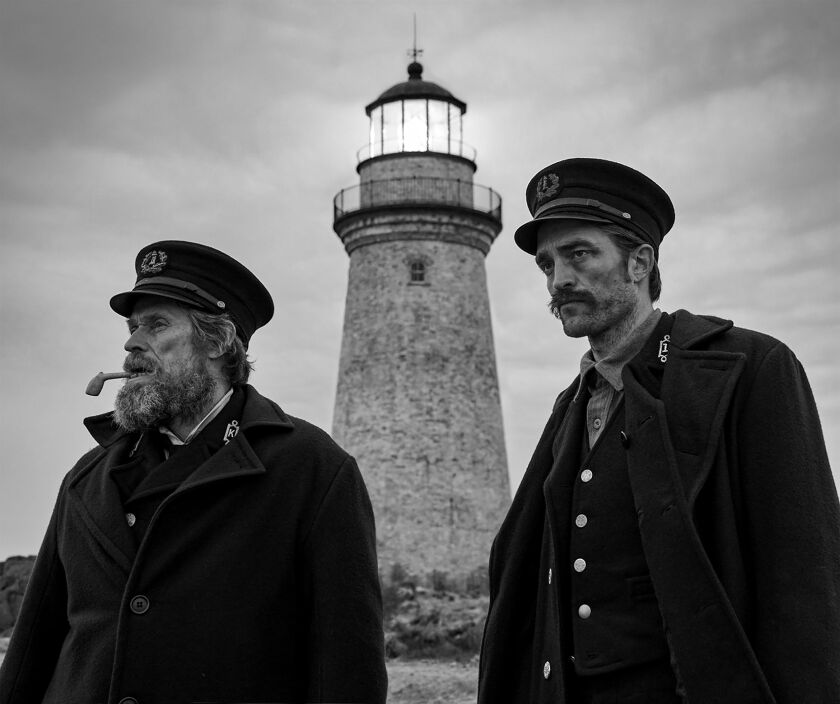
Image result for the lighthouse movie

“The Lighthouse” is a senses-riveting immersion, aurally awash in the sonorous sounds of the sea, the pelt of torrential rain and the soul-shaking roar of the title structure’s bullhorn. It’s also brilliantly composed in austere black and white, in a retro-cropped format (practically, a neat square at 1.19:1) by Jarin Blaschke, who also shot director Robert Eggers’ debut, “The Witch” in 2015. “Roma,” another bold black and white gamble, walked off with the Academy’s best achievement in cinematography last year – and rightly so – but I must say, much of what Blaschke and Eggers conjure up here is more vital to their film’s core and registers an overall surpassing grade. Hard to imagine, but yes, it’s that stunning.

The narrative the ambience hangs from isn’t quite as sure, but what’s to worry when you have Willem DaFoe and Robert Pattinson? The setup, based on writings by Melville and sea-obsessed others of the era, has two men keeping the flame on a remote isle somewhere far off the New England coast. It’s circa 1890, so there are no cell towers; there’s also no Morse code from the island should something go wrong. The pair are dropped off on the rock for a four-week shift. Dafoe’s Thomas is a salty old tar, Pattinson’s wide-eyed Ephraim the newbie in his charge. The order of things gets laid out early on: Thomas does the all the attending to light, which is kept under tight lock and key, as well as the cooking, while Ephraim pretty much does the backbreaking rest – scrubbing the floors, hauling heavy loads of coal across jagged rock outcroppings, emptying the piss pots and painting the structure from a rickety harness that would make any OSHA official cringe. 

Thomas proves to be an Ahab-like taskmaster, though just what his white whale is never surfaces. The first rub between the mates comes over the consumption of booze (Ephraim won’t partake) and later the quality of those scrubbed floors. What Eggers begins to simmer here (as he did in “The Witch”) is a slow descent into madness as things fall apart, with faint hints of perhaps something bigger and more divine at play – fog-impaired siren sightings, booze-addled images of sensually writhing tentacles and even the incarnation of Neptune himself. The existential horror story gets triggered by a vociferant gull with all the brio and menace of the devil-eyed goat Black Phillip in “The Witch,” and the arrival of a nor’easter that could hold up their relief by weeks, if not months. The stranding ultimately becomes an opportunity for the actors to really dig in and Act – and boy do they, as alcohol, sexual tension and stormwater rain down upon the splintering shingles of their characters’ relationship with the mystery of the lighthouse tower and Thomas’ journal (also conspicuously under lock and key) ever pulling at Ephraim.

The chemistry between the two, well at the top of their games, couldn’t be any more perfect, and it’s a pretty physically taxing slog, to boot. Pattinson, so good in such offbeat, gritty ditties as “Good Time” (2017) and “High Life” this year, pours himself into the part, never flinching as torrents of wind-driven rain or fecal matter pelt his face. But this is Dafoe’s flick, his mercurial changeups and old sea dog affect behind a beard so thick and mangy it rivals that of Edmond O’Brien’s old coot in “The Wild Bunch” (1969), sells and seals both the authentic air of the period and the reality-warping mayhem. 

The film’s finest moment, echoing the “Indianapolis” scene in “Jaws” (1974), has the marooned liquored up and singing and dancing gaily. In the cloistered quarters, the choreography and execution are pure bravura. Of course there’s no shark to break the interlude, just the specter of loneliness, haunted pasts and the unmistakeable boundary of taboo. Other cinematic borrowings from “The Shining” (1981) and “Apocalypse Now” (1979) may raise a brow, but are otherwise unnecessary distractions. 

The other bright spot is the titular structure itself. The isle-perched beacon looks a legitimate relic, 150 years old, but truth be told, it was erected to house Eggers’ haunted hall of personal demons. There’s also some eye-grabbing visual effects with the use of white burning light and an eerie score by Mark Korven that deepens the whole, beguiling experience. Like Pattinson’s deep space cruiser en route to a black hole in Claire Denis’ “High Life,” “The Lighthouse” is less about liftoff or landing and more about the tormented sojourn.