
Tom MeekThe Shade structure at Sennott Park in Cambridge, seen Aug. 22, is run by teens to provide community activities and a break from summer heat.
That structure at the south end of Sennott Park on Broadway is not a performance stage, but a community gathering spot designed to get people mingling and interacting and out of the heat. The concept, called Shade, is the creation of community engagement activists Debbie Bonilla and Jeff Goldenson, responding to climate change and teen mental health issues.
While Shade aims to benefit teens by providing a safe, cool space to hang out, it’s also designed to imbue them with a sense of responsibility: Teens are involved directly in all aspects of its social-justice-driven projects, from the structure’s design to its maintenance and operations, paid though grants and resources such as the Mayor’s Summer Youth Employment Program. “Teens know teens best,” Goldenson said during an onsite conversation, “and deserve a place at the table.”

This stay-cool-and-chill pop-up is a series of interconnected ramps and raised platforms capped by an undulating wave of multihued shade sails and an aesthetically pleasing lighting halo. There are hammock seats, built-in benches and a few collapsible camp chairs. It’s available for all to use any time the park is open, and is staffed 5 to 8:30 p.m. Tuesdays, Thursdays and Fridays by teens who can break out a popcorn cart, games, a smattering of radio controlled cars to race and an audio system (all stored in an adjacent shipping container when not in use). Given a few restrictions – not too loud, no graphic lyrics – the teens get to pick and manage the playlists. Pizza is ordered in regularly.
The Sennott Park facility is the second of its kind; the first went up last year not too far away at Donnelly Field as part of the city’s Shade is Social Justice program, which drew a climate resiliency grant from the Metropolitan Area Planning Council and Barr Foundation. The “Sun Block” cube at Lafayette Square – at the of Central Square – was realized as part of the same grant.
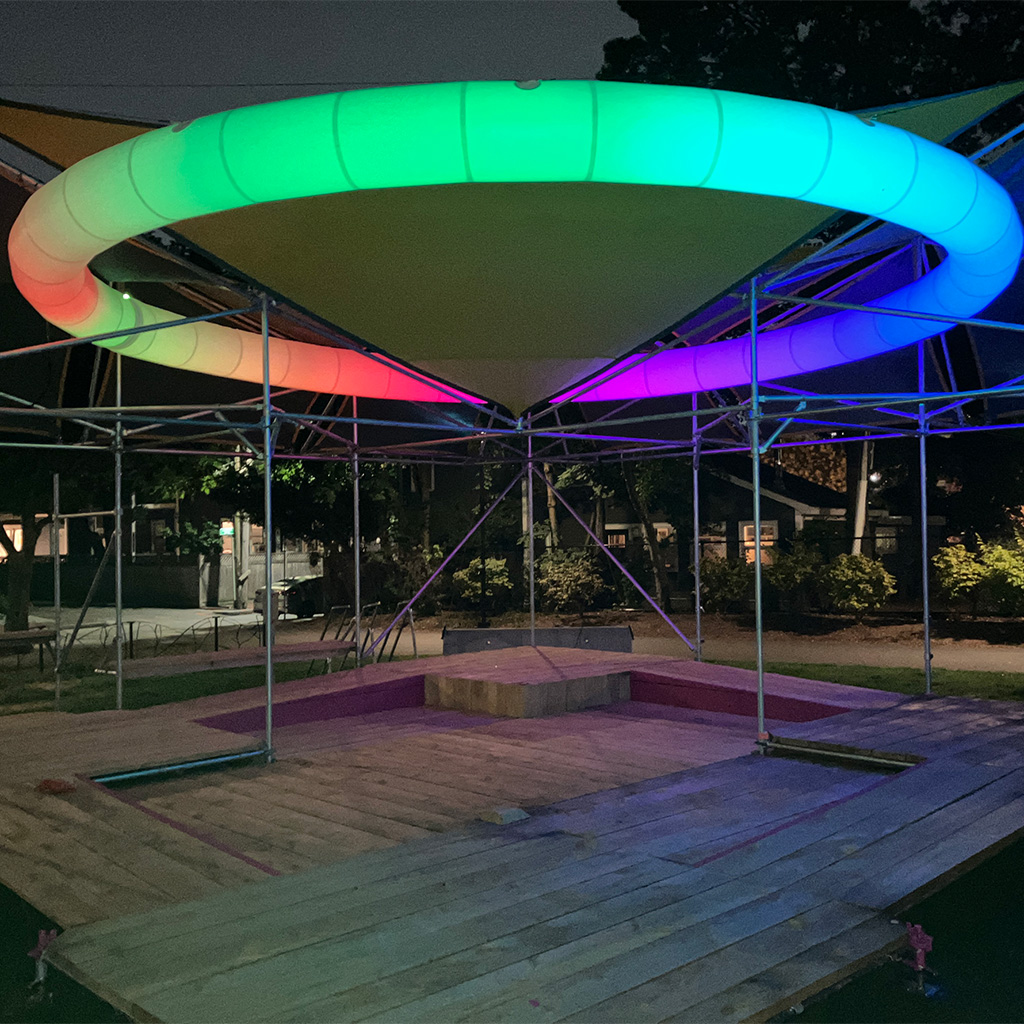
ShadeShade’s halo of light comes on at night in Sennott Park.
The Broadway Shade installation came about this year through a grant that Bonilla and Goldenson helped secure from the New England Foundation for the Arts. The site also qualified for the mayor’s program that hires teens into community jobs during the summer. Shade was able to employ six to eight teens part-time from February through June during the administrative, planning and design phases, Goldenson said, and the structure was designed by a committee of local youth: Cheryl Rateau, Eli Goncalves, Nico Chandler, Samadhi Simmons, Matt Keane and A’mara Henry-Guity. More hires were added as part of the Mayor’s Summer Youth Employment Program for setup and operation.
Extreme heat is the leading cause of weather-related deaths, and the area already faces much higher temperatures than in decades past, with a greater number of hot days and some records being set. The hottest June day for the area since data collection began in 1872 was this year: June 24 hit 102 degrees (also the area fourth-hottest day for any month). Another heat record was set July 29, when temperatures hit 98 degrees. Cambridge’s Climate Change Vulnerability Assessment predicts the number of days above 90 degrees could almost triple by 2030 and might be the norm every day of summer by 2070.
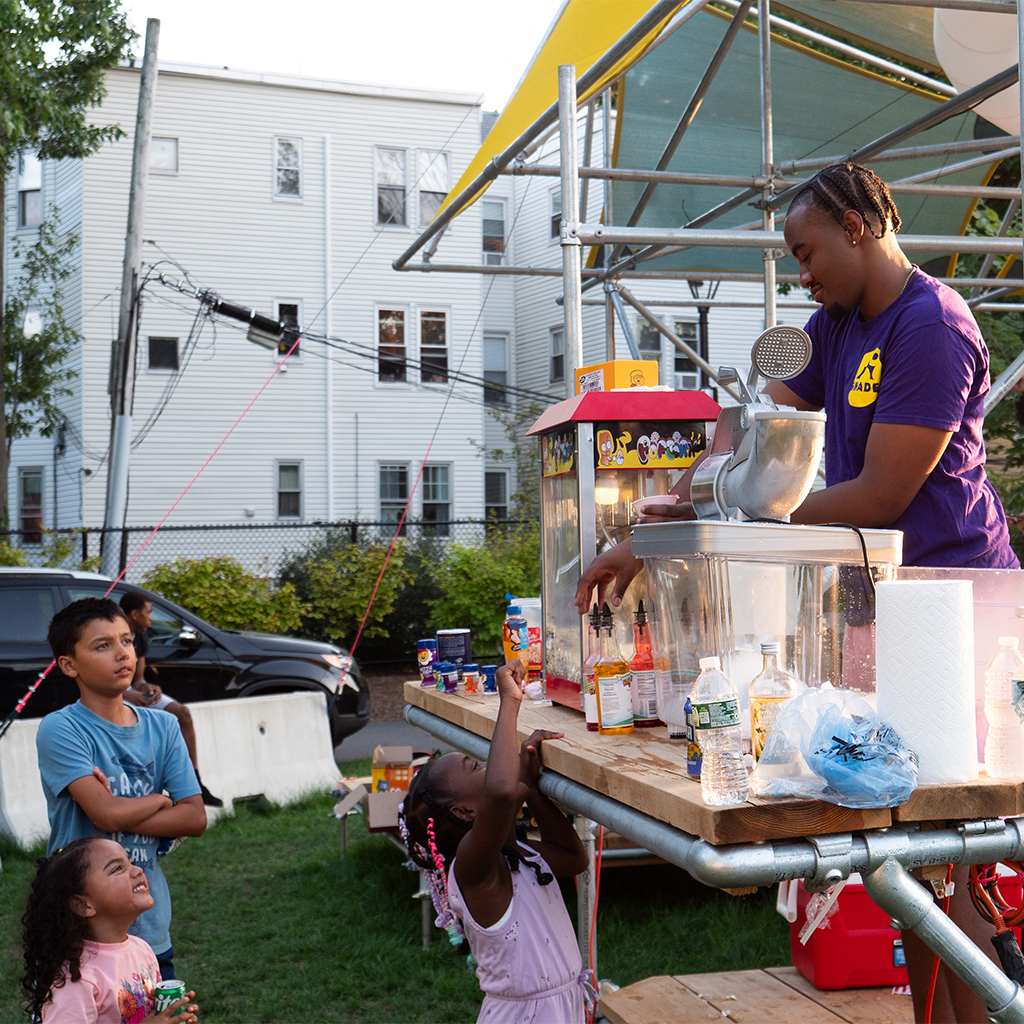
ShadeA Shade worker serves neighborhood kids from its dedicated popcorn maker.
A Cambridge Health Department survey in 2022, meanwhile, reported that 37 percent of teens professed regular feelings of depression, and that 20 percent expressed suicidal thoughts, the highest marks since 2012.
As a project that combines summer cooling and teen engagement, Shade won support from the city, and the City Council in particular. “Shade is a example of what happens when young people lead the way. These teens are not only creating spaces where their peers can gather and connect, but they’re also helping Cambridge confront the realities of climate change with creativity and care. I’m proud of their leadership, and of the citywide collaboration that brought this project to life,” councillor Sumbul Siddiqui said.
For the first-year structure, the main material supplier and building partner was a scaffolding company, but scaffolding by design is meant to be climbable and had too many footholds, which presented risk concerns. For Sennott Park, a different framing firm was engaged that donated much of the materials – leaving more money to pay teens, Goldenson said.
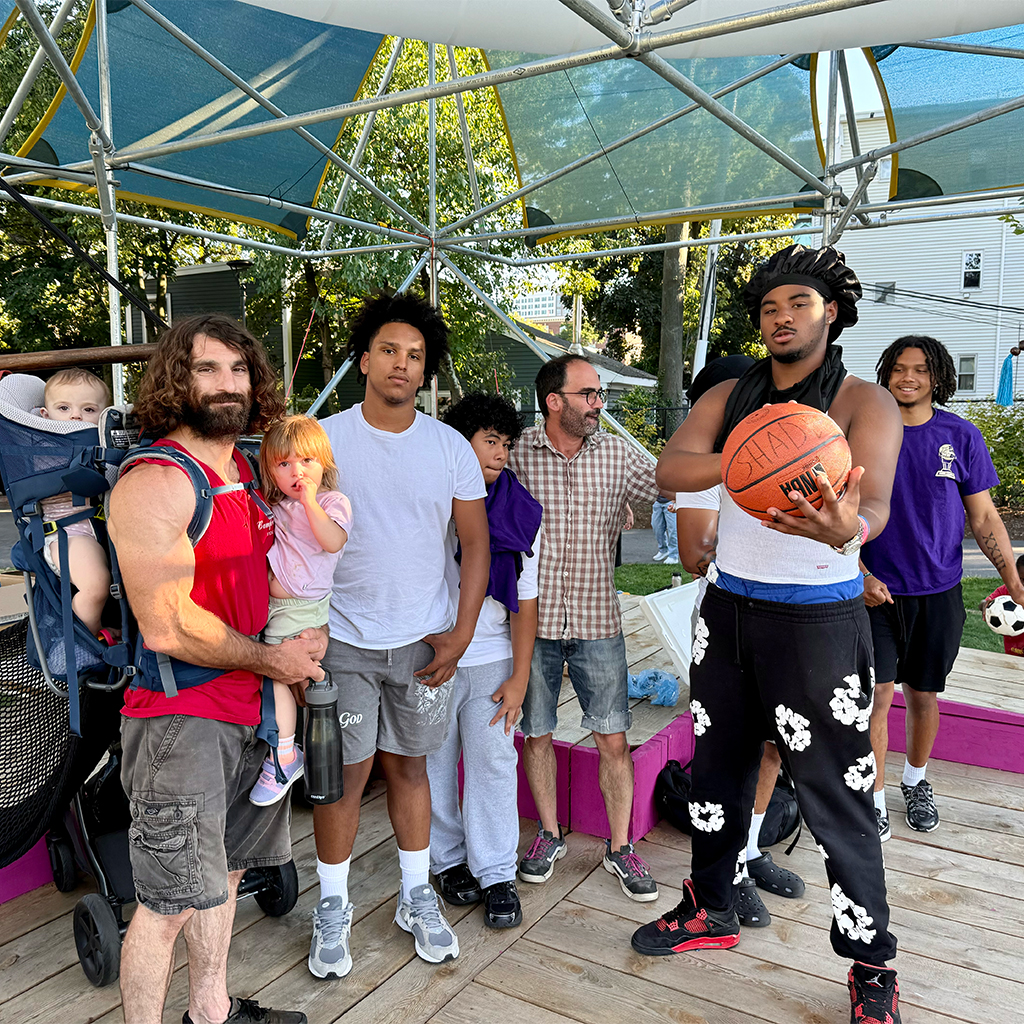
Tom MeekJeff Goldenson, third from right, with Shade workers and visitors on Aug. 22.
Shade is at the less-frequented south end of the park, Goldenson noted, and might have benefited from being near the north-end basketball courts and its regular three-on-three tournaments. The organization runs them, giving winners prizes such as Amazon gift cards.
The community that gathers at Sennott Park is diverse. On a Friday night visit, there were mothers with toddlers rocking in the hammock swings as elementary-aged children giggled over races of those radio-controlled monster trucks, sending them under the Shade structure and across the field. A basketball tourney was underway with players enough for eight teams, and more people to watch. Goldenson said basketball and snow cones are the big draw, but hopes to add movie nights, which would make apt use of that popcorn machine.
But the mayor’s employment program is winding down with the end of summer, and Sennott Park’s Shade structure comes down mid-September.
It’s unknown if another Shade stage will be built in Cambridge next summer, they said.
Bonilla and Goldenson, whose community-based teen engagements before Shade included programs such as the popular Friday Night Hype, hope to share the concept with other communities. A grant from the Sasaki Foundation is paying for the work of imagining how – potentially a franchise or membership-based model, or the selling of the design (made with the help of Wentworth College), materials or even a “best practices” knowledge base from the teen engagement program.
In the fall, with Shade packed away, Bonilla and Goldenson will turn their focus to figuring it out.
“We want to share, but we want to be sustainable too,” Goldenson said. “We don’t want to be always chasing grants.”
Amid climate change challenges, Shade presents obvious answer: Let teens show how to be cooler
The Shade structure at Sennott Park in Cambridge, seen Aug. 22, is run by teens to provide community activities and a break from summer heat.
That structure at the south end of Sennott Park on Broadway is not a performance stage, but a community gathering spot designed to get people mingling and interacting and out of the heat. The concept, called Shade, is the creation of community engagement activists Debbie Bonilla and Jeff Goldenson, responding to climate change and teen mental health issues.
While Shade aims to benefit teens by providing a safe, cool space to hang out, it’s also designed to imbue them with a sense of responsibility: Teens are involved directly in all aspects of its social-justice-driven projects, from the structure’s design to its maintenance and operations, paid though grants and resources such as the Mayor’s Summer Youth Employment Program. “Teens know teens best,” Goldenson said during an onsite conversation, “and deserve a place at the table.”
This stay-cool-and-chill pop-up is a series of interconnected ramps and raised platforms capped by an undulating wave of multihued shade sails and an aesthetically pleasing lighting halo. There are hammock seats, built-in benches and a few collapsible camp chairs. It’s available for all to use any time the park is open, and is staffed 5 to 8:30 p.m. Tuesdays, Thursdays and Fridays by teens who can break out a popcorn cart, games, a smattering of radio controlled cars to race and an audio system (all stored in an adjacent shipping container when not in use). Given a few restrictions – not too loud, no graphic lyrics – the teens get to pick and manage the playlists. Pizza is ordered in regularly.
The Sennott Park facility is the second of its kind; the first went up last year not too far away at Donnelly Field as part of the city’s Shade is Social Justice program, which drew a climate resiliency grant from the Metropolitan Area Planning Council and Barr Foundation. The “Sun Block” cube at Lafayette Square – at the of Central Square – was realized as part of the same grant.
ShadeShade’s halo of light comes on at night in Sennott Park.
The Broadway Shade installation came about this year through a grant that Bonilla and Goldenson helped secure from the New England Foundation for the Arts. The site also qualified for the mayor’s program that hires teens into community jobs during the summer. Shade was able to employ six to eight teens part-time from February through June during the administrative, planning and design phases, Goldenson said, and the structure was designed by a committee of local youth: Cheryl Rateau, Eli Goncalves, Nico Chandler, Samadhi Simmons, Matt Keane and A’mara Henry-Guity. More hires were added as part of the Mayor’s Summer Youth Employment Program for setup and operation.
Extreme heat is the leading cause of weather-related deaths, and the area already faces much higher temperatures than in decades past, with a greater number of hot days and some records being set. The hottest June day for the area since data collection began in 1872 was this year: June 24 hit 102 degrees (also the area fourth-hottest day for any month). Another heat record was set July 29, when temperatures hit 98 degrees. Cambridge’s Climate Change Vulnerability Assessment predicts the number of days above 90 degrees could almost triple by 2030 and might be the norm every day of summer by 2070.
A Shade worker serves neighborhood kids from its dedicated popcorn maker.
A Cambridge Health Department survey in 2022, meanwhile, reported that 37 percent of teens professed regular feelings of depression, and that 20 percent expressed suicidal thoughts, the highest marks since 2012.
As a project that combines summer cooling and teen engagement, Shade won support from the city, and the City Council in particular. “Shade is a example of what happens when young people lead the way. These teens are not only creating spaces where their peers can gather and connect, but they’re also helping Cambridge confront the realities of climate change with creativity and care. I’m proud of their leadership, and of the citywide collaboration that brought this project to life,” councillor Sumbul Siddiqui said.
For the first-year structure, the main material supplier and building partner was a scaffolding company, but scaffolding by design is meant to be climbable and had too many footholds, which presented risk concerns. For Sennott Park, a different framing firm was engaged that donated much of the materials – leaving more money to pay teens, Goldenson said.
Jeff Goldenson, third from right, with Shade workers and visitors on Aug. 22.
Shade is at the less-frequented south end of the park, Goldenson noted, and might have benefited from being near the north-end basketball courts and its regular three-on-three tournaments. The organization runs them, giving winners prizes such as Amazon gift cards.
The community that gathers at Sennott Park is diverse. On a Friday night visit, there were mothers with toddlers rocking in the hammock swings as elementary-aged children giggled over races of those radio-controlled monster trucks, sending them under the Shade structure and across the field. A basketball tourney was underway with players enough for eight teams, and more people to watch. Goldenson said basketball and snow cones are the big draw, but hopes to add movie nights, which would make apt use of that popcorn machine.
But the mayor’s employment program is winding down with the end of summer, and Sennott Park’s Shade structure comes down mid-September.
It’s unknown if another Shade stage will be built in Cambridge next summer, they said.
Bonilla and Goldenson, whose community-based teen engagements before Shade included programs such as the popular Friday Night Hype, hope to share the concept with other communities. A grant from the Sasaki Foundation is paying for the work of imagining how – potentially a franchise or membership-based model, or the selling of the design (made with the help of Wentworth College), materials or even a “best practices” knowledge base from the teen engagement program.
In the fall, with Shade packed away, Bonilla and Goldenson will turn their focus to figuring it out.
“We want to share, but we want to be sustainable too,” Goldenson said. “We don’t want to be always chasing grants.”
 For What it's Worth
Leave a comment