Porter Square’s Upton Bell is a legend in football giving nothing away about Sunday’s Super Bowl
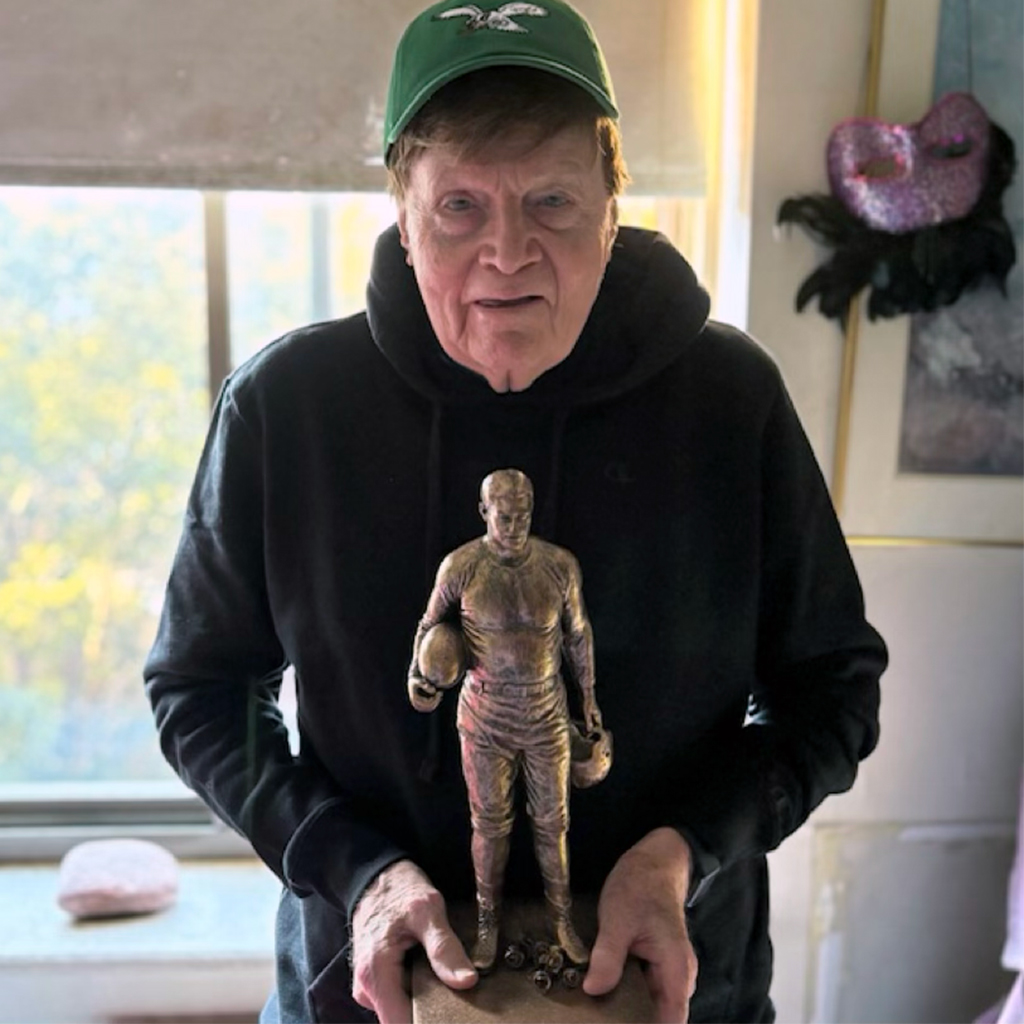
Football legend Upton Bell of Porter Square, Cambridge, with a model of a statue dedicated to his father at the University of Pennsylvania’s Franklin Field.
This weekend is the big one, Super Bowl LIX – which is likely not that big of a deal around these parts now that the Patriots are the doormat of the AFC East. Sure, the team went to nine Super Bowls from 2000 to 2020 and still holds the record for the most appearances by any NFL franchise (11), but those glory days are in the rearview and there’s little hope on the horizon (other than Drake Maye and a coaching reboot).
The ad blitz campaign contest on tap features a rematch of Super Bowl LVII (2023) in which the Kansas City Chiefs and all-world QB Patrick Mahomes beat the Philadelphia Eagles in a 38-35 thriller. It was the Eagles too in Super Bowl LII (2018) who notched their first Lombardi Trophy by beating the Brady-led Patriots 41-33. (The mystery and sting of the Malcolm Butler benching still lingers like the scent of floral flatulence in the wake of a weekend cleanse retreat.)
There is one here among us who has deep ties to the Chiefs, Eagles and Patriots alike and a personal and professional portfolio that’s a veritable who’s who from the gridiron to the White House: Upton Bell, who walked and talked for a series of catch-ups last week on the street, on the phone, at the gym and over email.
If the name doesn’t click, the Porter Square resident was the Patriots’ general manager in the early 1970s – the youngest in the NFL. His father, Bert Bell, founded and was owner of the Eagles. The connection to the Chiefs is something a bit more complicated (but we’ll get to that later).
The affable Bell, a spry 87, has football in his blood. His grandfather, John C. Bell, worked alongside Walter Camp to help shape American football from its rugby roots to the creation of the line of scrimmage and the quarterback position. He also negotiated with president Teddy Roosevelt to launch the modern sport at the collegiate level and helped found the NCAA. Bell’s father, Bert, played quarterback at Penn, leading the team to its only Rose Bowl appearance, and later coached at Penn alongside John Heisman (yeah, the trophy guy). Bert Bell would ultimately become NFL commissioner and institute its draft, sudden death overtime and the Pro Bowl. Before that, he bought the Frankford Yellow Jackets and rebranded them the Philadelphia Eagles, a name that came on a whim when Bert glimpsed a billboard of FDR’s National Recovery Act with an eagle on it, Upton told me.
Bert at the time was not financially stable and got funding for the team from his wife, Frances Upton Bell, who had made her fortune on Broadway as a Ziegfeld Follies performer (and from whom Upton got his name). Bert Bell would ultimately sell the Eagles and go into part ownership with Art Rooney of the Pittsburg Steelers. In 1959, when serving his tenure as commissioner, Bell died of a heart attack while watching a game between the Eagles and the Steelers.
Upton Bell departed the Pats’ front office after a fairly public feud with then-owner Billy Sullivan and moved to the broadcast booth, anchoring WBZ’s “Post Pats Game Show” and co-hosting “Calling on Sports” with Bob Lobel, also on WBZ.
As a broadcaster, Bell has interviewed the likes of president George H. W. Bush, Mike Tyson and horror-meister Stephen King.
Of the Bells, Upton was the only one who did not attend Penn (his dad, grandfather and son did) but attended nearby La Salle University to play basketball. As a high school cager, Bell played alongside former Boston Celtic and LA Lakers coach Paul Westphal. Bell describes himself of something of a “Zelig.” (Conversation with Bell is rife with Woody Allen references.)
Getting to Boston
The young Bell got into the NFL with the Baltimore Colts by working in the team’s ticket office, working his way up to director of player personnel. Bell got a Super Bowl ring with the Colts’ win at Super Bowl V, beating the Dallas Cowboys 16-13.
Then it was onto Boston, where Bell initially stayed at the Royal Sonesta in Cambridge (the Pats were playing at Harvard Stadium at the time) while hashing out his arrangement with Sullivan. Of his contributions to the Pats during those brief years, when they moved from playing at Harvard Stadium to Sullivan Stadium in Foxboro, Bell lobbied hard (and won) to have the Boston Patriots rebranded as the New England Patriots, as opposed to the Bay State Patriots, the proposed name at the time.
As for his connections to the Chiefs, it was Bell’s father who set Lamar Hunt in action to launch the AFL in the late 1950s (the Patriots were part of the original eight and the Chiefs were then the Dallas Texans) by discouraging him from starting an NFL franchise. The NFL and AFL would merge in 1966, and the inaugural Super Bowl was played in 1967.
After leaving the Patriots, Bell become a short-term owner of the Charlotte Hornets of the World Football League. The team was a floundering franchise in New York (the Stars) that Bell, on instinct, moved to the Carolinas. If the WFL doesn’t jump off the page at you, that’s because it lasted only two years. It made a splash, though, taking big names from the NFL that included the entire famed backfield of Larry Csonka, Jim Kiick and Paul Warfield from the undefeated 1972 Miami Dolphins. Bell regards Dolphins legendary coach Don Shula, who coached the Colts when Bell was there, as a friend.
A football family
Bell’s wife, Joanne Hearst Bell, worked in the PR departments of the Patriots and the Dolphins. They met there and reunited in Boston by chance after each lost their spouse. Hearst also worked many years as part of the Berkowitz-run Legal Seafood’s management team. Bell used to love to frequent the Legals on the patio at the Charles Hotel in Harvard Square and is a big fan of Harvest and Stoked Pizza.
Bell’s life has been all about football, as illustrated in his 2019 biography, “Present at the Creation: My Life in the NFL and the Rise of America’s Game” co-written with longtime Boston Globe sports writer Ron Borges.
Late last year Bell attended a statue dedication to his father at Penn’s Franklin Field. “It’s the only statue of my father as a football player,” Bell noted. His father was also enshrined posthumously in the Pro Football Hall of Fame in Canton, Ohio. Bell himself has his own honor at the University of Massachusetts at Amherst: An archive called the Upton Bell Collection, subtitled “In the Huddle of Football History” and including that 1971 Super Bowl ring. At the University of Massachusetts at Lowell, a collection of Bell’s inscribed books and interviews over the years is in the work. Beyond the trove of sports personalities, interview subjects include 20 Pulitzer Prize winners and three Nobel winners.
Thoughts on football
With all his insight into football, Bell still won’t commit to a team in Sunday’s game. But he had other observations to offer.
Bell’s more than okay with Mahomes and crew scoring the NFL’s first three-peat: “Records are meant to be broken.” The biggest problem Bell sees ahead is the uneasy alliance with gambling – something his father railed against back in the day, saying, “There will be a major scandal in the future, and it’s already created gambling addicts.”
Of the Brady and Mahomes debate, Bell is firm: They are on par as two of the three best quarterbacks ever, alongside Johnny Unitas. Bell also points out that many have forgotten about success notched by Cleveland Browns QB Otto Graham, who in the ’40s and ’50s went to 10 consecutive championship games. He calls the tandem of legendary coach Paul Brown and Graham “Brady and Belichick” before there was Brady and Belichick. Bell is also emphatic about the skill of Jayden Daniels, the Washington Commanders’ rookie QB taken ahead of current Patriots’ QB Maye in the 2024 draft, calling him “the best rookie QB I have seen in my life.” (Though Bell sees huge potential if Maye can lessen his turnovers and the “hitch” in his arm.)
 For What it's Worth
Leave a comment