Archive | May, 2024

Furiosa: A Mad Max Saga

25 May

Series put in reverse to fill in the gaps on a map of dangerous ground
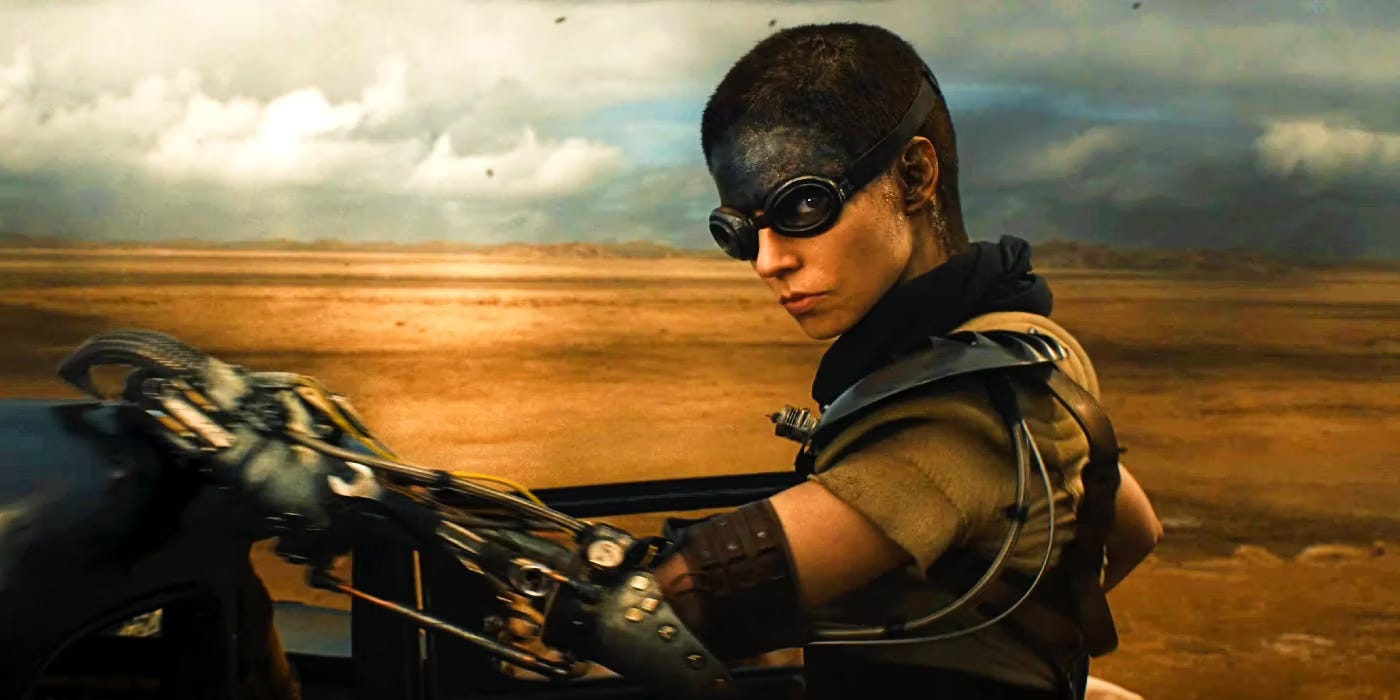

Hard to believe it’s been nearly 10 years since George Miller punched us all in the face with “Fury Road,” his amped-up reenvisioning of the post-apocalyptic “Mad Max” universe. A phenomenal cast and action scenes that arguably topped the original trilogy’s signature episode, “The Road Warrior” (1981), made that spectacle of a lawless world taken over by marauding tribal factions a reboot like no other. “Furiosa: A Mad Max Saga,” the new nitro-injected prequel to that 2015 desert storm, is a high-energy affair, to be certain. It doesn’t move the needle, but it is game to try to keep pace.

One of the perverse pleasures of those late 1970 and 1980s films (“Mad Max” and “Beyond Thunderdome” bookending “Road Warrior”) was Miller’s minimal backstory or world building. In voiceover we’re told only that fuel become scarce, nations went to war over it and nukes happened – leaning in on catastrophic climate change before COP 21 was even a glimmer in the U.N.’s eye. Then again, global nuclear warfare pretty much leapfrogs an environmental crisis. 

As always, scarce resources are the crux of conflict in “Furiosa” and the reason for the rise of ’roid-rage tyrants such as the Morlock-ish Immortan Joe or our new dispenser of wasteland sadism, Dr. Dementus (Chris Hemsworth), whose MO is drawing and quartering by motorcycle after a bit of “Squid Game” fun. (This younger Immortan Joe is played by Lachy Hulme, replacing Hugh Keays-Byrne from the 2015 film. Keays-Byrne, also indelible as Toecutter in the original “Mad Max” in 1979, died in 2020.) As we know from “Fury Road,” young, fertile women are worth warring over as well, or more so to be hoarded away in chastity belts with the intent to propagate legacies Genghis Kahn style. 

Miller and his longtime co-scribe Nick Lathouris, had a small part in the 1979 film, do a yeoman’s job of fleshing out the chaotic, dust-choked universe conjured up in “Fury Road.” In this chapter we actually get to go to the Bullet Farm and Gas Town, fortified encampments that loomed across the desert but were never visited or sieged by Immortan Joe’s pasty white phalanx of War Boys. “Furiosa” also becomes the first “Max” flick to play significantly off plot developments from another chapter (though to belie the title, while there is a Max stand-in, there is no one named Max). The film’s five segments begin in the Green Place of Many Mothers where “Fury” essentially ends, as a young Furiosa (Alyla Browne) is kidnapped by the minions of Dementus. Her mother (Charlee Fraser), a hell of a shot with a rifle, follows along in a pursuit. It’s long-simmering scene with the potent poetry of the grueling desert march from “Lawrence of Arabia” (1962). Jumping forward in time, an older Furiosa played by Anya Taylor-Joy (“The Queen’s Gambit,” “The Witch”) has been traded from Dementus to Joe to stave off a war and later, through near-death happenstance, goes incognito in Joe’s mountain cliff complex known as the Citadel. 

Given that what much of what goes down in wasteland has to do with dick waving (I mean, we have characters called Rictus Erectus, Scrotus and Pissboy) and prison-yard, alpha-male domination, the uneasy peace and trade accords with Gas Town and the Bullet Farm begin to fray, with Furiosa and her own agenda in play as war looms. This is also the first “Mad Max” to have hordes of equally matched factions go at it, not the haplessly underarmed and helplessly outnumbered stranded and beset in their own personal “Rio Bravo” (1959). And despite the outwardly mean, masculine veneer, like “Fury Road,” “Furiosa” is decidedly female in its humanist gaze and nurturing of hope for a better tomorrow. 

Taylor-Joy is seamless as the can-do, younger version of what Charlize Theron brought to the screen nine years ago. Equally superb is Browne as the adolescent Furiosa, and not enough can be said about Fraser’s mad mom, who may be the most formidable wasteland warrior of all. Hemsworth tries, but he’s no Lord Humungous, and his bawdy bad-ass retorts have a bit too much “Thor” jokiness to them. The other near miss is Tom Burke (Orson Welles in “Mank”) as Praetorian Jack, a weak-tea distillation of Mel Gibson’s morally ambiguous roamer from the initial films who lacks the harrowed, frying-pan-into-the-fire immediacy of Tom Hardy in the last go-round; a relationship dynamic between Jack and Furiosa that Miller aims for as they ride out into the wasteland in the requisite fortified tanker never really takes hold, because Taylor-Joy’s grease-smeared avenger is so much more fully baked and fire-breathing. 

“Furiosa,” as gorgeous as it is to take in, is long, and Miller and Lathouris unwisely rehash moments from past films (Gyro Captain ultra-lights, a botched Molotov catching fire on the legs of a hapless combatant and the whole “You want to get out of here, you talk to me” swagger line, among the many) as homage, which just weakens them. You can’t fault the film’s furious pacing, jaw-dropping action sequences and dutiful connecting of dots, but is it needed? “Fury Road” was a mic drop; “Furiosa” is a victory lap, the “Silmarillion” of the series. 

The bike bus rolls on each Friday in Cambridge, but a recent kids’ ride was more like a parade

23 May

By Tom Meek

Saturday, May 18, 2024

Darren Buck leads a bike bus in Cambridge on Friday.

The Peabody/Rindge Avenue Upper School bike bus is about to notch its second anniversary. It launched at the end of June 2022, just as Cambridge was emerging from pandemic lockdowns and shut-ins, and has operated nearly every Friday of the academic calendar since.

A bike bus is a parent-chaperoned group of children who ride to school together. There’s safety in numbers that provide visibility and street presence, and participants get a low-stress, fresh-air outing. The Peabody/RAUS group led by parents Katherine Beaty and Darren Buck is one of nine bike bus initiatives in Greater Boston and the only one in Cambridge. There are three in Somerville.

Beaty started the bike bus because being a bike advocate in the more traditional, political sense had become taxing, she said, noting its meetings, campaigns, emails and follow-ups yielding little immediate result or much joy. “I wanted to do something that would bring me joy and get my kids to school,” she said, speaking before a bike bus presentation she and Buck gave Wednesday as part of the Streetwise lecture series at the Aeronaut Brewery. Buck, who works in transportation policy, was in the midst of scouting cities to relocate his family to and happened to encounter Beaty leading a group of kids on bike. He knew immediately Cambridge was the place to land, he said.

One of the leading proponents for the bike bus movement is “Coach” Sam Balto, a Portland, Oregon, physical education educator who taught at the David A. Ellis School in Roxbury. He’s also a self-described tactical urbanist – activists such as those in Critical Mass or the Boston Bike Party who take a physical approach and might spray paint bike lanes on a street in the middle of the night. When in Boston, Balto used to place cardboard cutouts of Tom Brady around the Ellis school to get cars to slow down. Beaty referred to him as her “guru.”

A May 8 ride in recognition of National Walk, Bike and Roll to School Day included performers from the School of Honk.

In their Streetwise presentation, Beaty and Buck outlined the three steps necessary for a successful bike bus. First is finding a calm, safe route to the destination, probably less-trafficked side streets; there’s an engagement component of reaching out to the community, other parents and the school administration; the most critical part is to have fun. For a May 8 recognition of the National Walk, Bike and Roll to School Day, the Peabody/RAUC bike bus was accompanied by members of School of Honk, who performed while rolling along. Vice mayor Marc McGovern spoke and rode with the group. Beaty said the caravan had more than 130 riders.

For this past Friday’s regular ride, which I attended, revered Boston institution Keytar Bear was supposed to join but was unable to make it because off traffic issues, promising to accompany a future date instead. This time there was approximately 40 riders, which Beaty said was typical; drop-off in the winter is not significant, she said, though some rides have to be canceled when there’s ice or heavy snow or rain.

The route that Beaty and Buck lead begins at Russell Field near the Alewife T station, with organizers first gathering riders from the Fresh Pond Apartments on Rindge Avenue. Beside parents who serve as ride marshals, there are volunteers from the Cambridge Bike Safety Group who help make sure intersections are safe to proceed through and block traffic as necessary. The right, safer route in this case includes Dudley and Reed streets, some of it parallel to the busier avenue where the school is. Students of all ages participate, with some riding with parents in e-assisted cargo bikes, some kicking along on balance bikes and others doing their own two-wheel propulsion. The communal joy of the activity is palpable, and an apt flourish to the end the week. Most people the bike bus passes cheer and wave, Beaty and another Bike Safety volunteer said. You can often see on the faces of onlookers the effect of a parade of second-graders gliding by.

The Peabody bike bus works only for the commute to school, not from, because of varying after-school schedules and one-way streets that prevent a calm and safe path back to Russell Field. Many parents bike their kids home on the sidewalk, or load their bicycles into their car or the hold of a cargo bike. Organizers are asking the city to designate certain streets as a Neighborway, as they are doing in Somerville.

Beaty said she would love to see more bike buses, but cannot be in two places at once – and she and Buck live close to Russell Field. Their children won’t be at Peabody forever, either, and Beaty, a Harvard library employee, will be on a research sabbatical in Rome next year. The hope is that others will step up. Given the group’s energy and levels of participation, that might not be a problem.

Kingdom of the Planet of the Apes

11 May

Reboot hails Caesar

And so we enter into our next “Planet of the Apes” trilogy. Back in the ’60s and ’70s, theaters were packed for people in ape suits chasing after hunky Hollywood sorts such as Charlton Heston (the 1968 original with a script by “Twilight Zone” creator Rod Serling) and James Franciscus (“Beneath the Planet of the Apes”) playing men caught out of time and in the wrong place – a world ruled by talking apes where humans were largely mute also-rans. They were the kindlings of the blockbuster before there was “Jaws” (1975) or “Star Wars” (1977) Those films, all starring Roddy McDowall, were a five-pack with the actor playing the demure, science-minded chimp Cornelius in the first three and then his son, Caesar in the last two, “Conquest for the Planet of the Apes” (1972) and “Battle for the Planet of the Apes” (1973).

Skipping over Tim Burton’s 2001 stinker, the 2011-2017 trilogy (“Rise,” “Dawn,” “War for …”) wasn’t so much a reboot as a retooling that leveraged CGI and the talents of motion-capture actor extraordinaire Andy Serkis playing the series centerpiece, Caesar, who leads the apes out of human tyranny and along the path to a peaceful sovereign existence. In that series, apes achieved higher intelligence and the ability to speak because of humankind’s meddling and experimentation, while humans turned aphasic and dimwitted due to a virus that pretty much shut down the planet – this being pre-Covid, mind you. 

“Kingdom of the Planet of the Apes” is a new grab at a franchise (“From the beginning we thought about this as a trilogy,” director Wes Ball told Empire) that serves up a warm embrace of Caesar and his legacy. Since “War for the Planet of the Apes” the solidarity of ape-dom has fragmented and gone feudal. We’re a few generations out as the eagle clan of apes, a peaceful treehouse encampment-aviary, raise eagles to help them fish, scout and defend themselves. Humans are rare and believed to be near extinction. 

Our protagonist is Noa (Owen Teague), a coming-of-age chimp whose father (Neil Sandilands) is leader of the clan and harsh to his own. On an excursion to find coveted eagle eggs and rise in rank and stature, Noa and his posse see signs of a lone human in the woods and other forces moving through the valley as well. The latter turns out to be a column of soldier apes sent forth by a bonobo known as Proximus Caesar (Kevin Durand), who, like any good Roman leader seeking to expand the empire, does so by sacking and enslaving – which is exactly what happens to the eagle clan. In the aftermath Noa links up with Raka (a beautifully baritoned Peter Macon), a hermit orangutan well versed in the teachings of Caesar (“Ape not kill ape,” which Proximus Caesar, who trades on the name for effect and de facto authority, violates regularly) and keeper of books, which Noa has never seen. Noa’s also never seen a human, but sure enough, the waif in the woods, (Freya Allen, “The Witcher”), now trailing them for food scraps, comes out of the dark and joins them on their quest to infiltrate Proximus Caesar’s seaside fortress – an enormous, rusted-out aircraft carrier or cargo ship beached up against the rocky cliffside – and free the eagle clan survivors, Noa’s mother and a budding love interest among those imprisoned. It’s no spoiler to say that Allen’s Mae (the apes call all human women “Nova” by default) can speak, which blows even Raka’s mind.

The film’s gorgeously shot and boasts some imaginative world building, but there’s a lot going on, perhaps too much: Proximus Caesar’s larger agenda is to gain access to an old military silo for the ostensible humanmade war machine relics inside; to date, their big tactical weapon is an electric cattle prod; other than that, it’s knives, spears and fists. Several plot threads never get tied up, and Noa and Mae are thinly drawn – twice as much so if you hold them up against Serkis’ Caesar. Part of that is the uneven pacing by Ball, who cut his teeth on the “Maze Runner” series, another dystopian sci-fi concept. That said, there are some nice homages to the 1968 original, including a dark horse ambling regally down a deserted beach, those eerie scarecrow totems from the forbidden zone and the ominous trumpeting of a ram’s horn before a siege.

The film is less steeped in the metaphorical references to slavery and racism layered into the 1963 “Apes” novel by Pierre Boulle (who also wrote the novel that “The Bridge of the River Kwai” was based on) and more front and center in the earlier franchise. What we do get is some megalomaniacal clinging to power that feels Trumpian and plenty of fair digs about human hubris and the past due to repeat itself, as well as the perils of game-changing war technology falling into the wrong hands. Not much of it’s fresh, but it is dutiful and likely do well enough to ensure the next two chapters before another pause and a reboot. It’s how it goes, damn them all to hell.