Archive | March, 2024

Love Lies Bleeding

13 Mar

Noir goes to the gym, coming out taut and sweaty (with big hair)

“Love Lies Bleeding,” the delightfully audacious lesbian crime noir from Rose Glass, may not be a road movie per se, but it sure feels like one. It’s everything “Drive-Away Dolls” wanted to be and more: edgy, free of tropes and seared tight by the kind of angry authenticity that imbued “Titane” (2019), “Bound” (1994) or anything Greg Araki ever lambasted us with in the 1990s.

The setting’s a podunk New Mexico town in the mid-1980s – boxy cars, big hair and no cellphones – where Lou (Kristen Stewart) bides her time toiling at a no-frills pump-and-grunt gym, where unclogging the toilet is job No. 1. (And this loo is not like the sleek pieces of pristine public art tended to in Wim Wenders’ well received “Perfect Days.”) No, this is like a Fenway’s men’s room at its odorous worst, and the clientele are all juiced-up meatheads, though Lou feels at home among them, like one of those small fish that swims calmly among sharks and cleans their gills. It probably helps that she has a side hustle shilling steroids.

Lou lives a modest existence. Her flat is classic Allston: worn sofa, tatty rug and clothes strewn everywhere. Her life feels flat too. There is no light in it. Even her one passing love interest, Daisy, (Anna Baryshnikov, daughter of Mikhail), a vapid young woman with a beaming smile and nothing to say even though she’s always talking, feels done and over with. Clearly something has to give, and we get the first whiff of what’s going on under the covers when two FBI agents posing as old family friends come by to inquire about Lou’s father and mother. It’s here we learn Lou is somewhat estranged from her father, Lou Sr. (Ed Harris, rocking a Brian Eno ’70s do), who owns the gym, a gun range and most everything (and everyone) else in the town, but remains close to her sister Beth (an unrecognizable Jena Malone in a blonde bob) who has a tumultuous home life with her husband J.J. (Dave Franco), a rat-tailed scum who works at the firing range.

Tangled webs and criminal pasts get more tangled when Jackie (a super-jacked Katy O’Brien) drifts into town and Lou’s gym, but not before an encounter with J.J. Jackie’s a transient soul pumping her way across America en route to a bodybuilding contest in Las Vegas. She’s got big dreams and even bigger pecs. It’s love at first pump, or something like that. After getting cornered by two sneering lunkheads, Jackie and Lou fall into bed. Souls get bared, love springs and Jackie moves in (she had been sleeping under a bridge). For much-needed cash, she takes up a job waitressing at Lou Sr.’s shooting range, which doesn’t sit too well with Lou.

Glass, who made audiences take notice with “Saint Maude” (2019), an immersive, eerily tense ambient piece, strikes a dutiful balance between pulp punchiness and grrl power anthem with a peppering of gonzo genre-stretching flourishes. One of those goes-to-11 touches is Jackie juicing to the point of Hulk-like ’roid rages and some outré, almost Lynchian veers into alter reality. The chemistry between Lou and Jackie carries the film atop its broad, sculpted shoulders, driven by the kind of passion and injustice that made “Thelma & Louise” (1991) and “Bound” (1996) such indelible fist-in-the-air fuck-the-patriarchy staples. The cinematography by Ben Fordesman recasts the neon-basked Southwest in a gritty neo-noir light that deepens the film’s sense of time, place and genre, but the key here is Stewart, whose underreactive restraint is the film’s hook. Jackie’s the hammer. The two together are an intoxicating tandem, vulnerable yet steeled as they try to make it to tomorrow and their way out.

Dune Part 2

2 Mar

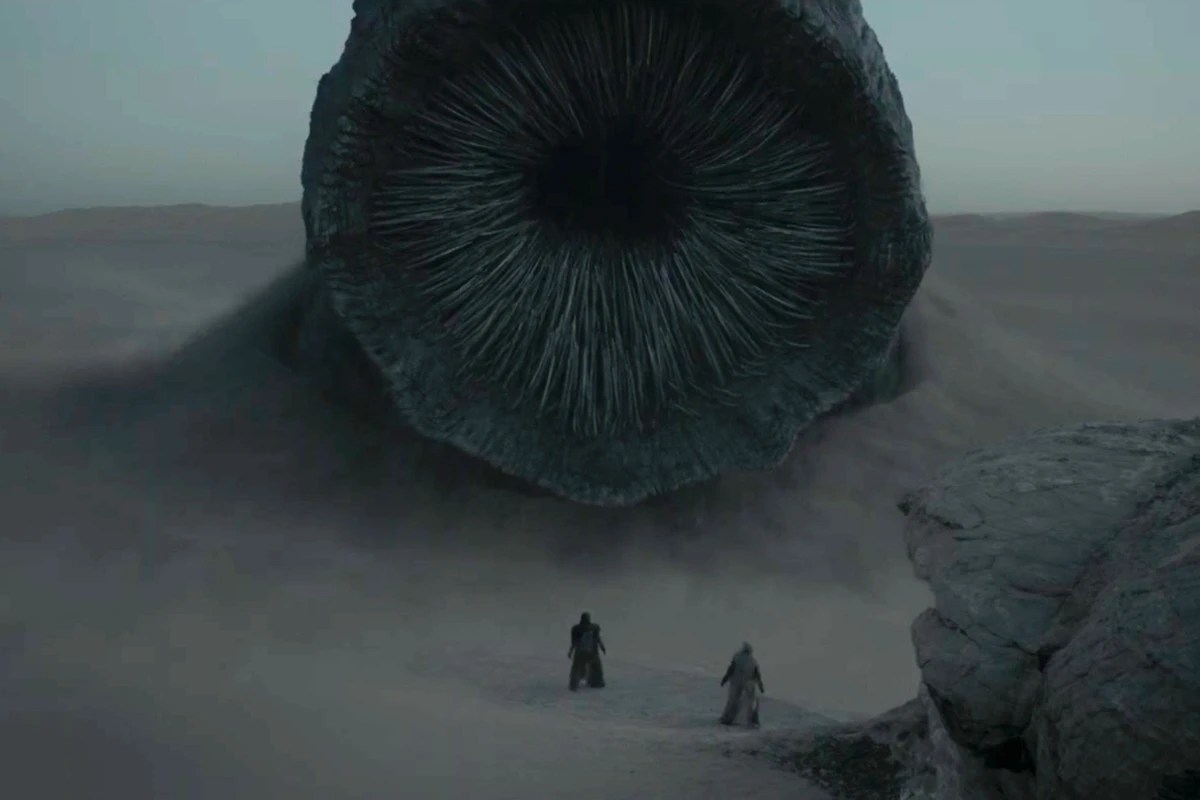
Feudalism and colonialism vie with the giant sandworm for best space monster

After seeing the first installment of Denis Villeneuve’s reenvisioning of Frank Herbert’s beloved sci-fi saga, the prospect of “Dune: Part Two” left me with a modicum of dread. Why? Villeneuve (“Arrival,” “Blade Runner 2049”), who is a competent craftsman and then some, had done well with a rote, by-the-numbers introduction that, while serviceable, didn’t seem to have the gravitas – or the legs – to go above and beyond David Lynch’s much-made-of 1984 version. Plus, who was going to take on the role of the ruthless Feyd-Rautha that Sting made so memorable in the Lynch version, and would Timothée Chalamet’s taciturn and aloof Paul Atreides ever give us a reason to yield up a precious thimble of perspiration? Questions to which we now get answers.

“Part Two” is bigger, a notch better and longer too, mostly because much of the requisite backstory has been dispensed: A feudal empire occupying the desert planet of Arrakis, the only source of melange or spice, a drug that lengthens one’s life and can imbue super-prescient capabilities and space travel via hyper warp. (Call it oil or coca for cocaine and you’d have the precious resource analogy.) The displacement and oppression of the Indigenous folk of the planet – yes, Herbert bridged feudalism and colonialism, for a double fucking of people simply going about their daily lives.

There’s more action in “Part Two” – and more worms – as Chalamet’s Paul and his mother, Lady Jessica (Rebecca Ferguson), transition into the messiah realized and Reverend Mother of the Fremen, the Indigenous people, by drinking the blood of one of those giant sandworms. It’s a crazy acid trip that kills most who decide to drop out and tune in; only those destined by prophecy make it through, or something like that. Paul even gets to ride a worm (far less cheesy than Kyle MacLachlan’s sand surfing back in 1984, but somehow not quite as satisfying). And of course there’s the whole big take-back-the-planet throw-down with the Harkonnens, bad guys led by a grotesque baron (the always excellent Stellan Skarsgård, nearly unrecognizable under makeup and CGI) who violently displaced House Atreides as stewards of Arrakis in “Part One.”

The mega battles are mostly blessedly brief – clearly Villeneuve knew that throngs of shadowy figures wielding knives in a sandstorm wasn’t a sustainable spectacle. The visuals that make it onto the screen are lean, pointed and stunning, some through fine editing and special effects (including beguiling shots of moons and distant planets) as well as scrumptious cinematography by Greig Fraser (“The Mandalorian,” “Zero Dark Thirty”), not only of vast sandscapes but in the gladiatorial arena on the home planet of House Harkonnen, shot in a post-nuclear-blast ashy black-and-white. That’s where the baron’s nephew, Feyd-Rautha, slices up a few Atreides holdovers as part of his birthday celebration. (Feyd-Rautha is played by “Elvis” portrayer Austin Butler, bringing his own bite to the part and looking like one of the pasty, skin-headed war boys out of 2015’s “Mad Max: Fury Road.”)

As far as the casting goes, Chalamet and Ferguson grow in their parts. There was something off about Chalamet in “Part One,” and that lingers some here too; the sum of the parts doesn’t quite add up. Winners are Zendaya getting more screen time as Chani, Paul’s Fremen warrior instructor and love interest; Javier Bardem’s cagey Stilgar, one of the Fremen elders who feels like he could walk into any David Lean-directed desert epic and be at home; Butler; and, in smaller parts as members of the priestess-witch sisterhood known as the Bene Gesserit – Lady Jessica belongs to it – Florence Pugh as the emperor’s daughter, coming into her powers; Charolette Rampling as the Mother Reverend, in consultation with the emperor; and Léa Seydoux, lithe and fawning as Lady Margot, who’s assigned by Rampling’s Mother to ferret out Feyd-Rautha by any charming means possible. The one negative is the casting of Christoper Walken as the emperor. Don’t get me wrong, I love Walken and nearly everything he’s done, but the soft-spoken Jersey boy heavy in outer space doesn’t quite make the warp jump.

With its coveted resource as the plot-triggering core, and a crash-and-burn extraction process, “Dune: Part Two” isn’t far off from an “Avatar” chapter. It has a different ecosystem – desert instead of jungle and water – but the same invasive avarice. It packs in a lot thematically beyond space colonialism, though. Religion comes under scrutiny: Is it a means of pacifying and controlling the masses, as Chani challenges, or can sustained faith lead believers to a better place? As prophecy meets politics, the players in Herbert’s universe reveal themselves to be playing games within games as the ones holding the strings of power vie for legacy and control.

Speaking of the future, just like with “Part One,” the next “Dune” chapter isn’t announced at the film’s conclusion. Rest assured there will be a “Part Three.”