The latest from Emerald Fennell, who stirred things up with “Promising Young Woman” (2020), is a slow burn of a psychological thriller with hot, homoerotic embers – à la “The Talented Mr. Ripley” – that catch fire every now and then. It’s also the second film this year in which Mother Nature’s cyclical purge of fertility during an act of oral pleasure plays for bloody spectacle – the other being Chloe Domont’s “Fair Play,” streaming on Netflix. There’s much about class and privilege in this dark semi-comedy starring Barry Keoghan, tripling down on strange doings after “The Killing of a Sacred Deer” (2017) and “The Green Knight” (2021) as a poor student at Oxford who can’t afford school attire but syncs up with the “it” boy Felix (Jacob Elordi, who’s had a banner year with this arresting performance as Elvis in “Priscilla”; Timothy Chalamet, you’ve got competition!).
Felix lives in the glorious British estate of the film’s title – a real-life keep that’s not far off from Balmoral or the Palace at Versailles – and invites Keoghan’s Oliver Quick (what a name) back to the estate for summer break. At first Oliver seems in awe of Felix’s family (Rosamund Pike and Richard E. Grant, dutiful as the parents, and Alison Oliver as their capricious and observant daughter), but then there are late-night doings by the pond and a “Shining”-like maze. As Oliver starts to shed his skin, matters shift to sexual knowing, station-in-life resentments, reveals and ensuing grim events.
It’s an ambitious go for Fennell, well framed and well acted (Carey Mulligan, who headlined “Promising Young Woman,” is in it for a blip, and piquantly hard to glean), but as the saga moves toward the third act, things turn hyperbolic and unbelievable, edging on the inane. There is a bit of a reprieve before the denouement that snaps you back in, but that herky-jerkiness is undeniable. The film will only add to Keoghan’s rise in creepy sociopathic appeal, and Fennell will again have art house audiences eager to see what she does next.
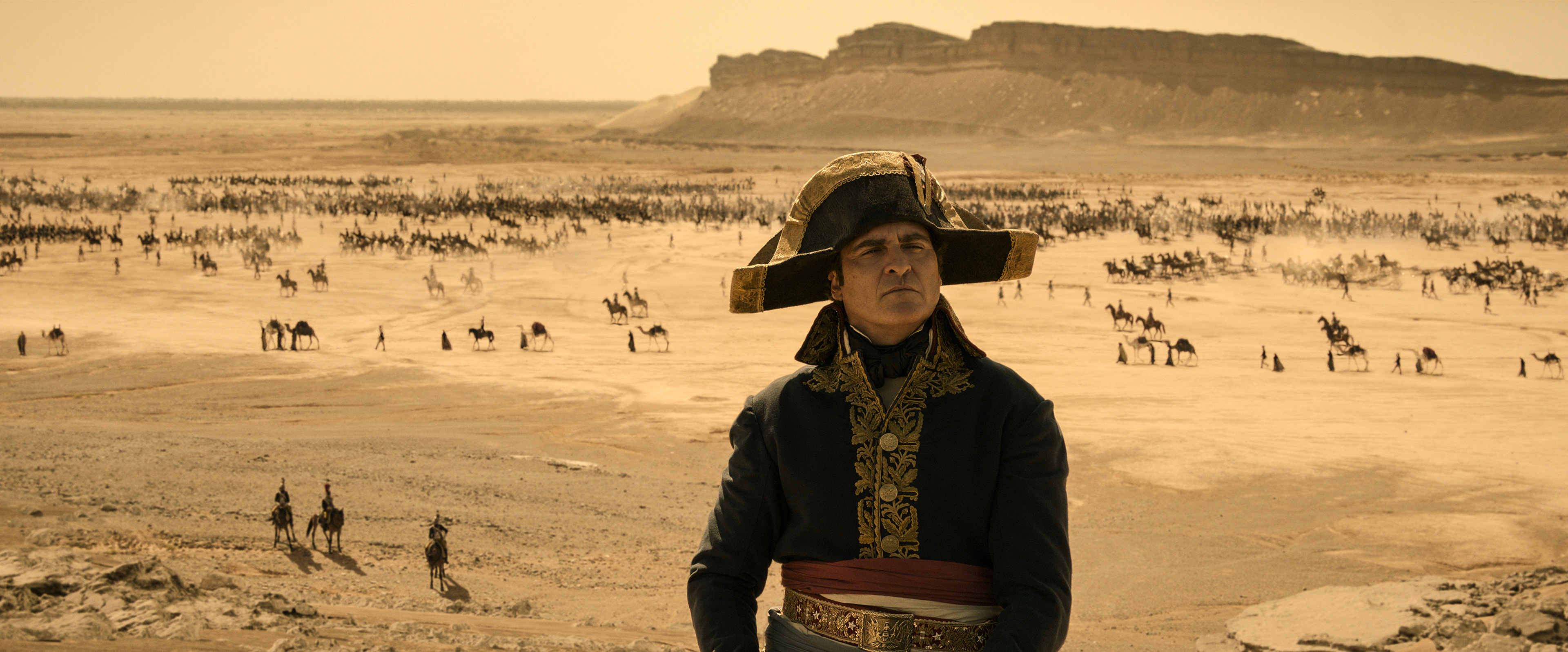
When you think of the films of Ridley Scott, it’s most likely his early sci-fi classics “Alien” (1979) and “Blade Runner” (1982), but the prolific filmmaker’s first effort, “The Duelists” (1977), was a period piece set in France during the Napoleonic wars. In that film (not to be confused with “The Last Duel” from 2021, which Scott made with local guys Ben and Matt), the French emperor’s presence was felt constantly, but Napoleon himself never steps into the frame; it’s with a daub of poetic justice that Scott, nearly 50 years later and with a budget almost 200 times bigger, gets to deliver a biopic epic centered on the historically notorious icon known as much for his hubris and the self-esteem complex named after his alleged diminutive stature and inflammable ego as for his military gamesmanship.
As Napoleon, the usually reliable Joaquin Phoenix (“Beau is Afraid,”“You Were Never Really Here”) feels somewhat subdued. That said, it is intriguing to see him reunite with Scott some 22 years after “Gladiator,” in which Phoenix also played a self-absorbed ruler – a deliciously sniveling fop of a Roman emperor. What’s missing is some of the entitled, mercurial and Oscar-winning zing baked into his mirthless Gotham ghoul in “Joker” (2019).
The film opens with Napoleon witnessing the beheading of Marie Antoinette. The French Revolution is in full swing, and the British are looking to gain a bigger foothold across the channel. To prove his worth to the new republic, Napoleon leads the fierce and tactically astute Siege of Toulon, where underpowered French forces take out a well-ensconced British fort under the cloak of night. It doesn’t help that the Brits are in the midst of sweeping, drunken merriment and caught with their pants down, literally.
Thus begins Napoleon’s ascent from military marksman to iron-fisted ruler as one part of the French Consulate triumvirate and later emperor, and efforts to expand the French empire into Africa and Eastern Europe take hold as well as the long-simmering desire to crush the hated English and their hold on the seas (see “Master and Commander”). The main threads of Scott’s film, penned by David Scarpa (“Man in the High Castle” and Scott’s “All the Money in the World”) focus on Bonaparte’s obsession with besting Russian Tsar Alexander I (Édouard Philipponnat), a handsome man-boy that Napoleon seems to hold in deference, and his capricious relationship with Josephine (Vanessa Kirby). Scott’s orchestration of the Battle of Austerlitz, where Napoleon takes it to Russian and Austrian forces (also called the Battle of Three Emperors), as well as the infamous, post-Elba exile grudge match, Waterloo, are stunning in scope, choreography and gritty grandeur. Kirby, who plays the White Widow in the “Mission: Impossible” films, is no stranger to strong women and fills those shoes well here, yet the relationship and the tempo of its tears and folds is wildly uneven – which is not on Kirby, to say the least. Kirby portrays a woman whose confidence and sensuality are more than worthy of holding the gaze of a man with limitless power and, as a result, after their marriage implodes because of heir matters, remains a regularly sought confidant, counsel and simmering longing. The sex scenes have a cheeky silliness, not too far off from some of Scott’s work with Cameron Diaz and a racy sports coupe in “The Counselor” (2013) and most recently Lady Gaga and Adam Driver in “The House of Gucci” (2021).
Beyond the major battles – epic with a capital “E” – and sticking to the historic record, Scott and Scarpa don’t let Bonaparte off the hook for his actions. His Ahab-esque quests cost needless lives, something the film registers as clearly and coldly as the hoar of the harsh Russian winter. As far as the size thing goes, the record shows Napoleon at just north of 5-foot-6; it’s rumored that the Corsican (a lesser, looked-down-upon ilk to most French noblemen at the time) was surrounded intentionally by taller, statuesque guardsmen. Scott and Scarpa wisely choose not to delve into the matter, but Scott often shoots down on Bonaparte, or up from his POV, lending to the effect.
The picture, which holds one’s eye throughout the 157-minute running time, is opulent but bears the jerky unevenness of Scott’s “Gucci.” Perhaps a Thanksgiving Day viewing will leave visual feasters of all things Napoleonic hungry and searching the streaming universe for the timeless 1927 treasure of the same name crafted by Abel Gance. Seek it out and enjoy the treat. It’s not an either-or, mind you, as Gance’s tale tells of a young Napoleon in school and his early days in the military, dovetailing nicely in time to where Scott’s vision starts.
The latest from Alexander Payne, set at an all-boy, New England prep school in the early 1970s, bears the distinct tang of J.D. Salinger, not to mention Wes Anderson’s “Rushmore” (1998) as it homes in on the loneliness of the disenfranchised among the entitled elite. It marks a nice rebound for Payne after his 2017 misfire, the dystopian sci-fi satire “Downsizing.” and a pleasant reunion with Paul Giamatti, who with his work here and the infectiously uproarious “Sideways” (2004), proves to be something of the director’s go-to alter ego as Leonardo DiCaprio and Robert De Niro have for Martin Scorsese.
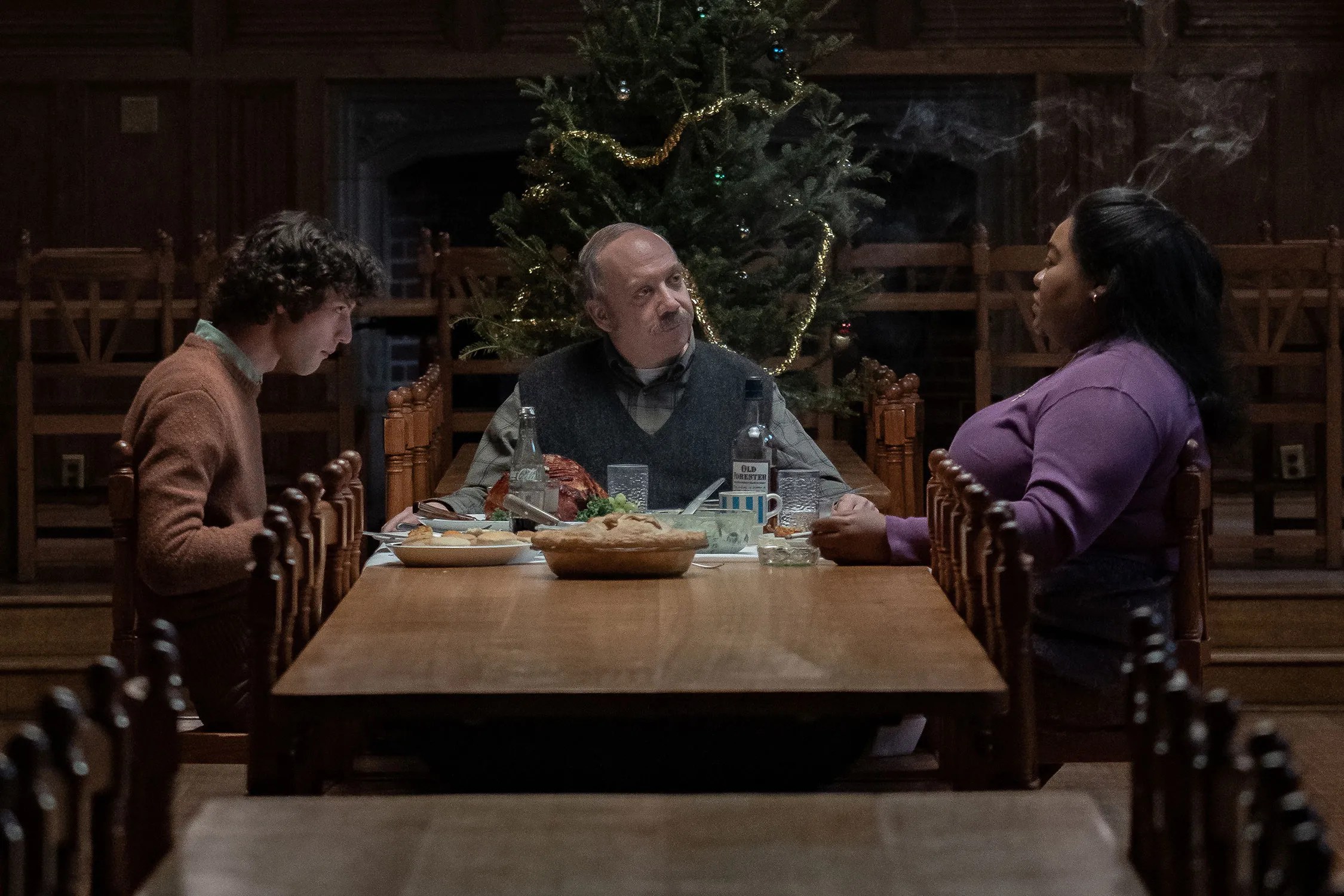
The setup’s fairly straightforward: Paul Hunham (Giamatti), a gruff, unapologetic Western Civ. professor, is the faculty member who’s drawn the short-straw assignment of looking after the “holdovers” for Christmas break at a fictional New England preparatory called Barton. These students have no place to go because Korea’s too far and expensive to fly home to, the house is being remodeled and there’s nowhere to sleep, or mom’s newly remarried and wants to have some honeymoon time. The latter is the bad-news phone call that Angus Tully (Dominic Sessa) gets. He’s also struggling in Hunham’s class, and Hunham’s not the most popular figure on campus; even the faculty and headmaster are none too smitten with him – for one thing, he failed the son of a U.S. senator and major benefactor of the school at the tail-end of the progeny’s senior year, his unwavering strictness costing the kid a golden ticket to an Ivy League institution.
Joining Hunham and the five boys is school cook Mary Lamb (Da’Vine Joy Randolph, divine and scene-stealing; you can also catch her in “Rustin,” out this week) a Black woman who spends much of her time – even when cooking – drinking and smoking to hold down the grief of having just lost her only child, a Barton grad (the only non-caucasian we know to attend the school besides that Korean boy) killed in the Vietnam War.
Early in the staycation, one of the boys’ fathers drops in via helicopter and offers to whisk the five off for a week of skiing. Not a bad reprieve for the cooped-up and bored, but parental consent is needed; all but Tully get it. What ensues is a slow grinding of nerves between Tully and Hunham with occasional explosions and slow reveals of underlying traumas that are the real root of their sniping and doubling down. Newcomer Sessa, who at times looks a bit too old for the part, holds his own with Giamatti as he effectively expresses restrained rage. Fans of Giamatti’s acerbic naysayer in wine-imbibing comedy “Sideways” and his quirky delve into comic book artist Harvey Pekar in “American Splendor” (2003), will delight in this nuanced turn. His Hunham is a self-loathing introvert who maintains his balance in the world with an outrigger of arrogant self righteousness, but also a lonely soul seeking human connection and totally unaware of how to get it.
The most vulnerable we witness the stranded three is at a Christmas Eve party hosted at the home of a bubbly Barton administrator (Carrie Preston, wonderfully perky, near “Fargo”-esque in the part) who takes shifts at the local watering hole to make ends meet. Tully and Hunham catch romantic flirtations that hit dead-ends for widely different reasons and Lamb, in the middle of the party, decides to confront her grief in a very public and all-consuming way. It’s a poignant, mood-shifting scene that should make many take notice of the emerging Randolph, who, like Giamatti, attended the Yale School of Drama. Later, the three find themselves in Hunham’s rickety car en route to Boston – Lamb on her way to visit her pregnant sister in Roxbury and Tully and Hunham taking an “academic excursion” that at one juncture lands them at the Somerville Theatre to take in a screening of Dustin Hoffman in Arthur Penn’s “Little Big Man.”
Poetically, the sojourn, initiated by Tully with a hidden agenda, ends in a meeting with Hunham on Boston Common. The two are forced to confront their pasts with a baring of their souls evocative of the joyous dread imbued into Hal Ashby’s “The Last Detail” (1973), in which Boston also served as a port of reckoning.
If you’re curious about that boarding school, it’s a composite of institutions in and around Massachusetts, but mostly scenes there were shot on the Deerfield Academy campus (one of the oldest prep schools in America) in Central Massachusetts.



 For What it's Worth