Tag Archives: Tenet

Oppenheimer

21 Jul

‘Oppenheimer’: Mass destruction, dirty politics and a messy personal life, down to the atom

At one juncture in Christopher Nolan’s last outing, the mind-bending, time-rewinding spy thriller “Tenet” (2020), a scientist in the future able to weaponize and manipulate the past to alter history is likened to J. Robert Oppenheimer, lead scientist at the Manhattan Project, which produced the nuclear warhead that in effect ended World War II. Foreshadowing for this next project?

That future scientist killed themselves to take their secrets with them and prevent further ripples in time; Oppenheimer, as the Cold War set in, became outspoken against nuclear proliferation and subsequently – with the help of FBI dirty trickster J. Edgar Hoover – had his security clearance revoked by the Atomic Energy Commission. It didn’t help that his wife, lover and several other personal associates had ties to the American Communist Party. 

Nolan began work on his “Oppenheimer” in January, shortly after the Biden administration conferred public wrongdoing on the AEC and U.S. government for its lack of process and credible evidence against Oppenheimer, who died in 1967 at the age of 62.

The film plays loyally to its roots, the 2005 biography “American Prometheus: The Triumph and Tragedy of J. Robert Oppenheimer” by Kai Bird and Martin Sherwin, and both embrace Oppenheimer (“the father of the atomic bomb”) as a committed yet complicated man, caught at many crossroads: the morality of mass destruction, the dirty politics of Cold War paranoia and messy personal relationships. As Oppenheimer, frequent Nolan collaborator Cillian Murphy portrays the scientist as a reserved, buttoned-up sort with a kind, demurring affect. He’s charismatic and approachable, with piercing blues and a gaunt sheen clearly deepened for the part; Oppie’s signature wide-brim porkpie fedora goes a long way to cement the image. It’s a bravura performance that rightly sends Murphy, best known for the series “Peaky Blinders” and Danny Boyle’s  “28 Days Later” (2002), to the fore after many years of almost getting there. He feels custom minted for the part.

Nolan is a filmmaker who likes to play with time – the brilliant weaving of three timelines that converge at singular moment in “Dunkirk” (2017) as well as “Tenet” and “Memento” (2000) – and works another triptych here: the race to build the atomic bomb before the Nazis at the Las Alamos complex (something of a Western mining town) in the middle of the New Mexican desert; Oppenheimer’s 1954 hearing before the AEC inside a cramped conference room; and the senate proceedings on Eisenhower’s secretary of commerce nominee Lewis Strauss, who had been Oppenheimer’s boss at the commission. The clear but kinetic interweaving that frames the Strauss hearings in black and white and the rest in color is eerily evocative of Oliver Stone’s energetically edited and sharply acted bit of nearby history, “JFK” (1991); in “Oppenheimer,” that then-junior senator from Massachusetts poetically has a small hand in one of the three timelines. 

“Oppenheimer” for the most is a deeply internal film, and Nolan deepens our access to Oppenheimer’s mental and emotional state with tearaways to stars colliding in the cold dark universe, people in a celebratory audience suddenly melting in a hot white light and, at one point during his AEC security access hearing, sex with his lover Jean Tatlock (Florence Pugh, fantastic in the small part) and him confessing to the tryst to his wife Kitty (Emily Blunt, fantastic in a larger part). The soul-rattling aural immersion and meticulous imagery by Nolan regulars composer Ludwig Göransson and cinematographer Hoyte Van Hoytema, as well as an ace team effort by the sound department, fill out the spectacular, collective achievement. The cast beyond Murphy and Robert Downey Jr., who manages to make the eely Strauss human, is a long list of potential competing supporting-actor award nods, starting with Matt Damon as general (to be) Lesley Groves, who oversees the Manhattan Project and gets to deliver a fiery back-and-forth that’s almost on par with his indelible rant in “Good Will Hunting” (1997). Also notable are director Benny Safdie (“Uncut Gems,” “Good Time”) as H-bomb scientist Edward Teller; Josh “where have you been?” Hartnett solid as Oppenheimer’s department mate at Berkeley, Ernest Lawrence; Kenneth Branagh as physicist Niels Bohr; Jason Clarke, insidious as AEC special counsel Roger Robb; and Tom Conti (another “where have you been?”) avuncular and dead on as Albert Einstein. The list goes on. Less effective are Casey Affleck as military investigator Boris Pash interrogating Oppenheimer and Gary Oldman as President Harry Truman.

How Nolan pulls it all together is interesting in how much you see – or don’t – of the actual use of the atomic bomb and the devastation it had on Hiroshima and Nagasaki (thought it’s in the corner of every frame) versus the high of the Trinity experiment at Los Alamos (well orchestrated cinematically) and chaotic proceedings in the rooms and halls of government. Ever meticulous, Nolan also does a masterful job of taking subthreads and small gestures and weaving them into surprising and disparate places with subtle poetic panache that doesn’t scream, “Did you just see what I did there?” I wouldn’t want to call them Easter eggs, but …

As to Oppenheimer’s initial reluctance to signing onto the Manhattan Project due to the potential moral and historical implications, one fellow Jewish colleague says, “We don’t know if we can’t trust ourselves with it, but we know we can’t trust the Nazis.” A point well taken, with added personal appeal. Later, after the Germans have been defeated and Truman drops the two bombs, he justifies it by saying it saved American lives and allowed him “to bring our boys home.” Truman, like Strauss, comes off as a bit of a runaway ego (he calls Oppenheimer a “crybaby” when not quite out of earshot) and the film poses whether the bombings were necessary. It’s another good pique, and a complex one for me – this was when my father, a teenage member of the 101st  Airborne, had just finished his service in Europe and was on a slow boat to Japan. Heavy stuff all around.

Rewinding back to “Tenet,” Nolan’s tightly controlled 2020 release during the height of the pandemic and the first big theatrical release at a time we were still in masks, eating outside under heater lamps and spaced apart in theaters. That release signaled the revival of the filmgoing biz and a return to normal; with “Oppenheimer” we have Hollywood writers and actors on strike, which could mark a notable damper to the release schedule come holiday season and beyond. For now we have “Oppenheimer,” which is more than a movie or a just a biopic; it’s an immersed contemplation on destiny, control and power, and obligations to the future. Looking at the political shenanigans then and now, it’s easy to see where we came from and where we are. “Oppenheimer” may not quite be an American history lesson, but it is most certainly an American fable.

Amsterdam

10 Oct

Murder mystery with an A-list cast

David O. Russell has made some broad-ranging films. His debut, “Spanking the Monkey” (1994) roiled literally in the Oedipal; “Three Kings” (1999), semi-famous for George Clooney and the director rankling each other, was one of my favorites of the 1990s; the locally shot story of Micky Ward in “The Fighter” (2010) was a gritty something-else for Russell; and then there was the almost-never-released “Accidental Love” (2015), an Affordable Care Act satire starring Jessica Biel as a waitress who gets a nail stuck in her head (the original title was “Nailed”) and experiences nymphomaniacal impulses. That last film has an abysmal IMDB ranking of 4.1 and came on the heels of two highly successful Jennifer Lawrence collaborations, “Silver Linings Playbook” (2012) and “American Hustle” (2013). To cleanse his palate of “Accidental Love,” Russell reteamed with Lawrence for the Home Shopping Network spoof “Joy” (2015), but his camera has been silent since. Given the ambitious scope of his latest, “Amsterdam,” that’s understandable.

If some confused Russell’s “I Heart Huckabees” (2004) for a Wes Anderson film, get ready for more: “Amsterdam” has that “Grand Budapest Hotel” (2014) punchiness to it, and an equally eclectic ensemble of quirky A-listers. We begin between the two great wars in New York City (the sets are super impressive) with Dr. Burt Berendsen (Christian Bale), a fallen-from-grace practitioner who uses his own meds, and his pal, Harold Woodman (John David Washington), an attorney looking into the suspicious death of a decorated World War I general (Ed Begley Jr.). To get information, our sleuths seek out the general’s daughter (Taylor Swift), but before she can whisper that big thing her father was on to, bad happenstance befalls her and Burt and Harold are on the hook for it.

From there it’s off to (or a flashback to) France and the Great War, with Burt as an officer assigned to lead a platoon of black soldiers because their last leader, a racist, had Harold, the spokesmen for the platoon, on the verge of mutiny and a likely court martial. In action, the pair get pretty well shot up. Burt loses an eye, and the two spend weeks in a hospital where a smart-mouthed French nurse played by Margot Robbie pulls shrapnel from their backs and buttocks. The war ends, a romance blossoms between Harold and Robbie’s Valerie, who it turns out is not really French, and the three head off to Amsterdam to mend and unwind as Burt, in moments of pause, mewls for his less-than-attentive wife back home (Andrea Riseborough, who played a similar aloofness in “Oblivion”).

But what of that mysterious death of the general and Ms. Swift, looking 1930s glam, onboard for such a brief intonation or two? Well we have the rise of Hitler, Robert De Niro (who worked with Russell on “Silver Linings”) in the mix as another war hero general, Rami Malek as an overly patriotic philanthropist, Anya Taylor-Joy, as his wife with neatly coiled braids that rival those of Princess Leia, Mike Myers and Michael Shannon as bird-loving spies, Chris Rock as Harold’s sergeant-at-arms and the ever elegant Zoe Saldana as Burt’s patient nurse and potential love interest. There’s a lot going on, to say the least, and it builds nicely in a frenetically chaotic murder-mystery way with smart twists and turns. The final end feels like an arduous goose chase without the gander – you almost wish the film never ended. Bale is at his shaggy-dog, disheveled best, far from his turns as Batman but not too far from his maniacal performance of the drug-abusing Dicky Eklund in “The Fighter,” for which her won an Oscar. It’s also good to see Washington, who was somewhat inert as a covert agent in “Tenet” (2020), return to the warmhearted intensity and signs of promise he showed in “BlackKklansman” (2018). The buddy bond that Bale and Washington forge goes a long way to holding “Amsterdam” together, and Robbie’s free-spirited third cements it.

Malcolm & Marie

8 Feb

‘Malcolm & Marie’: Couples get in arguments, but this barn-burner gives us front-row seats

By Tom MeekSaturday, February 6, 2021

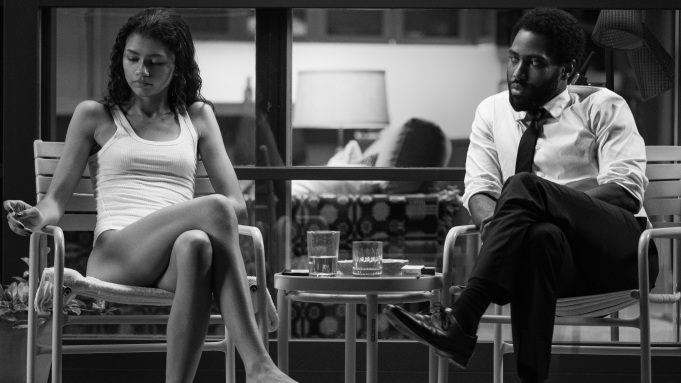
MALCOLM & MARIE (L-R): ZENDAYA as MARIE, JOHN DAVID WASHINGTON as MALCOLM. DOMINIC MILLER/NETFLIX © 2021

“Malcolm & Marie” is a he-she rat-a-tat that revolves around a couple that has just notched a new high, and as a result is on the edge of breaking apart. The entirely of the film takes place in a chic Malibu bungalow. Just how chic it is we never really know, because most of the action takes place inside (with a few artful outside-looking-in shots) and it’s night. One o’clock and onward, to be exact. We catch up with the titular couple arriving at the rented-by-the-studio digs following the premiere of his (John David Washington) film about a young female drug user’s struggle to recovery. The film’s a hit, but she (Zendaya) is the one whose life is up on screen – and she’s an actor he did not cast. Those things could float, but in his big post-party speech he fails to acknowledge her. it’s here that a bowl of mac and cheese becomes a driving wedge, and through the night the conversation ebbs and flows in tides of rage, compassion, accusation and revelation.

It’s something like “Who’s Afraid of Virginia Woolf?” (1966) without the second couple, though the specter of other paramours creep in (she’s cheated on him, he’s still fond of an old flame who likes cheesy motels). It’s also not as dark or compelling as that barn-burning Mike Nichols adaptation of Edward Albee’s play, though the film, written and directed by Sam Levinson – who pens the hit streaming series “Euphoria” that has rocketed Zendaya to fame – has a trio of aces to play here: the drop-dead gorgeous black-and-white cinematography by Marcell Rév (who has done several projects with Levinson), his two actors (more on that in a bit) and edgy dialogue that often takes on white privilege. Given that topic, does it matter that the performers are black and writer-director Levinson is white? The answer really lies in the verisimilitude of the art. And while it’s riveting to hear Malcolm take apart a white female critic who’s paying him praise along color lines (“White-assed writer making it about race, because it’s convenient”), it feels fabricated and overly highbrow. One thing it raises is the odd, symbiotic relationship between critic and artist and the lines each draw, which most recently blew up when Casey Mulligan took exception to a Variety review of “Promising Young Woman” (2020) that she felt unfairly took shots at her credibility in the part due to her looks.

All the arguing can be entertaining, but does it feel genuine? In pieces it does, which helps the film work given the thin conceptual veneer. The performers are dead on too. It’s mostly Washington’s film, but Zendaya gets her licks in (feigning despair to prove she can act, describing how to be a better partner in a bit that feels ripped from a Spike Lee joint). Washington’s career seemed so promising after “Blackkklansman” (2018), and then he got caught up in Christopher Nolan’s time rewind riddle “Tenet” (2020), where he felt less than heroic or involved in stature and I developed some doubts about Denzel’s progeny being able to carry a film; here he’s set the record straight with range, charisma and a character conviction that shows.

By the end, “Malcom & Marie” doesn’t really move the conversation on race, relations or art. It’s two great performances on an alluring stage, but nothing feels truly at risk and nothing life-altering is revealed. This is the blueprint for the next red carpet event – one I’d want a ticket to, as well as some post-party mac and cheese with Malcolm and Marie.

Tenet

14 Sep

‘Tenet’: Time travel caper by Christopher Nolan chooses its moment, masked against apocalypse

By Tom Meek

Well, I did it: I went to a theater and saw “Tenet.” Would I recommend you to? That’s a personal call. For me it didn’t feel too risky, but read on. I attended a 4 p.m. show at Landmark’s Kendall Square Cinema. I bought my ticket online, but still had to wait in line to show the usher behind a plexiglass shield my emailed barcode and get a printed ticket. I saw only three other people at the theater, all folks asking for senior discounts – in short, those in high-risk categories but clearly desperate for an in-theater experience, as was I. Landmark offered no snacks, and masks had to be worn 100 percent of the time. Every two seats in the theaters are blocked off, and management asks you to sit in alternating rows – something, I did not need to worry about. I was the only person at my screening. (Apple Cinemas near Fresh Pond and Alewife is showing it too, since reopening Friday.)

This being a Christopher Nolan film, seeing it on a big screen is kind of a must – in the very least for the imposing, driving score (by Ludwig Göransson, though it feels and sounds a lot like Hans Zimmer’s work on Nolan’s 2010 “Inception”) and the impressive camera work by Hoyte Van Hoytema, Oscar-nominated for Nolan’s WWII time scramble, “Dunkirk” (2017). Playing with time and space is Nolan’s thing; he did it with “Memento” (2000) to tell a murder mystery in reverse, and “Interstellar” (2012) as space travelers who go through a black hole where decades of Earth time pass in minute. Here time is imbued into objects sent back from the future. Sounds zany, right? It’s one of the things you just let wash over you, because no matter how hard Nolan and his characters try to explain, you feel like you’re just not getting it. The best I can do is that you can rewind history and insert yourself into the action – in essence, altering the future – but the catch is everyone else is moving in reverse while you’re going forward. People walk backward, cars go in reverse, and bullets get sucked back into their gun. 

Continue reading

Is it safe to see a film in a theater?

2 Sep

Kendall Square Cinemas has reopened quietly, with fare such as ‘Tenet’ for up to 25 in theater

By Tom Meek
Tuesday, September 1, 2020

Two weeks ago, I penned a column about movie screens staying dark in Cambridge and Somerville because of the pandemic, even as AMC, ShowPlace Icon and other theater chains opened in and around Boston. Friday that all changed: the Landmark theater in Kendall Square had something of a stealth opening.

“Face masks at all times, limited seating and no concessions at this time, per state guidelines,” theater manager Howie Sandler said in an email. “Also we are cleaning throughout the day, and after each show we wipe down chairs. We have signs up all over the place stipulating masks and social distancing, and we have markers on the floor leading you to buy tickets.” (State guidelines actually allow prepackaged foods.)

The limited seating measures including every other row being blocked off in the bigger theaters, “and we ask folks to leave two chairs between them and another party. Smaller theaters have seats blocked off in each row to spread people out,” Sandler said. A maximum 25 people are allowed in the larger theaters, and 16 to 24 people in Kendall Square Cinemas’ three smaller ones.

For now, The Brattle Theatre in Harvard Square remains closed to public screenings but is available for private rentals – most of which have been to couples, according to the “Brattle Film Podcast.” Apple Cinemas in Fresh Pond also remains closed, like the Somerville Theatre in Davis Square and Harvard Film Archive.

The Kendall Square theater is playing traditional arthouse fare such as “The Personal History of David Copperfield” and “Tesla,” but also Charlie Kaufman’s latest “I’m Thinking of Ending Things,” which caught me by surprise, as my press kit says it’s coming to Netflix on Sept. 4. What’s also interesting is that this week Landmark will open “Tenet,” the latest big-screen extravaganza from Christopher Nolan (“Dunkirk,” “Inception”). It’s a shift for Landmark, though its sister theater Embassy Cinema in Waltham plays more mainstream box office fare.

Nolan’s film has been a sore point for critics; many say they won’t go to a theater yet and prefer to get screener links. No links were given out for “Tenet,” so if you didn’t go to theater-staged press screening, you did not see it. Some media outlets (including The Washington Post) won’t run reviews for theater-only releases; others (including The Boston Globe) that get screener links for theater-only releases will post a safety caveat. I’m still struggling with the “Do I review a film in the confines of my house and recommend it to you when you can only see it in the theater” conundrum. I missed the “Tenet” press screening due to a personal conflict, so if you see a review here from me, you’ll know I went to the theater just as you would. I have to say Sandler’s precautions at Kendall sound thorough – but it’s still an indoor space.

In response to this whole Covid-19, get-back-to-normal limbo, studios take different approaches. “Bill & Ted Face the Music” was released simultaneously theatrically and through online streaming (for $20). The live-action “Mulan” from Disney will be released this weekend on the conglomerate’s streaming platform Disney+ for $30.