Home is where you’re dumped, family is who you’re stuck with, and it’s good

The latest from Alexander Payne, set at an all-boy, New England prep school in the early 1970s, bears the distinct tang of J.D. Salinger, not to mention Wes Anderson’s “Rushmore” (1998) as it homes in on the loneliness of the disenfranchised among the entitled elite. It marks a nice rebound for Payne after his 2017 misfire, the dystopian sci-fi satire “Downsizing.” and a pleasant reunion with Paul Giamatti, who with his work here and the infectiously uproarious “Sideways” (2004), proves to be something of the director’s go-to alter ego as Leonardo DiCaprio and Robert De Niro have for Martin Scorsese.
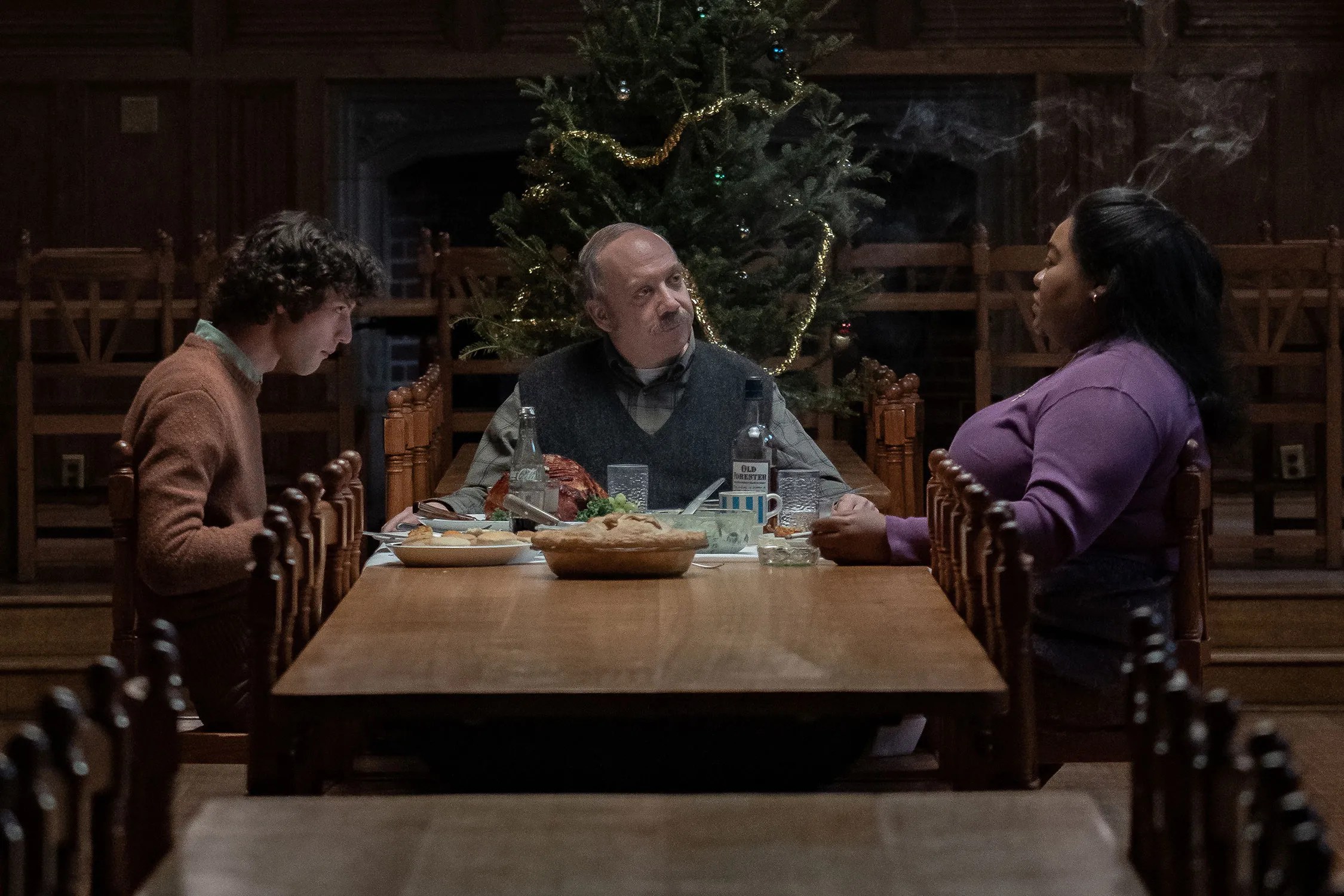
The setup’s fairly straightforward: Paul Hunham (Giamatti), a gruff, unapologetic Western Civ. professor, is the faculty member who’s drawn the short-straw assignment of looking after the “holdovers” for Christmas break at a fictional New England preparatory called Barton. These students have no place to go because Korea’s too far and expensive to fly home to, the house is being remodeled and there’s nowhere to sleep, or mom’s newly remarried and wants to have some honeymoon time. The latter is the bad-news phone call that Angus Tully (Dominic Sessa) gets. He’s also struggling in Hunham’s class, and Hunham’s not the most popular figure on campus; even the faculty and headmaster are none too smitten with him – for one thing, he failed the son of a U.S. senator and major benefactor of the school at the tail-end of the progeny’s senior year, his unwavering strictness costing the kid a golden ticket to an Ivy League institution.
Joining Hunham and the five boys is school cook Mary Lamb (Da’Vine Joy Randolph, divine and scene-stealing; you can also catch her in “Rustin,” out this week) a Black woman who spends much of her time – even when cooking – drinking and smoking to hold down the grief of having just lost her only child, a Barton grad (the only non-caucasian we know to attend the school besides that Korean boy) killed in the Vietnam War.
Early in the staycation, one of the boys’ fathers drops in via helicopter and offers to whisk the five off for a week of skiing. Not a bad reprieve for the cooped-up and bored, but parental consent is needed; all but Tully get it. What ensues is a slow grinding of nerves between Tully and Hunham with occasional explosions and slow reveals of underlying traumas that are the real root of their sniping and doubling down. Newcomer Sessa, who at times looks a bit too old for the part, holds his own with Giamatti as he effectively expresses restrained rage. Fans of Giamatti’s acerbic naysayer in wine-imbibing comedy “Sideways” and his quirky delve into comic book artist Harvey Pekar in “American Splendor” (2003), will delight in this nuanced turn. His Hunham is a self-loathing introvert who maintains his balance in the world with an outrigger of arrogant self righteousness, but also a lonely soul seeking human connection and totally unaware of how to get it.
The most vulnerable we witness the stranded three is at a Christmas Eve party hosted at the home of a bubbly Barton administrator (Carrie Preston, wonderfully perky, near “Fargo”-esque in the part) who takes shifts at the local watering hole to make ends meet. Tully and Hunham catch romantic flirtations that hit dead-ends for widely different reasons and Lamb, in the middle of the party, decides to confront her grief in a very public and all-consuming way. It’s a poignant, mood-shifting scene that should make many take notice of the emerging Randolph, who, like Giamatti, attended the Yale School of Drama. Later, the three find themselves in Hunham’s rickety car en route to Boston – Lamb on her way to visit her pregnant sister in Roxbury and Tully and Hunham taking an “academic excursion” that at one juncture lands them at the Somerville Theatre to take in a screening of Dustin Hoffman in Arthur Penn’s “Little Big Man.”
Poetically, the sojourn, initiated by Tully with a hidden agenda, ends in a meeting with Hunham on Boston Common. The two are forced to confront their pasts with a baring of their souls evocative of the joyous dread imbued into Hal Ashby’s “The Last Detail” (1973), in which Boston also served as a port of reckoning.
If you’re curious about that boarding school, it’s a composite of institutions in and around Massachusetts, but mostly scenes there were shot on the Deerfield Academy campus (one of the oldest prep schools in America) in Central Massachusetts.

 For What it's Worth