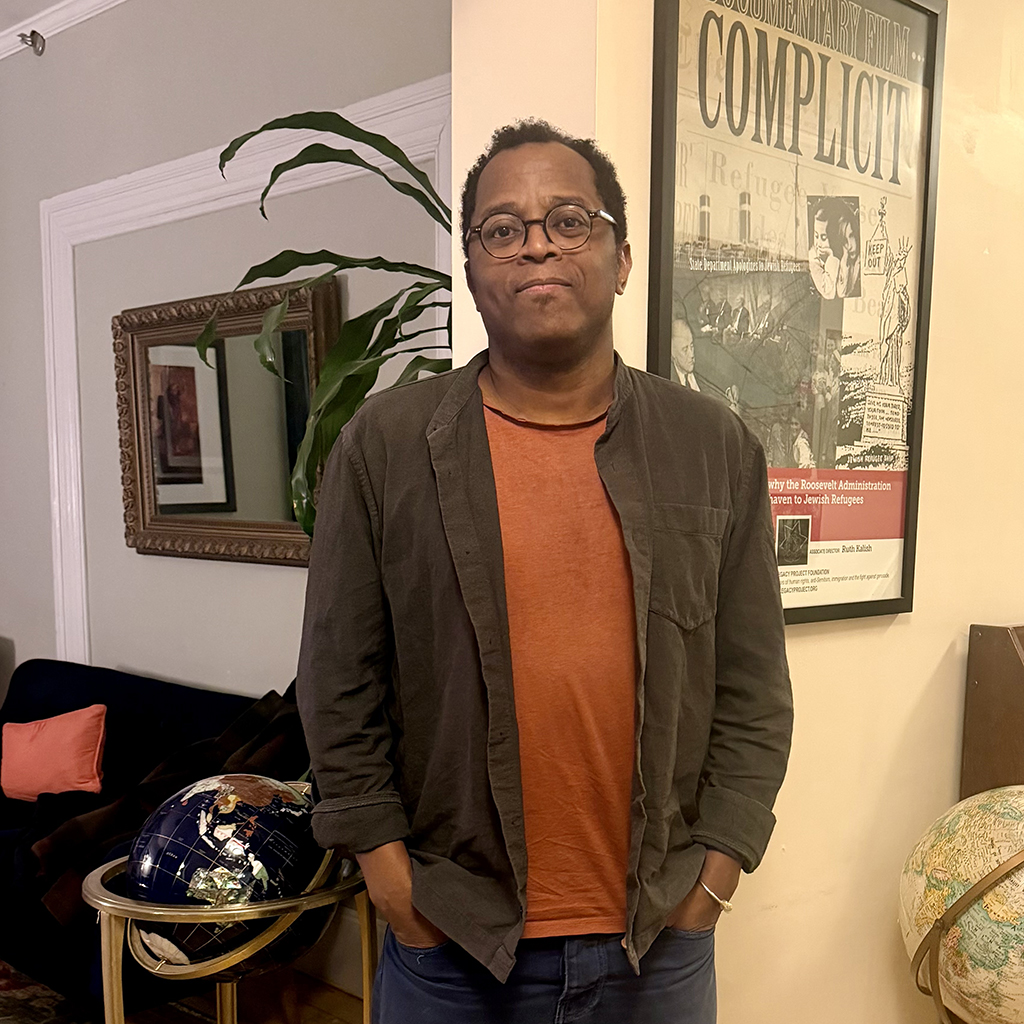
Alain Kassanda, Congolese French filmmaker
Alain Kassanda‘s documentaries take personal stories and make them confront and reframe history, exploring matters of identity, race and power.
Kassanda‘s films will show at Harvard University this weekend, part of his residency as this year’s McMillan-Stewart Fellow in Distinguished Filmmaking. The fellowship, jointly hosted by the Harvard Film Archive and Harvard’s Film Study Center, brings internationally recognized filmmakers to campus for screenings, classroom visits and public conversations. He spoke with Cambridge Day at the beginning of his residency.
His first feature, “Trouble Sleep,” (2020), showed Friday. His second film, “Colette and Justin” (2022), shows tonight at 7 p.m. at the Harvard Film Archive. His most recent, “Coconut Head Generation” (2023), will screen Monday.
The works together trace a line from European colonial rule in Central Africa to modern protest movements shaped by globalization and economic extraction. Though Kassanda’s scope spans Congo, France and Nigeria, his starting point is personal. Born in Kinshasa, at 11 he left the Democratic Republic of Congo for France. In Congo he felt he was seen as French and in France as Congolese — a duality that would become the emotional engine of his filmmaking.
As a longtime cinephile, Kassanda’s path to filmmaking began when he worked selecting movies to show at a small theater outside Paris. “I became a film programmer by accident — out of love for films,” he said. These were films being released in France. What struck him were how people of color were portrayed as stereotypes, “as a Black French man, I couldn’t see myself in French films. The stories I wanted to see simply were not being made.”
“Colette and Justin,” his first hour-plus film, was driven by the loss of his mother at 12 and his dual identity. He began interviewing his grandparents about their life in the Congo in the 1950s and 1960s. That became “Colette and Justin” (his grandparents’ first names). “Making the film began with acknowledging my own ignorance about my family and my country,” he said. “The film was also a way of learning who I am.”
Turning colonial images against themselves
Skillfully composed, “Colette and Justin,” begins as a family portrait but unfolds into a meditation on colonial memory and inherited history. His grandparents were members of Congo’s emerging Black bourgeoisie during Belgian rule, and their lives intersected with the country’s struggle for independence.
Rather than rely on traditional narration, Kassanda layers their voices over archival footage shot by colonial authorities — images originally intended to reinforce imperial power. “Images are never neutral,” he said. “They carry the gaze of those who created them.”
By recontextualizing those images, Kassanda effectively reverses their meaning, transforming subjects once filmed as objects of empire into narrators of their own history. The film is both intimate and political — a family conversation that expands into a national reckoning.
Making the film forced Kassanda into uncomfortable personal discoveries. While researching his family history, he learned that the political loyalties within his own lineage conflicted with his admiration for independence leader Patrice Lumumba.
From colonial past to neocolonial present
If “Colette and Justin” excavates the past, “Coconut Head Generation” shifts Kassanda’s lens to the now.
Filmed at the University of Ibadan in Nigeria — where Kassanda lived for several years because his partner, an anthropologist, was doing a study on human relationship with trees in urban areas — the documentary follows a student film club that becomes part of the #EndSARS protests against police brutality (the tag refers to Nigeria’s Special Anti-Robbery Squad). The film’s title refers to a Nigerian insult aimed at outspoken youth. Activists “flipped the insult,” Kassanda explained, making it a badge of independence. “They reclaimed it to express freedom of mind.”
The film captures students arguing about cinema, politics, gender, corruption and colonial legacy — conversations that gradually mirror the country’s political upheaval. As protests escalate, the film reveals how colonial structures persist under new economic systems.
“Colonialism doesn’t disappear — it changes form,” Kassanda said. “Congo has been independent for decades, but economically we are still not independent.”
He points to cobalt mining — essential to electric cars and digital technology — as an example of modern extraction linking African resources to global capitalism. “You cannot talk about today’s technology without talking about Congo’s cobalt,” he said.
The #EndSARS movement, he added, represented a rare moment of unity. “People stopped seeing each other through ethnicity or class and came together around justice.”
Documentary as uncertainty
Kassanda did not attend film school. His cinematic language emerged through his love of films, writing poetry and making music — influences visible in the pacing of his work. “Music drives the rhythm of my films,” he said. “I often edit images according to the music.”
Kassanda said he is drawn to making documentaries because they are not scripted. “What attracts me to documentary is uncertainty,” he said. “You arrive not knowing what will happen — whether someone will agree to be filmed or not. That loss of control became a creative method.”
That philosophy extends to his next project, “Energy for the Lilacs,” about the closure of a historic maternity hospital near Paris where his daughter was born — a story connecting intimate personal experience to broader debates about public health care and social policy.
“Personal stories and political structures are always connected,” he said.
His influences include recently passed Cantabrigian Frederick Wiseman, French-Senegalese director Alain Gomis and French director Alain Resnais. Kassanda said he specifically watched Wiseman’s “High School” (1968) and “Welfare” (1975) as inspiration for “Coconut Head.” The film also includes a clip of “Statues also Die,” a film by Resnais (co-directed with Chris Marker, before he made “La Jetée”) about Black art, which the film club watches.
Kassanda hasn’t ruled out narrative, but said he is not yet comfortable making a scripted film with a known beginning, middle and end.
A filmmaker in conversation
The McMillan-Stewart Fellowship, established in 1997, has a longstanding focus on African and African-diasporic cinema and emphasizes a dialogue between filmmakers and students rather than simple retrospectives. Past recipients include Mati Diop (“Atlantics”), Ousmane Sembène and Med Hondo.
Kassanda’s screenings will be paired with classroom discussions — an approach aligned with his belief that cinema should spark conversation rather than deliver conclusions.
“I want to see ordinary Black lives — not only in crisis [or stereotyped],” he said. “Cinema should allow people to recognize themselves, and then question the world around them.”
In that sense, Kassanda’s films do not merely revisit history. They challenge audiences to reconsider who controls images — and who finally gets to speak through them.
this story was originally published in the Cambridge Day
 For What it's Worth
Leave a comment